

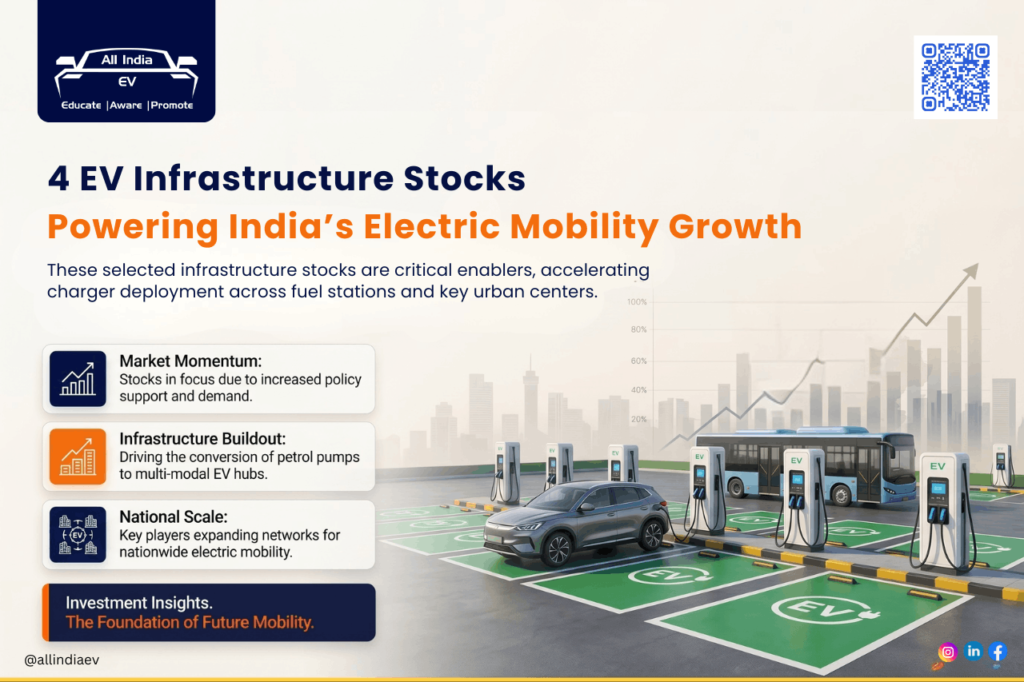
What: A set of four EV infrastructure-focused companies has emerged as key enablers of India’s electric mobility transition, targeting charging, power electronics, and grid support.
The Number: India’s EV market is projected to scale rapidly toward a multi-billion-dollar opportunity by 2030, driven by infrastructure expansion.
The Impact: Charging infrastructure and grid readiness are becoming the defining bottlenecks—and opportunity zones, in India’s EV growth story.

The Core News
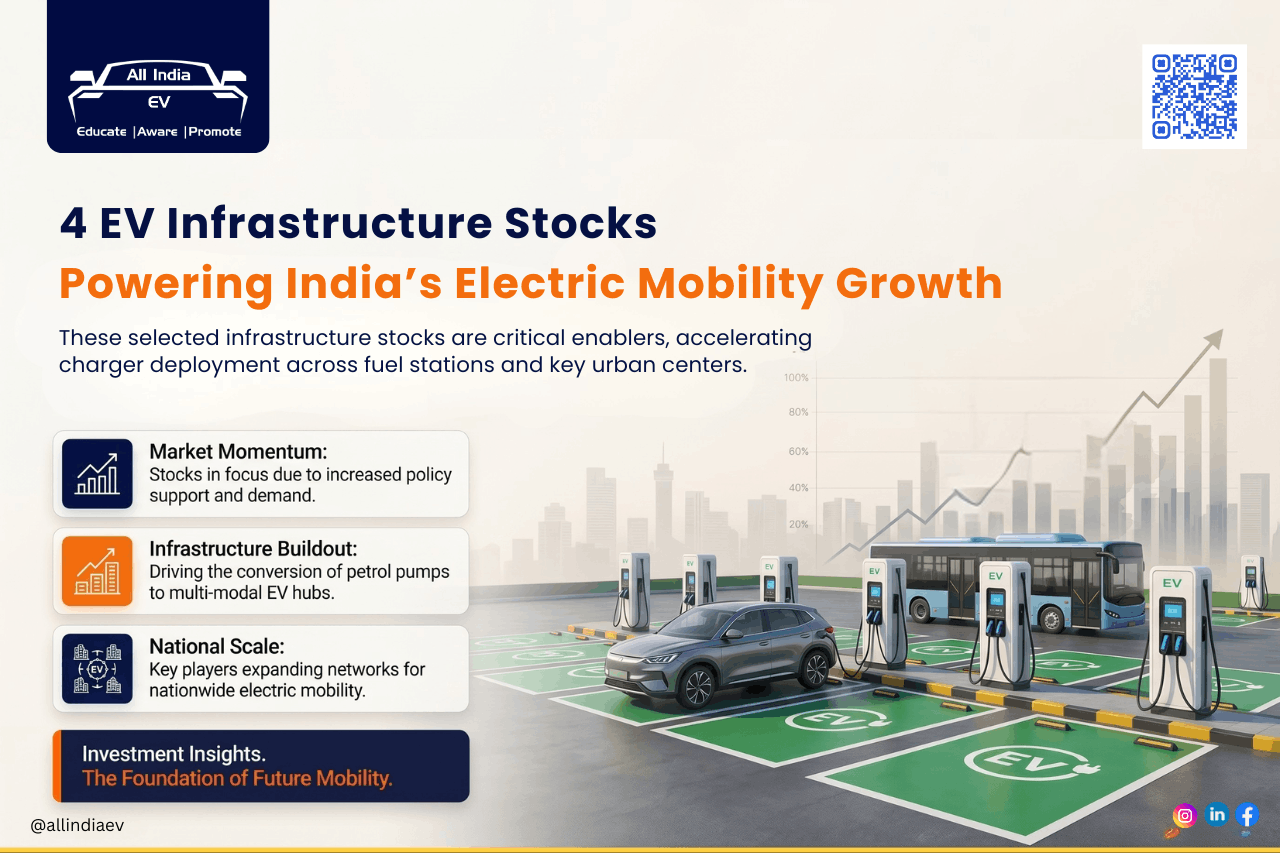
The narrative around EV adoption in India is shifting from vehicle sales to ecosystem readiness, and 4 EV Infrastructure Stocks Powering India’s Electric Mobility Growth sits at the center of that transition. The focus is now on companies building the backbone, charging networks, power electronics, and energy systems, required to sustain large-scale electrification.
Unlike OEM-led growth cycles, infrastructure-led expansion requires long gestation, heavy capital deployment, and regulatory alignment. Companies such as power utilities, battery manufacturers, and electrical equipment providers are increasingly becoming critical stakeholders. This aligns with the broader EV ecosystem, where value creation extends beyond vehicles into charging, storage, and grid integration.
The timing is crucial. India’s EV demand is accelerating, but infrastructure deployment is lagging, creating a structural gap. This mismatch is already visible in urban clusters where charging density is insufficient relative to vehicle growth. As a result, infrastructure-focused companies are likely to see sustained demand, not just from public charging but also from fleet electrification, depot charging, and energy storage integration.
More EV News
Breaking Down the Update
• EV growth is now constrained more by infrastructure than vehicle availability
• Charging networks, grid capacity, and battery systems are key investment areas
• Power companies and battery players are entering EV infrastructure aggressively
• Infrastructure build-out is capital intensive and long-term in nature
• Policy support and incentives remain critical for scaling charging networks
• Private sector participation is accelerating due to rising EV demand
How 4 EV Infrastructure Stocks Powering India’s Electric Mobility Growth will help Indian EV Market
The theme of 4 EV Infrastructure Stocks Powering India’s Electric Mobility Growth highlights a critical shift in India’s EV trajectory, from adoption to scalability. Infrastructure is no longer a supporting layer; it is now the primary growth driver.
First, these companies enable charging accessibility, which directly influences EV adoption rates. Without reliable and widespread charging, even strong vehicle demand cannot translate into sustained growth.
Second, infrastructure players are building energy resilience. With rising EV penetration, grid stability becomes a concern. Companies involved in power electronics, battery storage, and smart energy systems are addressing this gap by integrating EV loads into the grid more efficiently.
Third, they unlock fleet electrification, which is essential for commercial EV growth. Logistics, ride-hailing, and public transport segments depend heavily on fast, reliable charging infrastructure.
Finally, these companies create a multiplier effect across the ecosystem, stimulating investments in renewables, battery manufacturing, and digital energy platforms. This interconnected growth is what will ultimately determine whether India can meet its EV penetration targets for 2030.
Way forward…
The long-term relevance of 4 EV Infrastructure Stocks Powering India’s Electric Mobility Growth lies in their ability to bridge the gap between EV demand and real-world usability. As capital flows into charging networks and grid upgrades, execution will be the key differentiator. The next phase to watch is how quickly these companies scale deployments while maintaining cost efficiency and reliability.
Read More: Catch up on All India EV’s related coverage on India’s evolving commercial EV subsidies and battery swapping policies at All India EV