
All India EVAll India EVAll India EV
Notification
Font ResizerAa
  • Home
  • EV News
  • EV Launch
  • Market Insights
  • Investments & Funding
  • Guest Articles
  • EV Engineering
  • Contact
Reading: FADA data reveals 81% surge in EV passenger vehicle retail
Share
All India EVAll India EV
Font ResizerAa
  • Home
  • EV News
  • EV Launch
  • Market Insights
  • Guest Articles
  • EV Engineering
  • Contact
Search
Follow US
FADA data reveals 81% surge in EV passenger vehicle retail
Home » Blog » FADA data reveals 81% surge in EV passenger vehicle retail
EV Newsothers

FADA data reveals 81% surge in EV passenger vehicle retail

Piyush
By
Piyush
Last updated: 12 June 2026
Share
5 Min Read
SHARE
FADA data reveals 81% surge in EV passenger vehicle retail

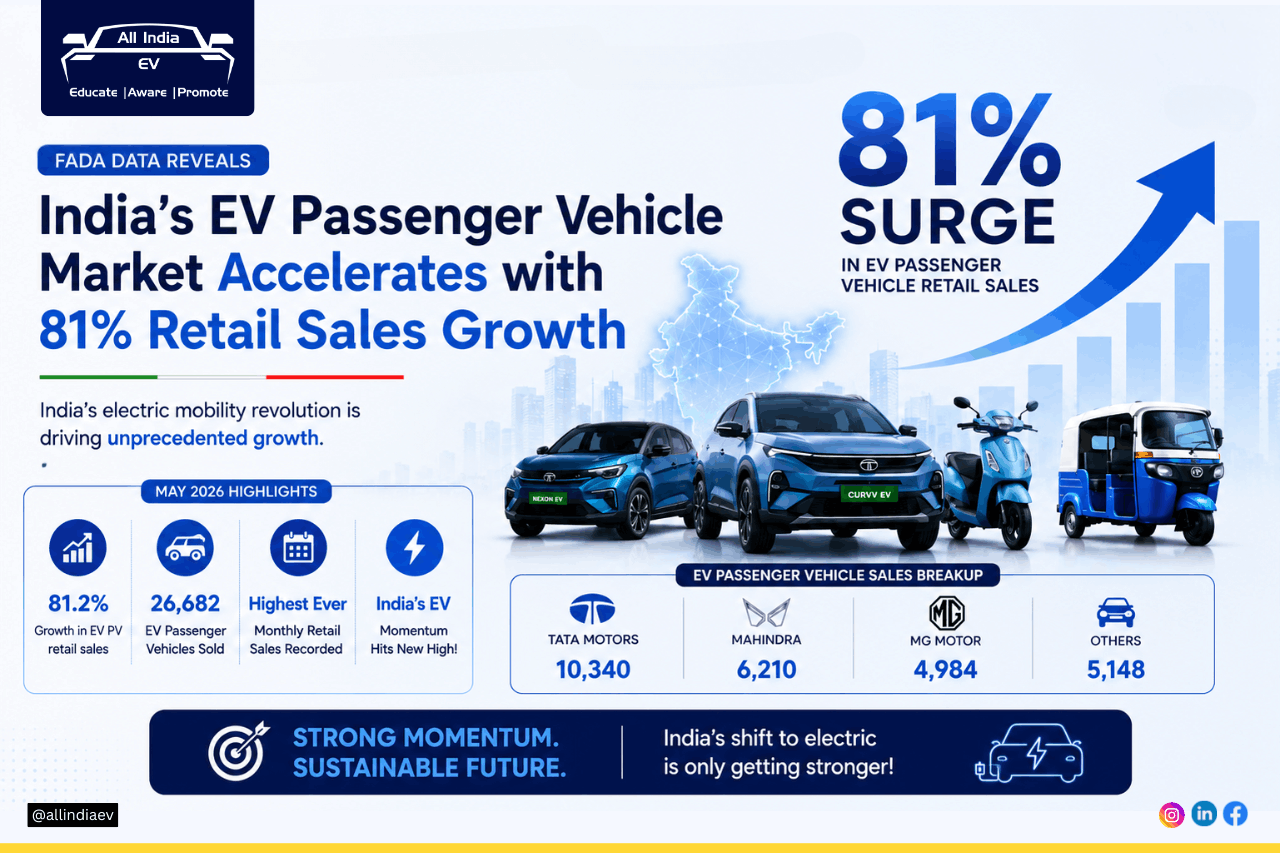
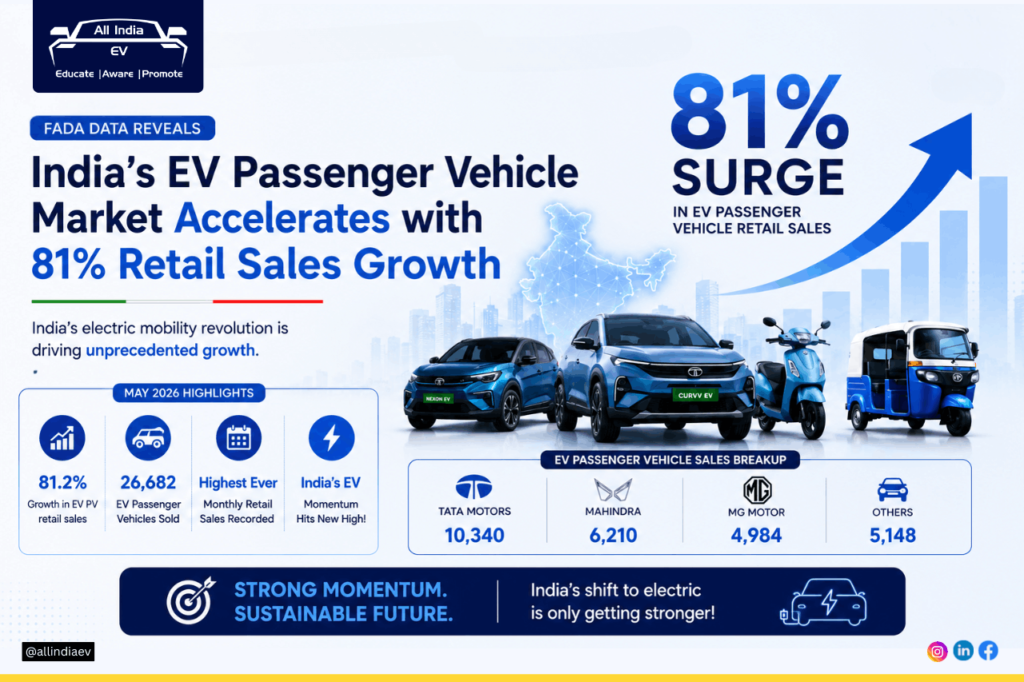
What: India’s electric passenger vehicle market recorded a sharp rise in retail sales during May 2026, with EV passenger vehicle registrations increasing by 81.2% year-on-year, according to the latest data released by FADA. The growth reflects rising consumer acceptance, expanding model availability, and improving EV infrastructure across the country.

The Number: Electric passenger vehicle retail sales reached 26,682 units in May 2026, up from 14,725 units in May 2025. EV penetration in the passenger vehicle segment also increased to 6.6%, compared to 4.5% a year earlier.

The Impact: The surge highlights accelerating EV adoption in India’s passenger vehicle market and indicates that electric cars are steadily moving from a niche category toward mainstream consumer consideration.

The Core News

The FADA EV passenger vehicle retail sales data underscores the rapid transformation taking place within India’s automotive industry. Retail registrations of electric passenger vehicles climbed to 26,682 units in May 2026, marking an 81.2% year-on-year increase. The growth significantly outpaced overall automobile retail market expansion, demonstrating strong momentum for electric mobility despite broader economic and geopolitical challenges.

The increase in EV adoption is being driven by multiple factors. Automakers have expanded their electric vehicle portfolios across price segments, while charging infrastructure has continued to improve in major urban centres and along key highway corridors. Rising fuel costs have also strengthened the value proposition of electric vehicles for consumers evaluating long-term ownership costs.

More EV News
EV Charging Network
From Frustration to Confidence: Building a Dependable EV Charging Network
Orxa Energies Collaborates with Nunam Tech for Reuse of EV Batteries in Second-Life Applications
India’s EV Battery Ambitions Face Supply Glut Challenges: ICRA
Recyclekaro Joins India’s EPR Portal for Battery Recycling
Tivolt and Tata Power Join Forces to Boost EV Charging Infrastructure

The broader EV ecosystem is also showing strong growth. FADA data indicates that overall EV retail sales across vehicle categories rose 45% year-on-year to a record 2.71 lakh units in May 2026. Electric vehicles crossed the 11% retail market share mark for the first time, suggesting that electrification is becoming a significant force in India’s mobility landscape rather than a niche trend. Passenger vehicles emerged as one of the fastest-growing EV segments during the month.

Breaking Down the Update

• Electric passenger vehicle retail sales rose 81.2% year-on-year in May 2026.

• Sales increased from 14,725 units to 26,682 units during the period.

• EV penetration in the passenger vehicle segment climbed to 6.6%.

• Total EV retail sales across all categories grew 45% year-on-year.

• EVs crossed 11% of total vehicle retail sales for the first time in India.

• Expanding model choices and charging infrastructure continue to support market growth.

How EV passenger vehicle retail sales will help Indian EV Market

The growth in EV passenger vehicle retail sales signals a crucial shift in India’s transition toward cleaner transportation. Passenger vehicles have traditionally been one of the most challenging segments for EV adoption due to concerns around range, charging infrastructure, and purchase costs. An 81% increase in retail demand suggests that these barriers are gradually reducing.

Higher passenger EV sales create a positive cycle for the industry. Increased vehicle volumes encourage manufacturers to invest more aggressively in local production, battery supply chains, software development, and charging infrastructure. Larger sales volumes can also improve economies of scale, helping reduce costs and expand affordability for future buyers.

The trend is equally important for charging network operators. Rising passenger EV penetration strengthens the business case for public fast-charging stations, highway charging corridors, and residential charging solutions. This infrastructure expansion further improves consumer confidence and accelerates adoption.

In addition, stronger passenger EV demand supports India’s broader goals of reducing oil imports, lowering transport-sector emissions, and strengthening domestic clean mobility manufacturing. Continued growth in EV passenger vehicle retail sales could therefore become a key driver of India’s long-term electrification roadmap.

Way Forward …

The latest FADA data confirms that EV passenger vehicle retail sales are entering a stronger growth phase in India. While charging infrastructure expansion, affordability, and battery localization remain important challenges, the current trajectory indicates growing consumer confidence in electric mobility. The next key indicators to watch will be sustained penetration growth, new model launches, and whether EV passenger vehicle retail sales can maintain this momentum through the remainder of 2026.

Read More: Catch up on All India EV’s related coverage on India’s evolving commercial EV subsidies and battery swapping policies at All India EV

What: India’s finance ministry has directed public sector banks, insurers, and financial institutions to reduce operational spending and accelerate adoption of electric vehicles across official fleets. The move is part of a wider austerity push linked to rising global economic uncertainty and fuel-related risks. The Number: The directive impacts major public institutions including State Bank of India, Bank of Baroda, and Life Insurance Corporation of India, covering millions of employees and thousands of operational vehicles nationwide. The Impact: The policy signals a new phase of institutional fleet electrification in India, where EV adoption is now being tied directly to fiscal discipline, fuel import management, and public-sector operational efficiency. The Core News India’s finance ministry has formally instructed state-run financial institutions to implement strict expenditure controls while simultaneously accelerating EV adoption for official transport operations. The directive from the Department of Financial Services asks organisations to replace petrol and diesel vehicles used at head offices and branch operations with electric vehicles “as far as possible.” The order comes amid growing concern over the economic impact of prolonged geopolitical instability in West Asia, which threatens to increase crude oil prices, widen India’s import bill, and pressure the rupee. Alongside the EV transition mandate, the government has also pushed virtual meetings, reduced foreign travel, and tighter administrative spending controls across public-sector institutions. For India’s EV ecosystem, the directive is strategically important because it expands demand visibility beyond state transport undertakings and government departments into the financial sector itself. PSU banks and insurers operate one of the country’s largest distributed office networks, including regional offices, branch fleets, field operations, and administrative mobility services. Even a phased transition could create a sizeable procurement pipeline for electric passenger vehicles, charging infrastructure providers, and fleet management companies. Breaking Down the Update • The Department of Financial Services issued the austerity and EV adoption directive to PSU banks, insurers, and financial institutions. • The government wants petrol and diesel vehicles used in official operations to be progressively replaced by EVs wherever operationally feasible. • The policy push follows Prime Minister Narendra Modi’s appeal for fuel conservation and controlled discretionary spending amid global energy uncertainty. • The directive also mandates greater use of video conferencing to reduce travel-related operational expenditure. • The move could indirectly support domestic EV OEMs, leasing firms, and charging infrastructure operators through institutional procurement demand. • The banking and insurance sector may emerge as a new enterprise fleet electrification category in India’s EV transition roadmap. How PSU banks EV adoption will help Indian EV Market The expansion of PSU banks EV adoption could create a strong institutional demand layer for India’s electric mobility sector. Public sector banks and insurers operate thousands of branch offices across urban, semi-urban, and rural India. Their transition to EV fleets can generate predictable procurement volumes for domestic automakers, especially in the electric sedan, compact SUV, and commercial mobility segments. Beyond vehicle sales, the policy may also accelerate deployment of workplace charging infrastructure at bank headquarters, zonal offices, and regional branches. This can support charger utilisation economics while helping normalise EV infrastructure in tier-2 and tier-3 cities. Another important impact is signalling. When large state-linked financial institutions adopt EVs as operational assets rather than pilot projects, it improves confidence across the broader enterprise mobility market. Private banks, NBFCs, and insurance firms could eventually follow similar fleet transition models to reduce long-term fuel and maintenance costs. PSU banks EV adoption also aligns with India’s larger energy security strategy. Lower petroleum consumption in institutional fleets directly supports efforts to reduce crude import dependence while stabilising operational expenditure during periods of volatile global oil prices. Conclusion & Next Steps The government’s push toward PSU banks EV adoption reflects a broader shift where EV deployment is increasingly being linked with macroeconomic resilience rather than only sustainability targets. Execution, however, will depend on procurement timelines, charging infrastructure readiness, and operational suitability across
India directs state-run banks, insurance firms to cut costs, shift to EVs
Raymond Dives into Aerospace, Defense, and EV Sectors with a Whopping Rs 682 Crore Purchase
MeitY launches indigenous integrated drive system to boost EV adoption
GST 2.0: How New Tax Slabs Will Impact EVs, Cars, FMCG and Consumers Across India
PG Electroplast and Spiro Mobility: A Strategic Partnership for the EV Future

Sign Up For Daily Newsletter

Be keep up! Get the latest breaking news delivered straight to your inbox.
Loading
By signing up, you agree to our Terms of Use and acknowledge the data practices in our Privacy Policy. You may unsubscribe at any time.
Share This Article
Facebook Whatsapp Whatsapp LinkedIn Copy Link Print
Leave a Comment

Leave a Reply Cancel reply

Your email address will not be published. Required fields are marked *

Follow US
XFollow
InstagramFollow
YoutubeSubscribe
LinkedInFollow
Mercedes-AMG E 53 Hybrid launched in India
26 July 2026
UP EV Charger Subsidy under VGF Step-by-step process
8 July 2026
Revolt Motors unveils RVX electric motorcycle priced at ₹1.24 lakh
6 July 2026
All India EV: Edition 51
What all happened in June 2026?
Click Here
All India EV
India's EV Industry Desk

All India EV is a media, market research and market intelligence platform tracking the companies, technologies, capital and market shifts shaping India's electric mobility ecosystem.

News Categories

  • EV News
  • EV Launch
  • Market Insights
  • Investments & Funding
  • EV Engineering
  • Guest Articles

Follow the Network

Instagram Follow daily EV updates LinkedIn Join the industry conversation WhatsApp Join the AIEV community

Contact the Desk

Business & Editorial
ankit.sharma@allindiaev.com allindiaev@gmail.com
Website
www.allindiaev.com
Based In
New Delhi, India

© 2026 All India EV. All rights reserved.

Aware Educate Promote

Welcome Back!

Sign in to your account

Username or Email Address
Password

Lost your password?