


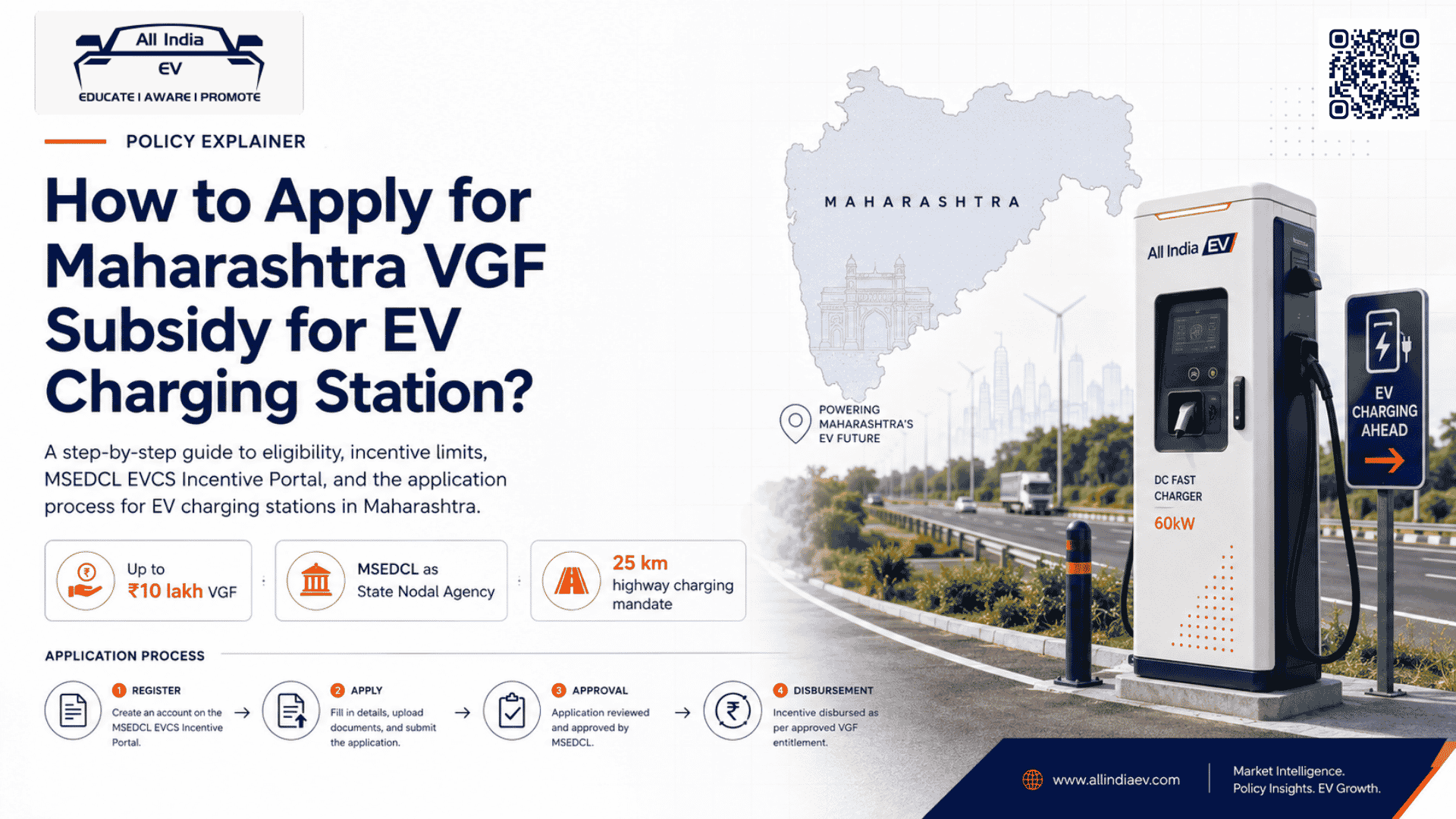
Maharashtra wants an EV charging facility every 25 km along its highways. To make that infrastructure commercially viable, the state is offering Viability Gap Funding of up to ₹10 lakh for eligible DC fast-charging stations.
- What is Maharashtra’s VGF incentive for EV charging stations?
- Important: do not mix the 2021 and 2025 incentive structures
- Which Maharashtra corridors are specifically prioritised?
- MSEDCL as the State Nodal Agency for Electric Vehicle Charging Stations
- Step 1: Check whether your proposed charging station is eligible
- Step 2: Finalise the site and assess electrical feasibility
- Step 3: Complete the electricity connection process with the relevant DISCOM
- Step 4: Install the correct charger and preserve every technical document
- Step 5: Prepare the mandatory documents
- Step 6: Fill in the applicant and premises details
- Step 7: Enter the exact charging station location and technical details
- Step 8: Add beneficiary bank details
- Step 9: Select the correct DISCOM, generate OTP and submit
- Stage 1: DISCOM verification
- Stage 2: Joint site inspection
- Stage 3: Application forwarded to MSEDCL as SNA
- Stage 4: SNA scrutiny
- Stage 5: Government disbursement
- 1. Assuming every EV charger gets ₹10 lakh
- 2. Ignoring the minimum charging-point requirement
- 3. Calculating subsidy on the total project cost
- 4. Buying a charger without complete certification documents
- 5. Finalising the site before checking grid feasibility
- Final takeaway
But getting the incentive is not as simple as buying a charger, installing it and asking the government for ₹10 lakh.
The amount depends on the charger category, eligible equipment cost and station configuration. The applicant must also go through a defined process involving the local electricity distribution company, MSEDCL as the State Nodal Agency and, finally, the Government of Maharashtra.
This article explains the entire process, step by step.
What is Maharashtra’s VGF incentive for EV charging stations?
The Maharashtra Electric Vehicle Policy 2025, effective from April 1, 2025 to March 31, 2030, aims to create a statewide charging network covering urban areas, rural regions and major highways. One of the policy’s headline targets is to provide EV charging facilities at every 25 km interval along highways.
To support the economics of high-power charging infrastructure, the state has created a Viability Gap Funding, or VGF, mechanism for DC fast-charging stations.
Under the current 2025 policy, the incentive structure is:
More EV News

| Charging category | Station requirement | Incentive | Maximum incentive | Number of stations targeted |
|---|---|---|---|---|
| DC charging, 50 kW to 250 kW | Minimum 4 charging points | Up to 15% | ₹5 lakh | 1,000 |
| High-power DC, 250 kW to above 500 kW | Minimum 2 charging points | Up to 15% | ₹10 lakh | 500 |
The incentive is calculated only on the cost of the charging station equipment. The policy explicitly excludes land and ancillary costs from the eligible cost base.
That distinction matters.
A ₹10 lakh incentive does not mean the government is paying ₹10 lakh for every new charging station. For example, the high-power category receives up to 15% of eligible charging-station cost, capped at ₹10 lakh. Both conditions matter.
Important: do not mix the 2021 and 2025 incentive structures
Some information still circulating online refers to the previous Maharashtra EV Policy 2021, which had separate incentive categories for slower and moderate charging equipment.
The current Maharashtra EV Policy 2025 has introduced a different VGF framework focused on:
- 50 kW to 250 kW DC charging stations
- 250 kW to above 500 kW high-power charging stations
For a new project, the 2025 policy table should be the starting point for financial planning. The official MSEDCL incentive portal still hosts the 2021 operational guidelines alongside the 2025 policy, so applicants should check for the latest operational circular before placing equipment orders or finalising project economics.
Why Maharashtra is pushing highway charging infrastructure
The VGF scheme sits inside a much larger highway electrification strategy.
The state’s target is clear: charging facilities at every 25 km interval along highways. The 2025 policy specifically calls for EV charging infrastructure on state and national highways.
The policy also proposes that:
Existing and new fuel stations on state and national highways should have at least one fast-charging station, subject to technical feasibility.
MSRTC bus stations and bus stops should have at least one fast-charging facility, again subject to technical feasibility.
The government also wants charging stations on highways to use appropriate signage so EV drivers can identify them easily from the road. High-mast signage may also be used by charging point operators.
One clarification is important here: the official 2025 policy says charging facilities should be provided at 25 km intervals along highways. It does not explicitly use the phrase “every 25 km on both sides” in the current policy text.
Which Maharashtra corridors are specifically prioritised?
The 2025 policy explicitly identifies two expressways as Sustainable Mobility Corridor demonstration projects:
Mumbai-Pune Expressway
The Yashwantrao Chavan Mumbai-Pune Expressway is expected to demonstrate advanced charging and sustainable mobility infrastructure for different vehicle categories.
Mumbai-Nagpur Samruddhi Mahamarg
The Hindu Hrudaysamrat Balasaheb Thackeray Maharashtra Samruddhi Mahamarg is the second explicitly named Sustainable Mobility Corridor.
The policy says these demonstration corridors should provide adequate charging infrastructure for different types of vehicles.
Atal Setu also has an important place in Maharashtra’s EV strategy, but under a separate intervention. Passenger EVs are covered by the policy’s 100% toll-tax exemption provision on the Mumbai-Pune Expressway, Samruddhi Mahamarg and Atal Bihari Vajpayee Sewri-Nhava Sheva Atal Setu.
So, in policy terms, Sustainable Mobility Corridors and toll-exempt EV corridors should not be treated as the same category.
Who manages the EV charging station incentive?
The official Government of Maharashtra EVCS Incentive Portal identifies:
MSEDCL as the State Nodal Agency for Electric Vehicle Charging Stations
However, MSEDCL being the State Nodal Agency does not mean every application goes directly to MSEDCL’s SNA team at the first stage.
The official process has four stages:
Applicant → Respective DISCOM → MSEDCL as State Nodal Agency → Government of Maharashtra for final disbursement
The portal states that the respective distribution company verifies the documents and conducts a joint site inspection with the applicant. The DISCOM then forwards the application to the State Nodal Agency. After SNA scrutiny and approval, the case is sent to the Government of Maharashtra for incentive disbursement.
Applications are submitted through the:
MSEDCL EVCS Incentive Portalevincentive.mahadiscom.in
How to apply for Maharashtra EV Charging Station VGF subsidy
Here is the practical, step-by-step process.
Step 1: Check whether your proposed charging station is eligible
Before buying equipment, first match the project with the 2025 policy.
For the 50 kW to 250 kW category, the policy requires a charging station to have a minimum of four charging points.
For the high-power 250 kW to above 500 kW category, a minimum of two charging points is required.
The maximum support is:
- Up to ₹5 lakh for the 50–250 kW category
- Up to ₹10 lakh for the high-power category
In both cases, funding is limited to up to 15% of the eligible charging-station cost.
Do this calculation before making the investment.
A fancy station with a ₹40 lakh total project cost does not automatically become eligible for ₹5 lakh, because the project cost may include land lease, transformer work, civil construction, canopy, branding and other non-charger expenses.
The policy’s calculation starts with the eligible charging equipment cost, not the total project bill.
Step 2: Finalise the site and assess electrical feasibility
The location is not just a real-estate decision. For a fast-charging project, power availability can decide the project’s timeline and economics.
Before proceeding, check:
- Available sanctioned load
- Distance from the nearest suitable distribution infrastructure
- Transformer requirement
- Expected connection cost
- Land ownership or lease documentation
- Vehicle entry and exit
- Space for charging bays
- Charger utilisation potential
The policy’s VGF provision appears within its highway charging infrastructure framework, so operators planning to claim support should carefully assess how their project fits the current policy and any updated operational guidelines.
The policy also provides for a future one-window online system that will integrate permissions from local bodies and government agencies. This should not be confused with assuming that every land, fire, grid and municipal approval is already automatically cleared through the current incentive application.
Step 3: Complete the electricity connection process with the relevant DISCOM
The EVCS portal allows applicants to select the appropriate distribution company, including:
- MSEDCL
- Tata Power
- Adani Electricity
- Brihanmumbai Electric Supply & Transport, or BEST
For MSEDCL-connected projects, the applicant must also select the relevant MSEDCL circle.
The application process requires evidence related to the electricity connection, such as an electricity bill, paid quotation receipt or sanctioned letter.
In practical terms, do not treat the subsidy process and the electricity connection process as two completely separate worlds. They meet in the same file.
Step 4: Install the correct charger and preserve every technical document
The online application asks applicants to provide:
- Charger type
- Number of connector guns
- Station operating hours
- Manned or unmanned station status
- Charging rate
- Charger base cost
- GST amount
- Incentive amount claimed
- Commercial operation or commissioning date
The portal specifically notes that the incentive is applicable on the charger’s base amount excluding GST.
This is where sloppy procurement can become expensive.
Before paying the charger supplier, make sure the invoice, technical specifications and type-test documentation are available in the correct entity name.
Step 5: Prepare the mandatory documents
The current EVCS Incentive Portal asks applicants to upload the following documents:
- Electricity bill, paid quotation receipt or sanctioned letter
- Charger invoice copy
- Charger specifications
- EV charging equipment type-test certificate
- Self-declaration certificate
- Undertaking of ownership and service charges
- Bank passbook or cancelled cheque
- Aadhaar card
The portal accepts JPG, JPEG, BMP, PNG, PDF and ZIP files, with a stated file-size limit of up to 1 MB per upload field.
The portal also provides downloadable formats for:
- Self-declaration certificate for operational use of the PCS/SPCS
- Undertaking of ownership and service charges, on ₹200 stamp paper
- Joint Survey Report
Preparing these documents before opening the application form will make the process much smoother.
Step 6: Fill in the applicant and premises details
The online form accepts applications from both:
- Individuals
- Corporate entities
Applicant details include information such as name, company name, email address, mobile number, TAN, Aadhaar and PAN.
For the premises, the applicant must provide the full address, village, PIN code and whether the property is:
- Self-owned
- Leased
Where the property is not self-owned, owner details are also required.
This is another reason to get the land or lease structure right before installing the charger.
Step 7: Enter the exact charging station location and technical details
The application asks for:
- Latitude
- Longitude
- Nearest landmark
- Ownership type
- Charger type
- Operating hours
- Number of connector guns
- Manned or unmanned status
- Charging rate
- Charger base cost
- GST amount
- Incentive amount
The station must also be classified as:
- Public
- Semi-public
The commercial operation or commissioning date is also required.
Do not guess the coordinates. A wrong location pin can create unnecessary trouble during site inspection.
Step 8: Add beneficiary bank details
The applicant must submit the beneficiary’s:
- Bank name
- Account-holder name
- Account number
- IFSC code
- MICR code
- Bank address
The portal states that these bank details will be used for crediting the incentive. The uploaded invoice will be used to determine the incentive amount.
For a corporate applicant, it is sensible to keep the applicant entity, charger invoice and beneficiary bank account aligned.
Step 9: Select the correct DISCOM, generate OTP and submit
At the final stage, select the relevant distribution company and, where applicable, the appropriate MSEDCL circle.
The applicant then generates an OTP and submits the form.
The portal specifically advises applicants to record the system-generated Application ID, because it is required for future tracking.
That Application ID is your breadcrumb trail through the system. Lose it, and tracking becomes unnecessarily painful.
What happens after the application is submitted?
The official workflow is straightforward on paper.
Stage 1: DISCOM verification
The respective distribution company checks the submitted documents.
Stage 2: Joint site inspection
The DISCOM conducts a site inspection jointly with the applicant.
Stage 3: Application forwarded to MSEDCL as SNA
After verification, the DISCOM forwards the case to the State Nodal Agency.
Stage 4: SNA scrutiny
MSEDCL, acting as the State Nodal Agency, reviews and approves the documents.
Stage 5: Government disbursement
The State Nodal Agency sends the approved case to the Government of Maharashtra. The government then checks the case and releases the incentive to the applicant.
The portal also provides an online facility to track application status.
What costs are not covered by the VGF incentive?
This is one of the most important parts of the scheme.
The policy explicitly says that eligible cost refers to the cost of the charging station only and does not include:
- Land cost
- Ancillary cost of setting up the station
The portal separately states that the incentive applies to the charger base amount and excludes GST.
Therefore, operators should not automatically assume that the following will be subsidised:
- Land purchase
- Land lease
- Civil construction
- Canopy
- Branding
- Parking development
- Transformer infrastructure
- Cabling
- Power connection charges
- Fire-safety systems
- Other EPC expenditure
The final treatment of individual cost heads should be checked against the latest operational guidelines before the project is financially committed.
Five mistakes that can delay your EV charging subsidy application
1. Assuming every EV charger gets ₹10 lakh
The ₹10 lakh figure is a ceiling for the specified high-power DC category, not a flat payment.
2. Ignoring the minimum charging-point requirement
A single charger may not satisfy the station-level configuration specified in the policy.
3. Calculating subsidy on the total project cost
Land and ancillary station costs are excluded, while the portal also excludes GST from the charger-cost base.
4. Buying a charger without complete certification documents
The portal specifically asks for charger specifications and the equipment type-test certificate.
5. Finalising the site before checking grid feasibility
A beautiful highway location without sufficient power availability can turn into an expensive parking lot with cables.
The bigger opportunity for CPOs in Maharashtra
Maharashtra’s charging policy is not just about handing out subsidies.
The state is trying to build a highway charging architecture around four major levers:
A 25 km charging infrastructure target, mandatory expansion through technically feasible fuel stations and MSRTC locations, VGF support for DC fast-charging projects, and future digital integration through unified platforms.
The policy also encourages CPOs to comply with the Unified Energy Interface, or UEI, protocol, which is intended to improve interoperability among charging platforms.
For charging point operators, that creates a much bigger question than simply, “How much subsidy will I get?”
The better question is:
Can I use the VGF to reduce the initial capital burden while building a location that can generate sustainable utilisation for the next 8 to 10 years?
Because a subsidy can help buy the charger.
It cannot manufacture traffic.
Final takeaway
The Maharashtra EV Charging Station VGF scheme can provide meaningful capital support, particularly for high-capacity DC charging infrastructure.
Under the 2025 policy:
50–250 kW DC stations: up to 15% of eligible cost, capped at ₹5 lakh.
250 kW to above 500 kW high-power stations: up to 15% of eligible cost, capped at ₹10 lakh.
Applications are handled through the Government of Maharashtra’s EVCS Incentive Portal, with the respective DISCOM carrying out the first verification, MSEDCL acting as the State Nodal Agency, and the Government of Maharashtra handling the final disbursement.
The smart approach is to study the policy before buying the charger, not after commissioning the station and discovering that the project structure does not match the incentive conditions.
Official portal: evincentive.mahadiscom.in
Note: This article is based on the Maharashtra EV Policy 2025 dated May 23, 2025 and the official EVCS Incentive Portal as available in July 2026. The portal currently also hosts operational guidelines issued under the 2021 policy, so applicants should verify whether updated 2025 operational guidelines or circulars have been issued before making a major capital investment.