
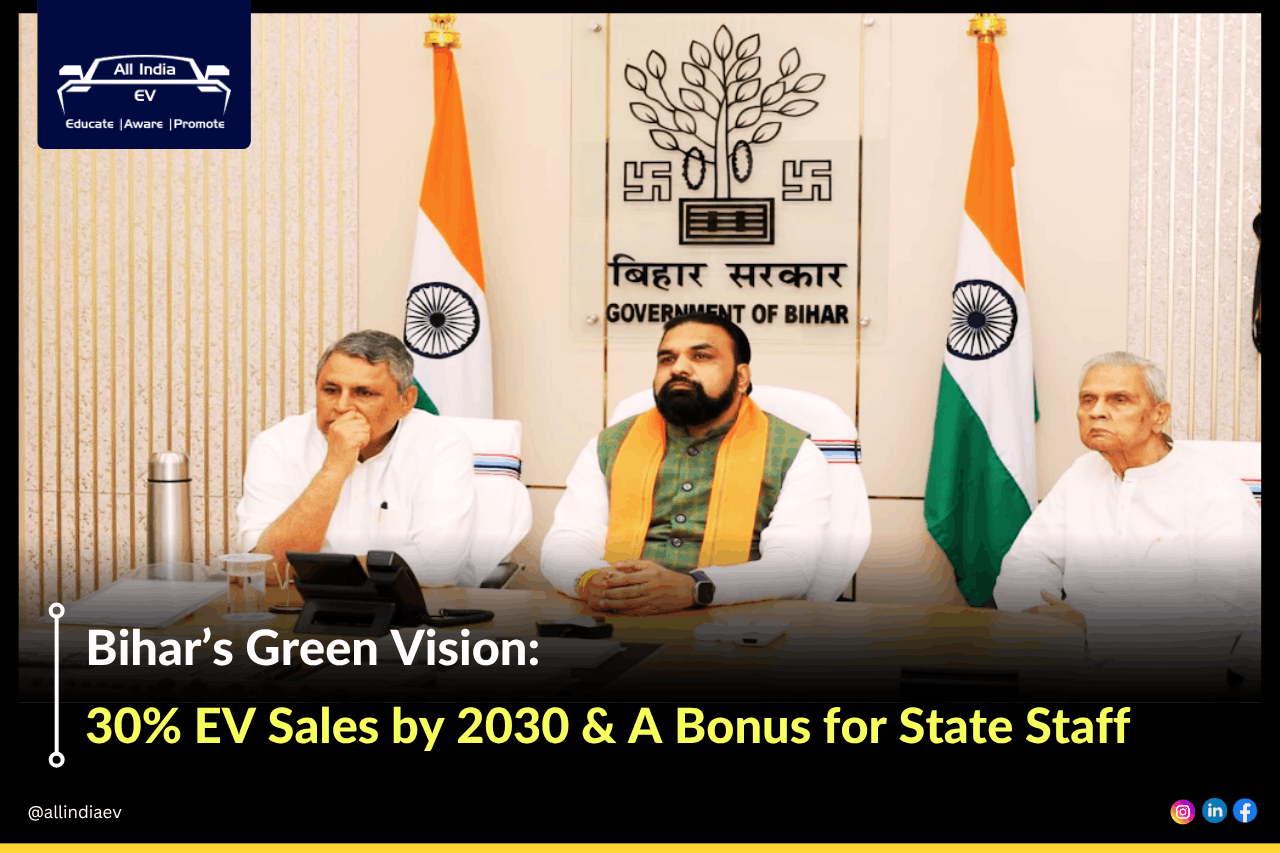

What: The Bihar government has approved amendments to its EV policy targeting 30% electric vehicle penetration in all new vehicle sales by 2030. The revised framework includes purchase incentives, charging infrastructure support, and rural mobility expansion.
The Number: 30% EV sales target by 2030, alongside DBT-backed incentives for commercial EVs, women-focused electric mobility schemes, and support for public charging infrastructure under the PM E-DRIVE scheme.
The Impact: The revised Bihar EV policy signals a deeper state-level push toward electrified transport beyond metro cities, especially targeting commercial logistics, rural transportation, and women-centric mobility adoption.

The Core News
The Bihar EV policy has entered a more aggressive implementation phase after the state cabinet approved amendments aimed at ensuring that at least 30% of all new vehicles sold in Bihar by 2030 are electric. The policy revision comes amid rising national pressure on states to accelerate EV adoption, improve urban air quality, and reduce fossil fuel dependence through localized electrification strategies.
A major focus of the revised policy is the expansion of commercial electric mobility and rural transport accessibility. Under the ‘Chief Minister Bihar Environment-Friendly Transport Employment Scheme’, the state plans to provide Direct Benefit Transfer (DBT)-linked incentives for electric commercial goods vehicles, electric two-wheelers, and women-focused non-commercial EV ownership. The government is positioning EV adoption not only as an environmental initiative but also as an employment and economic participation mechanism.
Charging infrastructure development has also been included as a central pillar of the updated framework. Bihar plans to provide financial support for charging station deployment while additionally seeking assistance from the Centre under the PM E-DRIVE scheme. The move aligns Bihar with broader national efforts to strengthen public charging access, particularly in tier-2 cities and semi-urban regions where EV infrastructure remains limited.
More EV News

Breaking Down the Update
• Bihar aims for 30% EV share in all new vehicle sales by 2030
• The cabinet approved amendments to the state EV policy in May 2026
• DBT incentives will support electric commercial vehicles and women-focused EV ownership
• Commercial electric goods carriers are expected to receive targeted incentives
• Financial assistance will be provided for EV charging station deployment
• Bihar may seek additional support under the Centre’s PM E-DRIVE scheme
• Rural transport electrification has been included as a policy objective
• The policy also links EV adoption with employment generation and cleaner mobility
• Bihar recorded strong growth in EV registrations during FY2024-25, led mainly by electric two-wheelers and three-wheelers
How Bihar EV policy will help Indian EV Market
The updated Bihar EV policy could become an important case study for EV penetration in non-metro and economically developing states. Unlike earlier EV policies that were largely urban-focused, Bihar’s revised framework directly targets rural mobility, commercial logistics, and employment-linked electrification. This expands the EV conversation beyond private passenger cars into practical utility-driven transport adoption.
The inclusion of DBT-based incentives for commercial electric vehicles can accelerate electrification in small-scale goods movement, delivery operations, and local transport businesses. Since commercial EVs generally deliver higher daily utilization, they can improve operating economics faster than private vehicles while also reducing fuel dependency in local economies.
The policy’s focus on women-centric EV ownership is also strategically important. Incentivizing electric two-wheelers and four-wheelers for women could increase first-time EV adoption in semi-urban and rural regions where mobility access remains uneven.
Infrastructure support is another key factor. Bihar’s alignment with the PM E-DRIVE scheme could help accelerate charging station deployment in underserved regions, improving confidence among buyers and fleet operators. If implemented effectively, Bihar’s approach may encourage other emerging states to adopt similar decentralized EV growth models focused on affordability, logistics, and local economic participation.
Way Forward ..
The success of the Bihar EV policy will ultimately depend on execution speed, charging infrastructure rollout, subsidy efficiency, and private-sector participation. While the 30% target is ambitious for a state where EV infrastructure is still developing, Bihar’s focus on commercial mobility and rural adoption could create a scalable blueprint for broader EV penetration across India’s emerging transport markets.
Read More: Catch up on All India EV’s related coverage on India’s evolving commercial EV subsidies and battery swapping policies at All India EV