

India’s electric two-wheeler market continued its upward movement in July 2026, supported by wider product portfolios, stronger dealership networks, improving consumer confidence and demand ahead of the PM E-DRIVE incentive deadline.
- June versus July 2026 sales
- TVS crosses 50,000 units
- Bajaj maintains second position
- Ather declines but remains a strong third
- Hero MotoCorp crosses 20,000 units
- Ola Electric loses momentum
- Greaves falls below 10,000 units
- River and BGauss record the fastest growth
- Simple Energy and Lectrix expand from smaller bases
- PM E-DRIVE created a July purchase deadline
- Electric scooters now cover more price points
- Legacy manufacturers have turned EVs into a distribution battle
- Charging confidence has improved
- Range and utility have improved
- Buyers are focusing more on ownership cost
- The bigger story
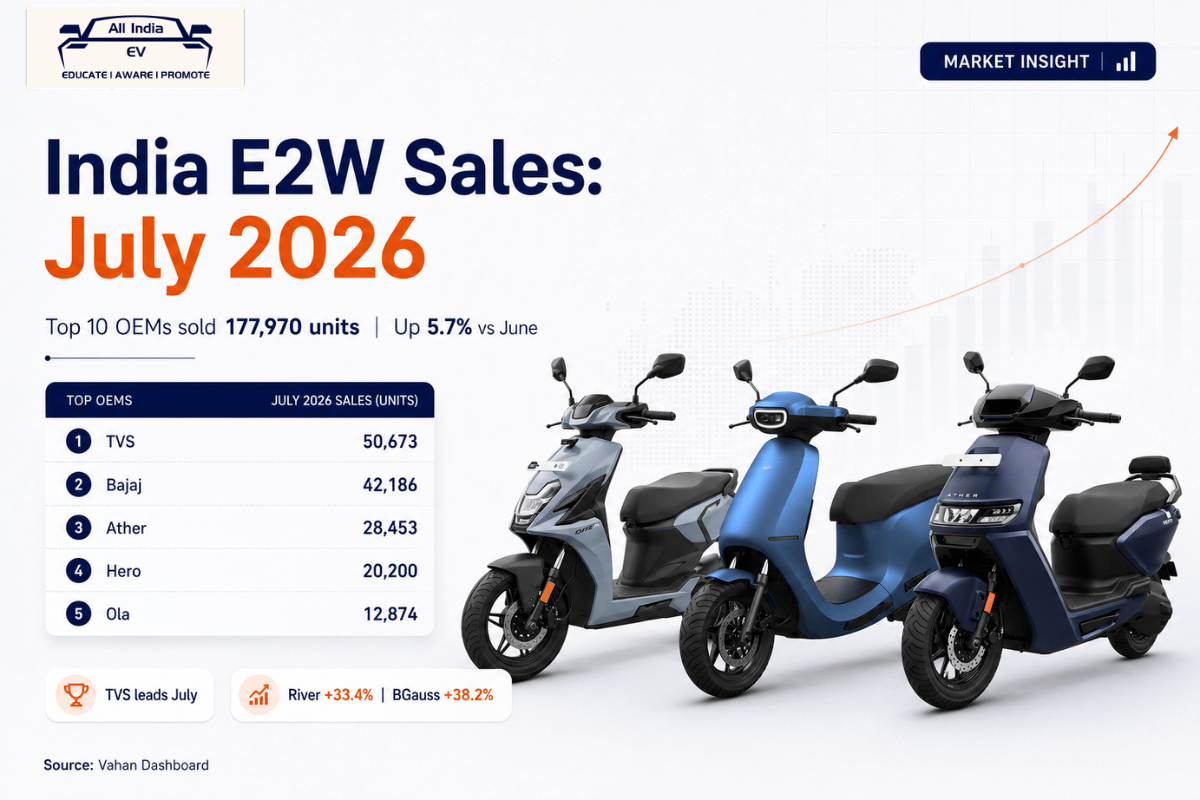
The ten manufacturers covered in this analysis collectively sold 177,970 units in July, compared with 168,343 units in June, representing a month-on-month increase of 5.7%.
Seven manufacturers recorded growth, while Ather Energy, Ola Electric and Greaves Electric Mobility reported declines.
TVS Motor Company remained the market leader with 50,673 units, followed by Bajaj Auto with 42,186 units and Ather Energy with 28,453 units. Together, the top three accounted for approximately 68.2% of the July volume recorded by these ten manufacturers.
Source: Vahan Dashboard
Calculations: All India EV analysis based on January–July 2026 sales data.
June versus July 2026 sales
| Rank | Company | June | July | MoM change |
|---|---|---|---|---|
| 1 | TVS Motor Company | 43,354 | 50,673 | +16.9% |
| 2 | Bajaj Auto | 40,096 | 42,186 | +5.2% |
| 3 | Ather Energy | 30,082 | 28,453 | -5.4% |
| 4 | Hero MotoCorp | 19,026 | 20,200 | +6.2% |
| 5 | Ola Electric | 14,902 | 12,874 | -13.6% |
| 6 | Greaves Electric Mobility | 10,156 | 9,310 | -8.3% |
| 7 | River Mobility | 4,450 | 5,938 | +33.4% |
| 8 | BGauss Auto | 3,949 | 5,459 | +38.2% |
| 9 | Simple Energy | 1,333 | 1,587 | +19.1% |
| 10 | Lectrix E-Vehicles | 995 | 1,290 | +29.6% |
| Total | 168,343 | 177,970 | +5.7% |
TVS crosses 50,000 units
TVS recorded the largest absolute increase, rising from 43,354 units in June to 50,673 units in July. The company added 7,319 units, representing growth of 16.9%.
TVS alone contributed around 28.5% of the top-ten July volume.
The performance reflects the broader positioning of the iQube portfolio, which now addresses different price, battery and range requirements. The company’s established dealership and service network has also helped reduce buyer concerns around maintenance and ownership support.
TVS’s July numbers show that electric scooters are increasingly being won through a combination of product variety, manufacturing scale and after-sales reach.
Bajaj maintains second position
Bajaj Auto recorded 42,186 units in July, up from 40,096 units in June, representing growth of 5.2%.
The Chetak portfolio has expanded across more price points, enabling Bajaj to target both value-conscious and premium urban buyers. The company’s manufacturing expansion and conventional dealer network have also strengthened its ability to convert demand into deliveries.
The wider industry is now moving from a product-launch race to a capacity-and-execution race. Strong specifications may generate interest, but sustained leadership depends on production, dealerships, financing and reliable service.
Ather declines but remains a strong third
Ather Energy recorded 28,453 units in July, down 5.4% from June.
Despite the decline, Ather remained firmly in third position and sold more than twice Ola Electric’s July volume. Its growth has been supported by the Rizta family scooter, the 450 series, an expanding Experience Centre network and the wider Ather Grid charging ecosystem.
Ather’s July fall appears more like a monthly correction than a structural decline. Its sales were still 30.4% higher than in January 2026.
The challenge ahead will be defending its technology-led position while competing with TVS, Bajaj and Hero, which possess much larger conventional retail networks.
Hero MotoCorp crosses 20,000 units
Hero MotoCorp’s VIDA business sold 20,200 units in July, up 6.2% from June.
Hero’s sales have increased from 12,411 units in January to 20,200 units in July, representing growth of approximately 62.8%.
The company has widened its electric scooter portfolio through the VIDA V2 and VX2 families and introduced different battery, range and charging configurations. Battery subscription models have also helped lower the initial purchase price for selected products.
Hero’s performance suggests that the company is beginning to translate its national brand presence and distribution strength into meaningful EV sales.
Ola Electric loses momentum
Ola Electric recorded 12,874 units in July, down from 14,902 units in June. The 13.6% decline was the steepest among the ten manufacturers in absolute terms.
Ola’s position is notable because the company previously led India’s electric scooter market. The latest numbers show how quickly leadership can shift when established manufacturers improve their products and scale service networks.
Ola’s July sales remained around 76% higher than January, but its competitors have grown faster. TVS sold nearly four times Ola’s July volume, while Bajaj sold more than three times as many units.
Greaves falls below 10,000 units
Greaves Electric Mobility, which sells scooters under the Ampere brand, recorded 9,310 units in July, down 8.3% from June.
Despite the monthly decline, July sales were approximately 85.9% higher than January.
Ampere occupies the middle ground between large legacy manufacturers and smaller startups. Its challenge is to maintain product differentiation as TVS, Bajaj, Hero and Ather expand into more price segments.
Price alone is unlikely to remain a sustainable advantage.
River and BGauss record the fastest growth
River Mobility and BGauss Auto delivered the strongest percentage gains in July.
River sales increased from 4,450 to 5,938 units, representing growth of 33.4%. BGauss grew from 3,949 to 5,459 units, an increase of 38.2%.
Both companies added around 1,500 units during the month.
River’s growth indicates that there is space for differentiated, utility-focused products. BGauss appears to be benefiting from wider retail expansion and growing EV adoption beyond the largest metropolitan markets.
Their volumes remain far below the market leaders, but the July performance shows that emerging manufacturers can still build meaningful positions.
Simple Energy and Lectrix expand from smaller bases
Simple Energy sold 1,587 units in July, up 19.1% from June, while Lectrix E-Vehicles recorded 1,290 units, an increase of 29.6%.
Compared with January, Simple Energy grew by approximately 183%, while Lectrix expanded by more than 212%.
However, rapid growth from a smaller base must be backed by consistent production, dependable deliveries, wider service access, battery support and retail financing. The market has repeatedly shown that sales growth can fade when ownership infrastructure fails to keep pace.
What changed in India during the last six months?
The rise between January and July cannot be attributed to one manufacturer or one product. Several market shifts occurred simultaneously.
PM E-DRIVE created a July purchase deadline
The extension of PM E-DRIVE support for electric two-wheelers until 31 July 2026 created a clear purchase window.
Some customers likely advanced their buying decisions to secure available incentives before the deadline. Manufacturers with sufficient inventory and dealership capacity were better positioned to capture this demand.
The months following July will reveal how resilient the market remains without the same incentive support.
Electric scooters now cover more price points
Electric scooters are no longer concentrated only in premium urban segments.
Manufacturers now offer multiple battery capacities, range options, software packages, charging formats and ownership models. TVS, Bajaj and Hero have widened their product portfolios to reach both entry-level and premium customers.
The purchase decision is gradually becoming similar to the conventional scooter market, with buyers comparing price, range, storage, brand, finance and charging convenience.
Legacy manufacturers have turned EVs into a distribution battle
Early EV growth was led largely by startups, but the market is increasingly favouring companies capable of combining technology with conventional automotive execution.
TVS, Bajaj and Hero already possess extensive supplier, dealer and service networks. As their electric products improve, these networks reduce perceived risk for buyers.
The four largest companies in July, TVS, Bajaj, Ather and Hero, accounted for almost 79.5% of the top-ten sales.
Charging confidence has improved
Most electric scooter owners still depend mainly on home charging, but public and semi-public charging infrastructure improves confidence.
Manufacturer-led charging networks, apartment solutions, workplace chargers and dealership charging are making ownership more practical. Even when public chargers are used infrequently, their visibility helps reduce range anxiety.
Range and utility have improved
Modern electric scooters increasingly offer sufficient real-world range for several days of average urban commuting.
Longer-range variants, better battery management, larger storage areas, family-oriented seating and connected features have expanded the category beyond early technology adopters.
Electric scooters are increasingly being evaluated as primary household vehicles rather than secondary urban runabouts.
Buyers are focusing more on ownership cost
Consumers are gradually looking beyond the showroom price and assessing:
- Electricity and petrol savings
- Monthly financing cost
- Maintenance requirements
- Battery warranty
- Insurance
- Resale value
- Daily utilisation
For high-usage riders and urban commuters, lower running costs can translate into meaningful annual savings. However, battery life, financing and resale assumptions must still be evaluated carefully.
A six-month growth story
Combined sales of the ten manufacturers increased from 111,193 units in January to 177,970 units in July, representing growth of approximately 60%.
| Company | January | July | Growth |
|---|---|---|---|
| TVS Motor | 33,545 | 50,673 | +51.1% |
| Bajaj Auto | 24,725 | 42,186 | +70.6% |
| Ather Energy | 21,828 | 28,453 | +30.4% |
| Hero MotoCorp | 12,411 | 20,200 | +62.8% |
| Ola Electric | 7,316 | 12,874 | +76.0% |
| Greaves Electric Mobility | 5,007 | 9,310 | +85.9% |
| River Mobility | 2,856 | 5,938 | +107.9% |
| BGauss Auto | 2,531 | 5,459 | +115.7% |
| Simple Energy | 561 | 1,587 | +182.9% |
| Lectrix E-Vehicles | 413 | 1,290 | +212.3% |
Every company in the dataset sold more vehicles in July than in January, although their monthly trajectories varied.
The bigger story
July 2026 marked more than another positive sales month. It represented the closing stage of India’s incentive-supported electric two-wheeler market and the beginning of a more demanding commercial phase.
TVS and Bajaj have created a clear lead. Ather remains a strong technology-focused player, while Hero is rapidly converting its distribution strength into EV growth. Ola must rebuild momentum, and emerging companies such as River, BGauss, Simple and Lectrix must convert percentage growth into sustainable scale.
The next phase will be decided less by product launches and more by the quality of the ownership ecosystem: reliable vehicles, accessible finance, dependable batteries, transparent warranties and widespread service.
India’s electric two-wheeler market is growing. The next test is whether that growth can remain durable as incentives reduce and competition intensifies.