

The Quick Update
What Happened:
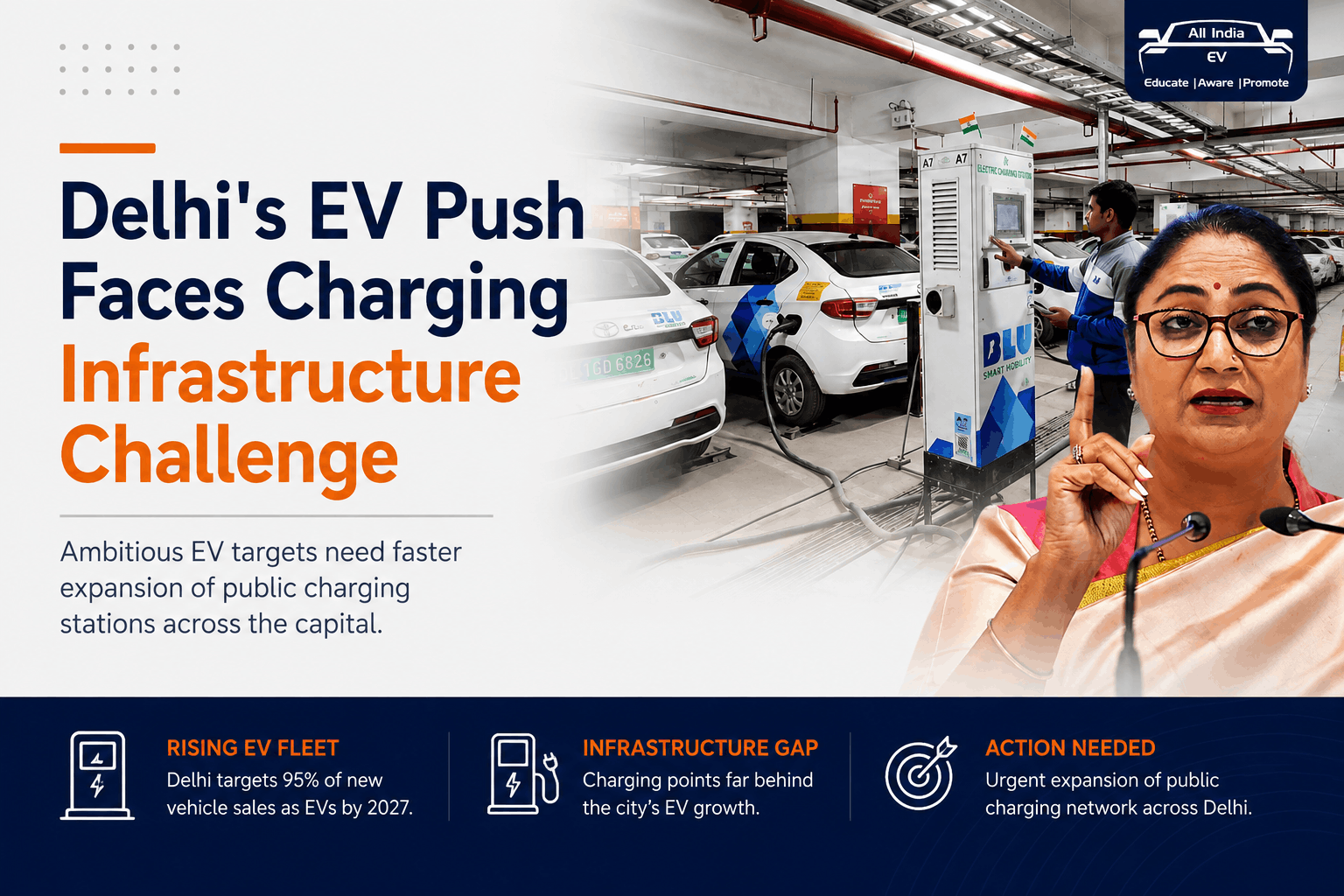
Delhi’s ambitious EV transition is gaining momentum under the Delhi EV Policy 2026, but industry experts and EV users say the capital’s charging infrastructure must expand significantly for the policy to achieve its targets. The government aims for the vast majority of new vehicle registrations to be electric by 2027, supported by incentives and infrastructure development.
The Key Number:
2027 – Target year for the majority of new vehicle registrations in Delhi to be electric.
Why It Matters:
While purchase incentives are expected to boost EV adoption, inadequate charging infrastructure, grid readiness and renewable energy integration remain major challenges that could determine the policy’s long-term success.
The Core News
Delhi EV charging infrastructure will determine policy success
The Delhi EV charging infrastructure network has emerged as the biggest challenge in implementing the capital’s ambitious electric mobility roadmap. Under the Delhi EV Policy 2026, the government plans to transition the majority of newly registered vehicles to electric by 2027 through purchase incentives, registration fee waivers, scrappage benefits and phased electrification of vehicle segments. However, EV users continue to report limited access to reliable public charging facilities, particularly for long-distance travel and commercial operations.
Recognising this gap, the policy introduces several measures to accelerate charging infrastructure deployment. It mandates public charging stations at EV dealerships, establishes a single-window clearance mechanism for charging operators, encourages Resident Welfare Associations (RWAs) and housing societies to install chargers, and appoints Delhi Transco Limited (DTL) as the nodal agency for planning and coordinating public charging and battery-swapping infrastructure. The government also plans to leverage central schemes such as PM E-Drive to support network expansion.
Despite these policy measures, experts caution that charging infrastructure alone will not be enough. Fast-charging stations require substantial grid upgrades, while increasing electricity demand must be supported by a larger share of renewable energy to maximise environmental benefits. Since most EV charging occurs at night, dependence on thermal power remains a concern. Addressing grid capacity, renewable integration and charging accessibility together will be critical for ensuring that Delhi’s EV transition delivers meaningful reductions in urban air pollution
Breaking Down the Update
- Policy Goal: Majority of new vehicle registrations to be electric by 2027.
- Key Challenge: Insufficient public charging infrastructure.
- Charging Plan: Single-window clearance for charging and battery-swapping operators.
- Dealership Mandate: OEM dealerships must install public charging stations.
- Residential Charging: RWAs and housing societies encouraged to deploy community chargers.
- Nodal Agency: Delhi Transco Limited (DTL) to coordinate charging infrastructure rollout.
- Funding Support: Government to seek assistance through PM E-Drive and other central schemes.
- Grid Challenge: Electricity infrastructure and renewable energy capacity must expand alongside EV adoption.
- Long-Term Goal: Reduce vehicular emissions while accelerating clean mobility across the capital.
How Delhi EV charging infrastructure Will Help the Indian EV Market
The Delhi EV charging infrastructure rollout is likely to become one of the most closely watched urban electrification initiatives in India. As the country’s largest metropolitan EV market, Delhi’s experience will influence how other cities approach large-scale charging deployment.
A comprehensive charging network can reduce range anxiety, improve consumer confidence and support higher utilisation of electric two-wheelers, three-wheelers, passenger vehicles and commercial fleets. The policy’s emphasis on public, residential and dealership-based charging also reflects a more integrated approach to infrastructure planning.
The introduction of a single-window approval mechanism can accelerate project execution by reducing administrative delays for charge point operators. At the same time, involving RWAs, private developers and DISCOMs encourages broader participation in infrastructure creation rather than relying solely on government investment.
However, the success of the Delhi EV charging infrastructure programme will depend on parallel investments in grid modernisation and renewable power. Without sufficient electricity capacity and cleaner energy sources, the environmental benefits of rapid EV adoption could be limited. If implemented effectively, Delhi’s model could provide a blueprint for other Indian cities seeking to balance aggressive EV adoption targets with practical infrastructure development.
Way Forward …
The expansion of Delhi EV charging infrastructure will be central to achieving the capital’s electric mobility ambitions. While the Delhi EV Policy 2026 provides a strong regulatory and financial framework, its success will depend on the pace of charger deployment, electricity grid upgrades and renewable energy integration. Over the next few years, the effectiveness of these infrastructure investments will determine whether Delhi can emerge as a benchmark for large-scale urban EV adoption in India