

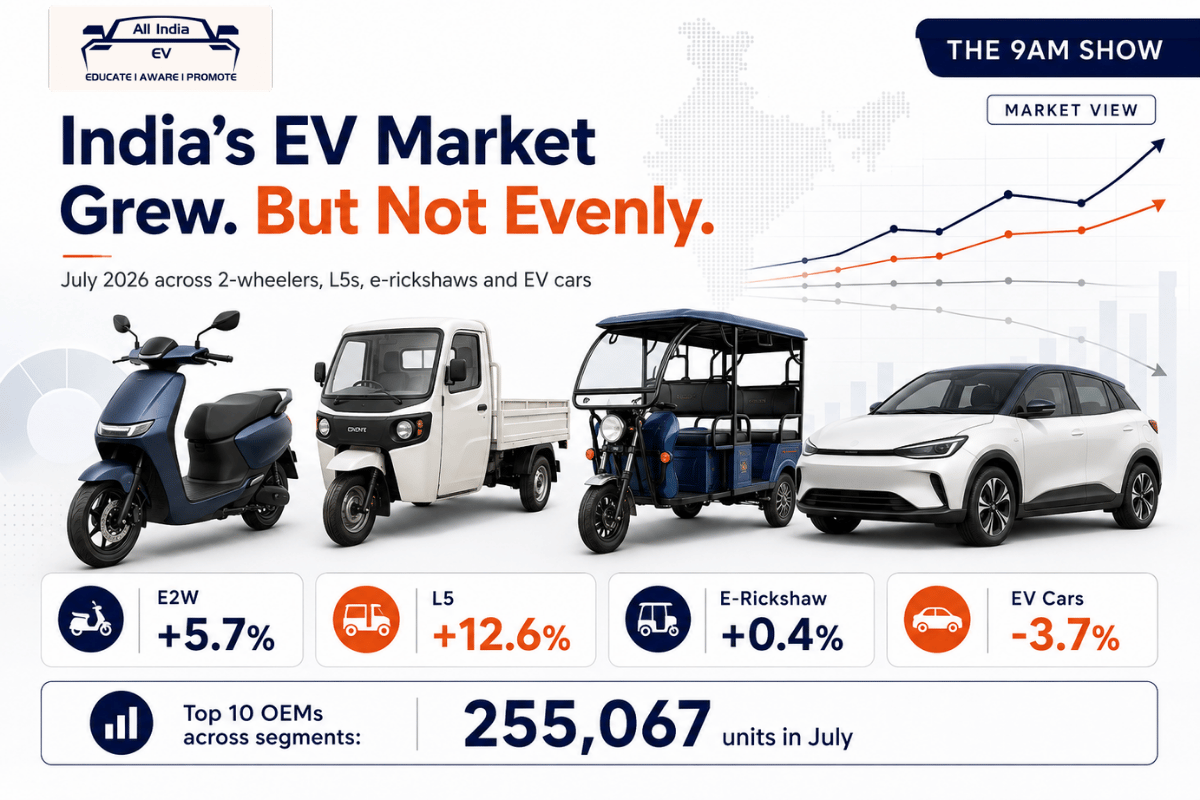
India’s electric vehicle market recorded a strong July 2026, but not a uniform one.
Across the four segments All India EV tracks — electric two-wheelers, electric L5 three-wheelers, e-rickshaws and electric passenger cars — the ten leading manufacturers in each category collectively sold 255,067 units in July, compared with 242,284 units in June. That is month-on-month growth of approximately 5.3%.
The aggregate is the least informative number in the dataset.
Two-wheelers rose 5.7%. L5 three-wheelers jumped 12.6%. Electric cars declined 3.7%. E-rickshaws moved 0.4%, which in practice means they did not move at all. Four segments, four trajectories, and four different explanations.
Source: Vahan Dashboard. Calculations: All India EV analysis, top-ten manufacturers per segment.
The segment that grew fastest is the one that stopped being paid to grow
Electric L5 three-wheelers recorded 38,019 units in July against 33,752 in June, up 12.6%. Nine of the ten manufacturers in the dataset grew. Since January, the segment has expanded approximately 78.9%.
PM E-DRIVE demand support for the L5 category closed on 26 December 2025.
That single fact reframes the entire month. The fastest-growing commercial EV segment in India has now delivered seven months of expansion without direct purchase incentives, because the buyers are not consumers responding to a subsidy. They are operators running a spreadsheet: energy cost per kilometre, EMI, uptime, payload, battery warranty, resale.
Mahindra Last Mile Mobility crossed 13,389 units, up 9.1%, and has more than doubled since January. Bajaj Auto added 1,559 vehicles — the largest absolute gain in the segment — to reach 12,777, leaving it just 612 units behind the leader. TVS consolidated third at 4,410.
Behind them, the second tier is moving faster than the leaders. Mini Metro EV grew 56.6% in a single month and is now more than nine times its January volume. Saera added 25.2%, YC Electric 23.5%, Dilli Electric 17%.
Two OEMs control 68.8% of this market. Three control 80.4%. Concentration is rising even as the tail accelerates — which is what a market looks like when it is scaling and consolidating at the same time.
Two-wheelers grew. But the wrong companies grew.
Electric two-wheelers reached 177,970 units against 168,343 in June, up 5.7%. July was also the final month of PM E-DRIVE incentive support for the category, which closed on 31 July 2026.
TVS crossed 50,000 units for the first time, adding 7,319 vehicles for 16.9% growth and taking roughly 28.5% of top-ten volume on its own. Bajaj held second at 42,186. Hero MotoCorp crossed 20,000 and is now 62.8% above January. River (+33.4%) and BGauss (+38.2%) posted the sharpest percentage gains.
The uncomfortable detail is on the other side of the table. Ather fell 5.4%. Greaves fell 8.3%. Ola Electric fell 13.6% — the steepest decline in the segment — during a month when an expiring incentive should have pulled purchases forward.
TVS sold nearly four times Ola’s July volume. Bajaj sold more than three times. The company that once defined India’s electric scooter market now sits fifth.
The four largest players — TVS, Bajaj, Ather, Hero — accounted for 79.5% of top-ten volume. Electric two-wheelers have stopped being a technology contest and become a distribution contest, and legacy manufacturers own the distribution.
August will be the first honest month this segment has had in a while.
Cars corrected. At a much higher base.
Electric passenger vehicles declined 3.7% to 30,245 units. Only four of ten manufacturers grew.
Tata Passenger Electric Mobility was one of them, rising 4.8% to 12,750 units and extending its share to approximately 42.2% of the top ten. Mahindra Electric fell 8% to 6,722 but remains a clear second and is still 95.2% above January. JSW MG declined 10.1% to 5,283. Hyundai delivered the sharpest percentage gain at 48.5%, though from a base of 363 units.
The top three now hold 81.8% of the segment — the most concentrated of any category we track.
But the six-month picture matters more than the monthly one. Combined volume has risen from 19,921 units in January to 30,245 in July, growth of 51.8%. A 3.7% correction on a base that has expanded by half in seven months is not a reversal. It is what a maturing market looks like.
E-rickshaws did not have a month. They had a pause.
The organised e-rickshaw market sold 8,833 units, up 0.4% from June. Six OEMs grew, three declined, one was flat.
YC Electric retained the lead at 1,175 units — while falling 13.9% and finishing only 89 units ahead of Zeniak. Hotage India (+16.4%) and Move Stone Services (+20.5%) posted the strongest gains.
The segment is 13.7% above its April floor but still 33.5% below January. The top three control just 37.3%, and fewer than 500 vehicles separate first place from tenth.
This is the only Indian EV segment where the leadership is genuinely undecided — and the only one where a 100-unit swing rewrites the ranking.
The bigger story
July did not test whether India wants electric vehicles. Demand is no longer the open question in three of these four segments.
It tested something narrower and more useful: which manufacturers can sell without being paid to.
The commercial segments answered clearly. L5 grew 12.6% with no demand incentive at all. The consumer segments answered less clearly — two-wheelers grew into a deadline, cars corrected, e-rickshaws stalled.
From August, electric two-wheelers join the L5 category on the unsubsidised side of that line.
That is the number to watch next month.
📊 Full segment analyses: EV Sales Analysis