

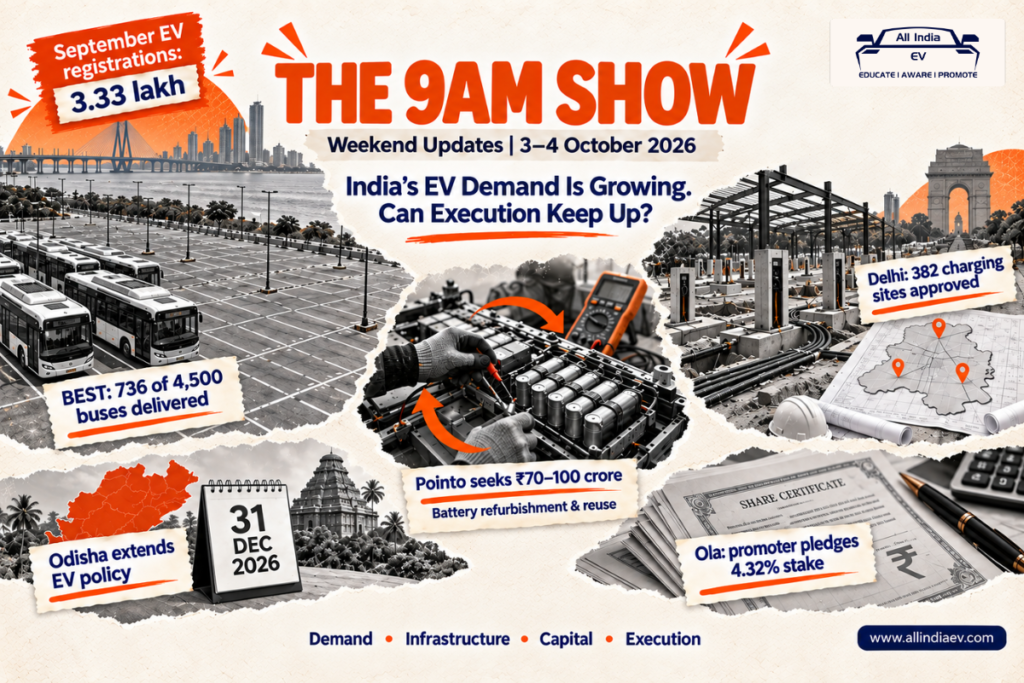
All India EV | The 9AM Show
Monday, 5 October 2026 | Weekend Review: 3–4 October
- All India EV | The 9AM Show
- 1. September’s EV Growth Was Strong, but Uneven
- 2. Delhi’s Charging Plans Move Towards Procurement
- 3. Mumbai’s Electric-Bus Backlog Puts Execution in Focus
- 4. JBM’s September Performance Shows Why National and City-Level Progress Differ
- 5. Ola’s Weekend Disclosure Concerns Promoter Financing
- 6. Pointo Highlights the Business Opportunity After the First Battery Sale
- 7. Odisha Extends Policy Continuity Through December
- 8. Hyderabad Adds Another Destination-Charging Example
- Other Weekend Signals
- What This Weekend Tells Us
India’s electric mobility transition is producing several different stories at once.
Weekend reporting showed September’s EV registrations moving higher, Odisha extending policy support, and Delhi preparing another substantial charging-infrastructure tender. At the same time, Mumbai’s electric-bus delivery backlog exposed the distance between awarding contracts and improving everyday transport.
On the business side, Ola Electric disclosed how its promoter intends to finance participation in the proposed rights issue, while Pointo outlined expansion plans around battery replacement, refurbishment and second-life applications.
Together, these developments raise a practical question: how effectively can India convert growing EV demand into dependable vehicles, accessible charging and sustainable businesses?
Here are the signals that mattered over the weekend.
1. September’s EV Growth Was Strong, but Uneven
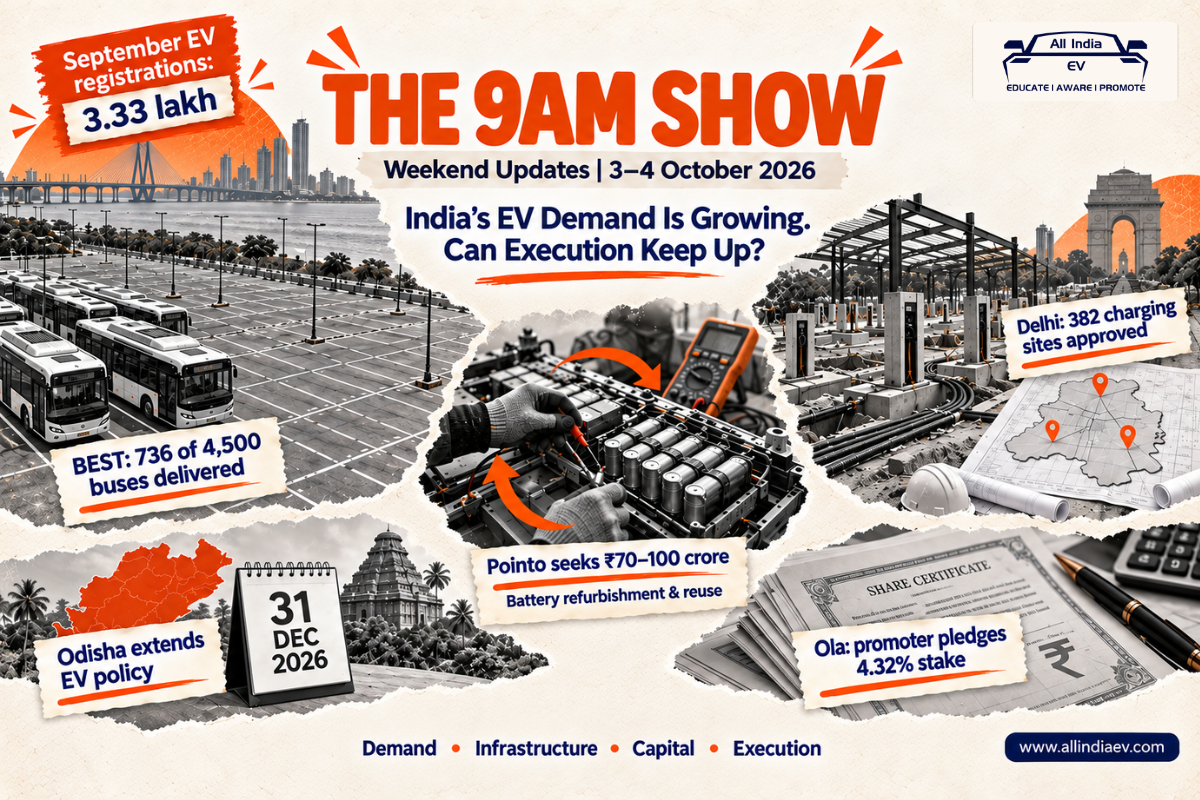
EVreporter’s September review, published on Saturday, recorded 3,33,571 EV registrations, compared with 3,02,746 in August—an increase of approximately 10.2%.
Electric two-wheelers rose to 2,07,314 registrations, while electric L5 passenger three-wheelers reached 44,738. However, electric-bus registrations declined from 910 to 832, and electric goods carriers fell from 3,831 to 3,329. The figures reflect a VAHAN snapshot dated 2 October and exclude low-speed electric two-wheelers.
The AIEV reading: India’s EV market is expanding, but each vehicle category follows its own adoption cycle.
Consumer purchases can respond quickly to product availability and festive demand. Commercial deployment depends on additional decisions around financing, contracts, charging access and operating requirements.
The headline growth therefore needs a second question: which segments are building repeatable demand, and which remain dependent on deployment schedules?
2. Delhi’s Charging Plans Move Towards Procurement
On Sunday, Delhi announced that the Ministry of Heavy Industries had approved 382 sites for EV charging infrastructure. A first tender covering 160–180 sites is planned. These are approved locations; they should not be counted as operational charging stations.
For charging companies, the announcement creates a procurement pipeline worth tracking. For EV users, its value will emerge when those sites become accessible, energised and reliable.
The AIEV reading: Site approval is an early milestone in a longer delivery process.
Tender conditions, electricity availability, commissioning timelines and maintenance arrangements will determine how much usable charging capacity reaches the market. The industry should track those milestones alongside the number of approved sites.
3. Mumbai’s Electric-Bus Backlog Puts Execution in Focus
A Sunday report on BEST’s rollout said that a major contractor responsible for supplying 4,500 electric buses had delivered 736, leaving 3,764 pending, according to a BEST official.
The report also cited sources close to the contractor saying deliveries could accelerate with access to existing charging and depot infrastructure. That explanation represents the contractor-side account, rather than an independently established cause of the entire backlog.
The AIEV reading: Electric-bus programmes need coordinated delivery across manufacturing, depots, electricity connections and operations.
For commuters, an awarded contract has little practical value until buses enter service. For the industry, the more revealing measures are buses delivered, buses operating, kilometres completed and service availability.
Mumbai’s experience makes deployment performance a central part of the electric-bus story.
4. JBM’s September Performance Shows Why National and City-Level Progress Differ
JBM’s performance update, reported on Saturday, cited 274 electric-bus registrations in September, representing approximately 33% of the monthly market.
For April–September 2026, the company reported 892 registrations, against an industry total of 3,771, giving it approximately 24% share.
These figures provide a useful companion to the BEST report.
The AIEV reading: Manufacturer performance and city-level deployment answer different questions.
Registrations show vehicles entering the market. Operational data shows whether a transport undertaking is delivering the intended service. A complete assessment of India’s electric-bus transition needs both.
5. Ola’s Weekend Disclosure Concerns Promoter Financing
Ola Electric disclosed on Sunday that Bhavish Aggarwal had pledged a 4.32% stake to finance his subscription to the company’s proposed ₹1,000 crore rights issue.
The company said the pledge was solely for that purpose and that shares were not being sold. The rights issue had been approved earlier; the weekend development was the clarification about promoter participation and financing.
The AIEV reading: Capital provides room to execute, but business recovery must ultimately show up in operating performance.
For Ola, the questions remain around sales momentum, service delivery and the productive use of fresh capital. Promoter participation is relevant to the financing story; the next assessment will depend on what the business achieves with the funds.
6. Pointo Highlights the Business Opportunity After the First Battery Sale
Pointo’s expansion plans, reported on Sunday, involve a proposed ₹70–100 crore fundraise to build an automated battery-refurbishment facility and expand distribution.
The company is targeting electric autos, battery energy storage and second-life products, with a model spanning battery deployment, buyback, refurbishment and reuse. Investor discussions are ongoing; the amount should be described as funding sought, rather than capital raised.
The AIEV reading: A growing installed base of EVs creates demand beyond new vehicle purchases.
Battery replacement brings questions about affordability, financing, collection and residual value. Refurbishment and second-life businesses can address parts of that opportunity, provided they establish sound testing, traceability and application suitability.
The battery economy increasingly includes what happens throughout ownership and after automotive use.
7. Odisha Extends Policy Continuity Through December
Odisha extended the validity of its Electric Vehicle Policy, 2021, until 31 December 2026, with reports identifying a notification issued on Saturday.
The extension continues policy support for EV adoption. Detailed subsidy amounts and eligibility should be read against the applicable government notification.
The AIEV reading: Predictability matters to buyers, dealers and fleet operators.
A clear incentive window supports purchase planning and reduces uncertainty around transactions. The next practical measure is how efficiently eligible buyers receive the benefits.
8. Hyderabad Adds Another Destination-Charging Example
Saturday coverage reported ThunderPlus’s announcement of a 120 kW fast-charging station at Prasads IMAX in Hyderabad, with participation from woman investor Kundurthy Pavithra.
The location allows charging to fit into activities such as cinema visits, shopping and dining. The report’s publication date does not separately establish the station’s inauguration date.
The AIEV reading: Charging locations should reflect how people actually travel and spend time.
Destination charging can make EV ownership more convenient. Its commercial performance will depend on utilisation, uptime, electricity costs and the suitability of charging capacity for users at that location.
Other Weekend Signals
Electric-motorcycle coverage reported 1,417 September registrations for Oben, 1,027 for Revolt and 536 for Ultraviolette. The published comparison lacked Ola’s motorcycle figures, so its ranking needs that qualification.
Honda’s 0 Alpha electric SUV was reported testing on Indian roads, adding a product-development update rather than a launch announcement. Meanwhile, the India International EV Show and Battery India Expo continued in Pune during their scheduled 2–4 October window.
What This Weekend Tells Us
Our reading of the weekend is that India’s EV opportunity is widening across vehicle sales, charging, public transport and battery services.
The challenge is increasingly operational. Approved charging sites need commissioning. Bus contracts need deliveries. Fresh capital needs productive deployment. Used batteries need safe and commercially viable pathways for recovery and reuse.
For the next phase of India’s EV growth, execution will determine how much of today’s opportunity becomes tomorrow’s dependable mobility.