

The 9AM Show | Midweek EV Review | August 17–19, 2026
- 1. India’s Electric Car Exports Just Had a Breakout Quarter
- 2. Telangana Is Testing Fleet Conversion Instead of Fleet Replacement
- 3. Commercial EV Demand Is Getting Tied to Vehicle Scrappage
- 4. India Is Pushing Deeper Into the EV Supply Chain
- 5. Epsilon’s Graphite Anode Push Puts Battery Materials Back in Focus
- 6. Montra Electric Is Attacking Commercial EV Financing
- 7. Battery Data Is Becoming Financial Infrastructure
- 8. The Sustainability Conversation Is Getting More Sophisticated
- The Common Thread
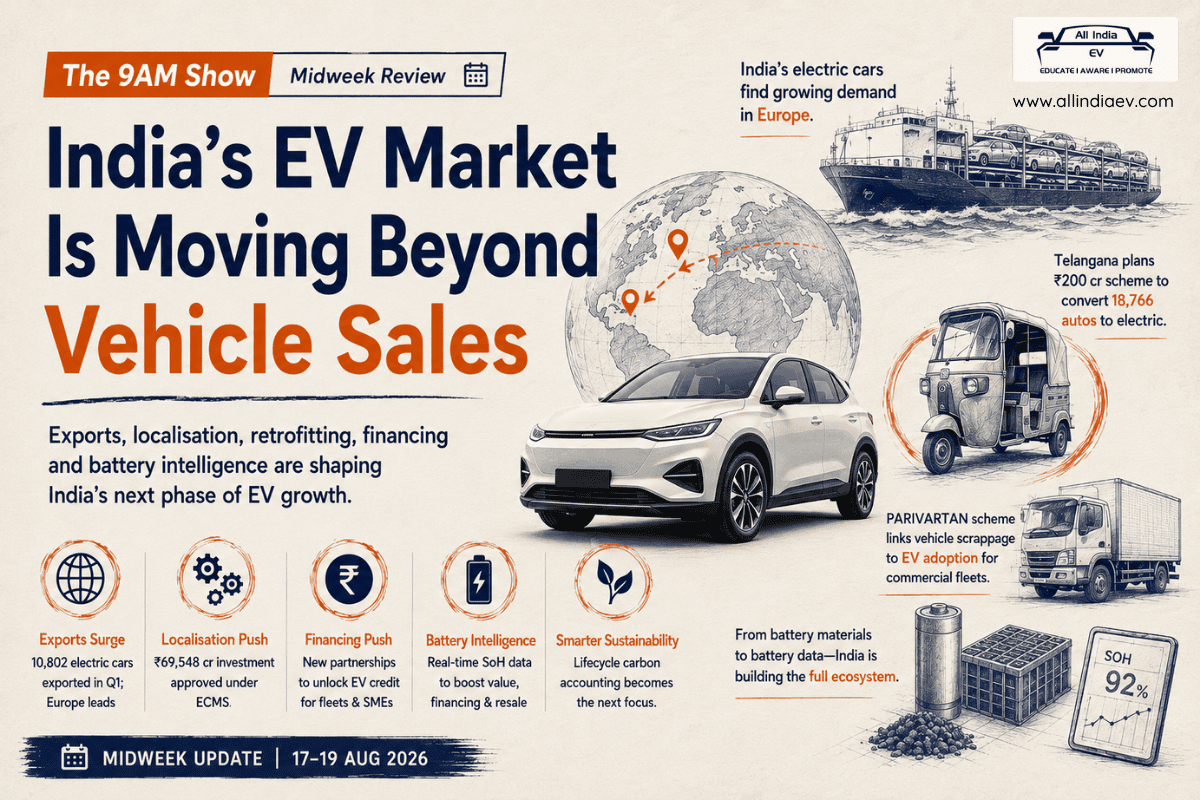
Between August 17 and August 19, 2026, India’s EV industry produced a set of developments that had little to do with new model launches or monthly sales charts. Instead, they pointed to what sits underneath the market: exports, local manufacturing, financing, fleet replacement, and battery data.
The old question was simple: how many EVs were sold. The new questions are harder:
- Can India export EVs to demanding, safety-conscious global markets?
- Can it manufacture more of the battery and electronics value chain domestically?
- Can ageing ICE vehicles be economically converted or replaced?
- Can commercial EV buyers actually get financing?
- Can lenders accurately price what an ageing EV battery is worth?
Here is what this week’s developments tell us about each.
1. India’s Electric Car Exports Just Had a Breakout Quarter
The data:
- Q1 FY2026-27 electric car exports: 10,802 units, up from 1,309 units in the same quarter last year
- Export earnings: $369 million, up from $22.2 million
- Spain: 4,007 vehicles worth $146.4 million
- UK: 2,646 vehicles worth $78.7 million
- Other key destinations: Germany, Norway, Denmark, Belgium, Netherlands
- Emerging markets reached: Japan, Australia, Israel, Singapore, South Korea, Latin America
Why it matters:
- Selling domestically and selling into Europe are not the same challenge. European buyers demand strict standards on safety, homologation, emissions accounting, software, and cybersecurity.
- This signals that India’s EV manufacturing opportunity could eventually outgrow its domestic EV market.
The caveat:
- One strong quarter does not confirm India as a global EV manufacturing hub. The real test is whether this growth holds across multiple quarters, manufacturers, and vehicle platforms rather than staying concentrated in a few export programmes.
2. Telangana Is Testing Fleet Conversion Instead of Fleet Replacement
The data:
- Scheme: Auto Rickshaw Electric Conversion Scheme, Telangana
- Budget: ₹200 crore
- Vehicles covered: 18,766 eligible petrol and diesel autos in the Core Urban Region Economy
- Diesel: 11,254
- Petrol: 7,512
- Support: up to ₹1.5 lakh per vehicle
- Owner options: retrofit with an AIS-123-approved electric conversion kit, or surrender the vehicle and buy a new type-approved L5M electric three-wheeler
Why it matters:
- India has millions of ICE vehicles already on the road. Electrification cannot rely solely on natural end-of-life replacement.
- A working retrofit programme could seed an entire new segment: certified conversion kits, installation centres, battery suppliers, testing, inspection, financing, and aftermarket service.
The catch:
- Retrofitting is operationally harder than a subsidy. Vehicle condition, homologation, battery safety, installation quality, warranty ownership, and resale value all need governance.
- Telangana becomes a real-world test of whether EV retrofitting can move from a fragmented aftermarket business into an institutionalised mobility segment.
3. Commercial EV Demand Is Getting Tied to Vehicle Scrappage
The data:
- Jupiter Electric Mobility (JEM) signed an MoU with MoRTH under the PARIVARTAN Scheme
- Eligible vehicles in Delhi-NCR: 1.9 lakh+ trucks and 16,000+ buses compliant with BS-IV or older
- Incentives for electric replacements: ₹64,000 to ₹2.56 lakh
- Additional support: tax concessions, registration-fee waivers, interest subvention
- In Delhi, replacement Light Goods Vehicles under the programme must be electric
Why it matters:
- Until now, the commercial EV pitch relied on convincing fleet operators through fuel savings and TCO math.
- Scrappage-linked programmes create a second, independent demand engine by connecting three markets that used to operate separately: vehicle retirement → financing → electric commercial vehicle acquisition.
- If this model scales beyond Delhi-NCR, scrappage policy could become one of the most powerful and least-discussed demand drivers for India’s commercial EV industry.
4. India Is Pushing Deeper Into the EV Supply Chain
The data:
- MeitY approved 31 new projects under the Electronics Components Manufacturing Scheme (ECMS)
- Projected investment in this round: ₹6,844 crore
- Cumulative ECMS approvals: 106 projects, ₹69,548 crore in investment
- Expected output: ₹5.34 lakh crore in production, 74,628 direct jobs
- Status: 38 plants already manufacturing, 16 more in advanced construction or machinery-installation stages
Components covered in this round:
- Anode materials
- Rare-earth permanent magnets
- Acetylene black
- Electrolyte additives
- Automotive connectors
- Transducers and electronics subassemblies
Why it matters:
- Vehicle assembly alone doesn’t build a resilient EV manufacturing ecosystem. These are precisely the components India needs to localise to move from assembling imported technology to owning more of the value chain.
5. Epsilon’s Graphite Anode Push Puts Battery Materials Back in Focus
The data:
- Epsilon Advanced Materials received ₹145 crore in CAPEX support under ECMS
- This covers roughly 25% of capital investment in its Epsilon C2GR graphite anode project
- Planned capacity: 30,000 tonnes per annum by 2028, with a second phase targeting 100,000 tonnes
Why it matters:
- Cell manufacturing gets most of the attention in battery localisation stories, but cathodes, anodes, electrolytes, separators, conductive additives, equipment, and process know-how determine how much economic value actually stays in India.
- This is part of the larger contest over who controls the battery-material stack, not just another factory headline.
6. Montra Electric Is Attacking Commercial EV Financing
The data:
- Montra Electric signed an MoU with Perpetuity Capital
- Focus: financing for electric passenger and cargo three-wheelers
- Target segments: individual drivers, entrepreneurs, fleet operators, small businesses
Why it matters:
- Commercial EV economics can look attractive on a spreadsheet and still fail at the dealership if the buyer can’t finance the upfront cost.
- Lenders face unfamiliar risk factors here: battery depreciation, residual value, utilisation patterns, technology obsolescence, and resale markets.
- The OEM that solves financing isn’t just selling a vehicle. It’s lowering the buyer’s cost of entry into the entire ecosystem.
- Expect OEM-NBFC/EV financier partnerships to matter more as EV penetration moves into owner-driver and small-fleet segments.
7. Battery Data Is Becoming Financial Infrastructure
The data:
- Omega Seiki Mobility (OSM) partnered with ELECTRA AI
- Scope: real-time battery monitoring, predictive analytics, and State of Health (SoH) insights across OSM’s EV ecosystem
Why it matters:
- On the surface, this reads as a fleet-maintenance announcement. Underneath, it’s a financing story.
- Reliable battery-health data lets operators predict maintenance needs, OEMs improve warranty management, and lenders estimate residual values more accurately.
- OSM itself linked transparent battery-health measurement to financing confidence and the growth of the used-EV market.
- For a used ICE vehicle, mileage and service history tell most of the story. For a used EV, battery State of Health is the critical missing metric, and it could become as standard to EV transactions as an odometer reading is today.
- This opens the door to battery analytics, digital battery passports, residual-value engines, fleet analytics, and specialised EV underwriting.
8. The Sustainability Conversation Is Getting More Sophisticated
- The EV emissions debate is shifting from zero tailpipe emissions to full lifecycle carbon accounting.
- A true EV carbon footprint spans battery-material extraction, manufacturing, electricity generation, vehicle operation, battery reuse, and recycling.
- This will matter more as India exports EVs and batteries into markets where product-level carbon reporting and supply-chain traceability are becoming standard requirements.
- The question is shifting from “is this EV clean?” to “how much carbon was emitted across its complete lifecycle?”, which could eventually influence battery sourcing, renewable-energy procurement, recycling infrastructure, manufacturing locations, and export competitiveness.
The Common Thread
Eight seemingly unrelated developments, one direction: India’s EV industry is expanding from a vehicle market into an industrial ecosystem.
| Development | What It Signals |
|---|---|
| Europe-bound electric car exports | Export opportunity beyond the domestic market |
| Telangana’s conversion scheme | Retrofit-led electrification as a parallel adoption path |
| PARIVARTAN + JEM | Scrappage policy as a new commercial EV demand engine |
| ECMS approvals (31 new, 106 total) | Localisation pushing into materials and electronics |
| Epsilon’s graphite anode project | Domestic control over battery-material supply |
| Montra + Perpetuity Capital | Credit access as a make-or-break factor for commercial EVs |
| OSM + ELECTRA AI | Battery data emerging as financial infrastructure |
| Lifecycle carbon accounting | A harder, more export-relevant sustainability standard |
The next phase of India’s EV story will not be decided only by who sells the most EVs. It will increasingly be decided by who controls the materials, technology, financing, data, aftermarket, exports, and residual value surrounding those EVs.
That is the bigger story from the first half of this week.
The 9AM Show | All India EV