

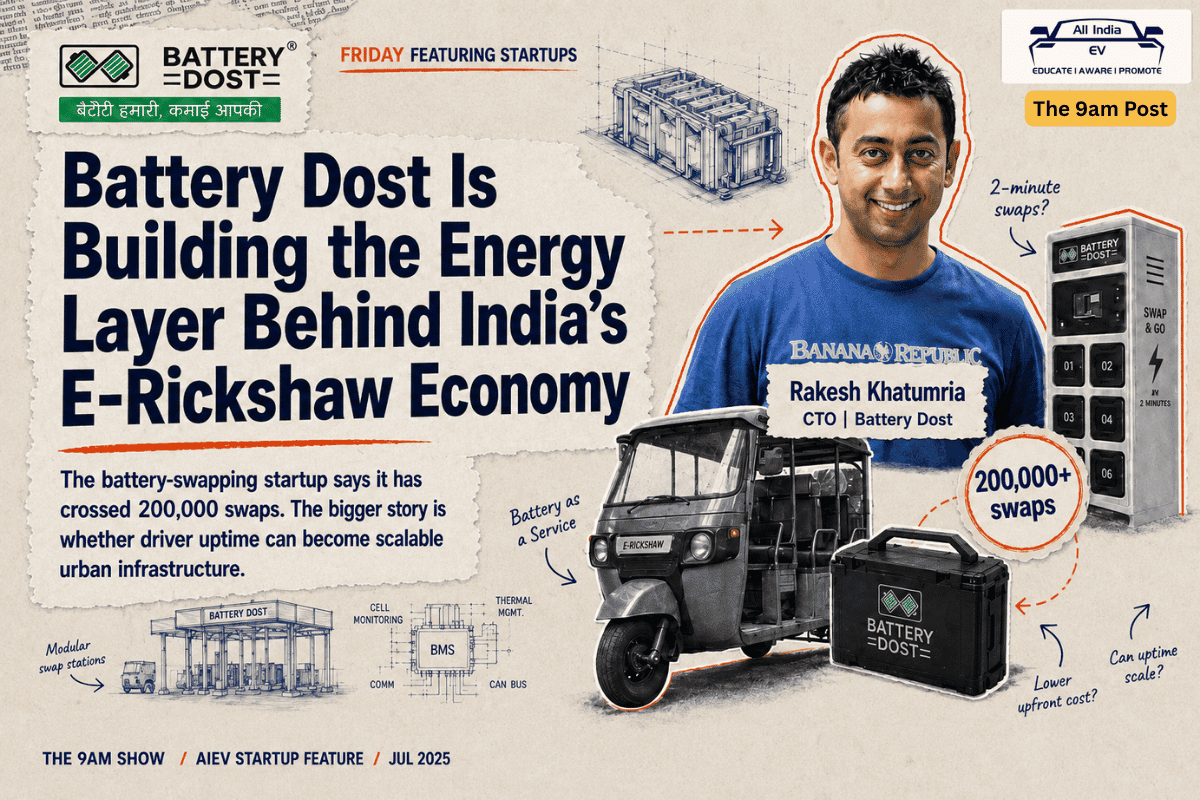
The Chandigarh-based startup has crossed 200,000 battery swaps. Its next test is proving that driver uptime can become a scalable and profitable infrastructure business.
Friday Featuring Startups | The 9AM Show
- The Chandigarh-based startup has crossed 200,000 battery swaps. Its next test is proving that driver uptime can become a scalable and profitable infrastructure business.
- The business is built around uptime, not batteries
- The market underneath Battery Dost is expanding rapidly
- The driver-level economics
- Battery Dost is becoming a software and operations company
- Why network density matters more than station count
- Policy is supporting the market, but interoperability remains unresolved
- The investment case
- The 9AM view
India’s electric three-wheeler transition has already moved beyond the early-adoption stage. The country registered 830,819 electric three-wheelers in FY2026, representing a 19% year-on-year increase. Electric models accounted for 61% of all three-wheelers sold during the year, up from 57% in FY2025.
Behind those vehicle sales, however, sits a less visible infrastructure problem. Commercial electric vehicles need reliable access to energy throughout the working day. For an e-rickshaw driver, a vehicle parked for charging is not merely inconvenient. It is an income-generating asset sitting idle.
Chandigarh-headquartered Battery Dost is attempting to solve that problem through a Battery-as-a-Service model. Instead of requiring drivers and fleet operators to purchase, charge and eventually replace their own batteries, the startup provides access to charged battery packs through a network of swapping stations.
The company says it has now completed more than 200,000 battery swaps and is operating in Chandigarh and Gurugram.
Battery Dost at a glance
200,000+ company-reported battery swaps
Under 2 minutes claimed swap time
Chandigarh and Gurugram currently live
₹1.5–₹2 per km estimated driver savings
Up to 90 km claimed driving range enabled by one swap
All operating and savings figures above are company-reported and have not been independently audited.
The business is built around uptime, not batteries
Battery Dost’s physical product includes battery packs, charging equipment and swapping stations. Its commercial product, however, is vehicle availability.
This distinction matters because commercial EV economics are fundamentally different from personal-mobility economics. A privately owned electric scooter can remain connected to a charger overnight without affecting the owner’s income. An e-rickshaw, delivery vehicle or cargo three-wheeler earns money only while it is moving.
Battery Dost claims that a discharged pack can be replaced with a charged battery in under two minutes, compared with the four to eight hours that the company estimates may be required for conventional e-rickshaw battery charging. The startup also claims that transferring battery ownership to the service provider can reduce the vehicle’s upfront cost by approximately 40% to 50%.
Charging versus swapping
| Operating factor | Battery swapping model | Self-charging model |
|---|---|---|
| Energy replenishment time | Under 2 minutes per swap | 4–8 hours, according to Battery Dost |
| Battery ownership | Swapping operator | Driver or vehicle owner |
| Battery maintenance | Managed by operator | Managed by driver |
| Degradation risk | Held by service provider | Held by vehicle owner |
| Payment structure | Recurring usage or subscription | Battery purchase plus electricity |
| Best suited for | High-utilisation commercial EVs | Vehicles with predictable idle time |
Source: Battery Dost. The comparison reflects the company’s operating assumptions and should not be interpreted as an independent total-cost-of-ownership study.
The model essentially moves the battery from the vehicle invoice to the swapping company’s balance sheet. This can reduce the amount financed by the driver while transferring the risks associated with degradation, maintenance and replacement to an operator with a larger pool of battery assets.
That transfer of risk may become one of the strongest arguments for Battery-as-a-Service. Most individual drivers cannot accurately assess battery state of health, remaining cycle life or future replacement value. A network operator can monitor thousands of packs, identify performance deterioration and redistribute or retire batteries based on actual usage data.
The market underneath Battery Dost is expanding rapidly
India’s electric three-wheeler market grew from 698,914 units in FY2025 to 830,819 units in FY2026. The category represented approximately 34% of all EV registrations in FY2026, making three-wheelers one of the largest components of India’s electric-mobility market.
| India electric three-wheeler market | FY2025 | FY2026 | Change |
| Electric 3W registrations | 698,914 | 830,819 | +19% |
| Electric share of total 3W sales | 57% | 61% | +4 percentage points |
| Share of total Indian EV sales | Not stated | 34% | — |
Source: Vahan registration data reported by Autocar Professional.
This expanding vehicle base increases the addressable market for charging, swapping, fleet energy management and battery financing companies. However, vehicle growth alone will not guarantee demand for Battery Dost. The company must build its network in locations where vehicles have sufficiently high daily utilisation and drivers cannot afford long charging windows.
Battery swapping is likely to be most economically attractive where three conditions exist:
- Vehicles travel long distances every day.
- The driver’s income is directly connected to vehicle availability.
- A dense concentration of compatible vehicles operates within a limited geography.
E-rickshaws, delivery fleets and urban cargo vehicles fit this profile more naturally than low-mileage personal vehicles. In these segments, the customer is not necessarily purchasing energy at the lowest possible electricity tariff. The customer is purchasing more working hours per vehicle.
The driver-level economics
Battery Dost says a driver purchasing a battery independently may spend approximately ₹50,000 to ₹60,000 upfront, along with ₹1,500 to ₹2,000 per month on electricity. It estimates that self-charging may keep a vehicle unavailable for four to six hours per day.
Under its swapping model, the company claims that drivers may save approximately ₹1.5 to ₹2 per kilometre compared with battery ownership and self-charging. For a driver covering 120 kilometres per day, Battery Dost estimates daily savings of ₹180 to ₹240, potentially exceeding ₹5,000 per month. It also says one battery swap can support up to 90 kilometres of driving.
Illustrative monthly saving claimed by Battery Dost
| Daily distance | Claimed saving per km | Estimated daily saving | 26-day monthly saving |
| 80 km | ₹1.5–₹2 | ₹120–₹160 | ₹3,120–₹4,160 |
| 100 km | ₹1.5–₹2 | ₹150–₹200 | ₹3,900–₹5,200 |
| 120 km | ₹1.5–₹2 | ₹180–₹240 | ₹4,680–₹6,240 |
These calculations illustrate the company’s claim rather than verified customer economics. The actual outcome will vary according to daily distance, battery subscription pricing, vehicle efficiency, route conditions, electricity tariffs, downtime and battery performance.
For All India EV, this distinction is important. A saving estimate is not the same as audited unit economics. The next level of validation would require anonymised data covering actual driver payments, kilometres travelled, swap frequency, battery availability and income before and after joining the network.
Battery Dost is becoming a software and operations company
A battery-swapping station can appear deceptively simple. A driver deposits a discharged battery, collects a charged one and returns to the road. The difficult part begins behind the cabinet.
A scalable operator must continuously manage:
- Battery state of charge and state of health
- Pack-level temperature and safety data
- Charging cycles and degradation
- Battery availability at each station
- Demand during peak operating hours
- Movement of packs between locations
- Driver payments and subscription reconciliation
- Preventive maintenance and end-of-life decisions
Battery Dost’s mobile application allows drivers to locate swapping stations and check battery availability. The company is also positioning its technology around battery-health prediction, demand routing and charging optimisation.
This is where the company could build a more defensible business. Physical cabinets, chargers and battery packs can be sourced or replicated. A dataset showing how thousands of batteries perform across real Indian commercial routes is significantly harder to reproduce.
Better operational data could help Battery Dost increase the number of swaps completed by each battery, reduce idle inventory and identify packs before they begin affecting driver experience. It could also support lenders and fleet owners by producing more reliable information on asset utilisation, degradation and residual value.
Why network density matters more than station count
Battery Dost’s public website currently contains more than one network figure. One section references “30 charging stations and counting,” while another mentions 15 stations in Chandigarh, each with approximately 40 batteries. Its LinkedIn communication confirms that Chandigarh and Gurugram are live and that further expansion will be demand-led.
This discrepancy does not necessarily indicate an operational problem, since the figures may refer to different dates or different types of sites. It does mean that the company should publish a clearer and consistently dated operating dashboard.
For a swapping company, station count by itself is an incomplete measure. A small, heavily utilised network may be financially stronger than a large network with low battery turnover.
The metrics that matter more include:
| Metric investors should track | Why it matters |
| Swaps per station per day | Measures station demand and asset productivity |
| Swaps per battery per day | Shows whether battery capital is being utilised |
| Charged-pack availability | Determines whether drivers can rely on the network |
| Average swap time | Measures operational efficiency |
| Battery degradation per cycle | Directly affects asset life and replacement cost |
| Driver retention rate | Indicates whether savings and reliability are real |
| Station-level break-even period | Reveals the capital required to enter a new city |
| Network uptime | Measures infrastructure reliability |
| Revenue per battery | Connects usage with battery investment |
| Customer acquisition cost | Shows whether expansion requires continuous incentives |
Battery Dost has shared cumulative swap figures, service-time claims and savings estimates, but it has not publicly disclosed most of these operating metrics. That is normal for an early-stage private company, although these numbers will become increasingly important as it raises capital and enters more cities.
Policy is supporting the market, but interoperability remains unresolved
The PM E-DRIVE scheme includes support for 39,034 registered e-rickshaws and e-carts, backed by ₹50 crore in central funding. The incentive window for registered e-rickshaws and e-carts has been extended until March 31, 2028, while incentives for the L5 electric three-wheeler category were closed in December 2025 after the programme achieved its target.
Government support can increase the number of electric vehicles entering commercial operations, indirectly expanding the customer pool for energy-service companies. But battery swapping still faces a structural challenge: India’s electric two- and three-wheeler ecosystem uses different battery formats, voltages, connectors and communication systems.
A tightly controlled battery architecture can improve safety and operating efficiency, but it may restrict compatibility with vehicles outside the network. Broader interoperability can expand the addressable market, although it also requires coordination among battery manufacturers, vehicle OEMs and infrastructure providers.
Battery Dost will eventually have to decide whether it wants to operate primarily as:
- A closed battery network serving selected vehicle platforms
- An interoperable swapping infrastructure provider
- A fleet-focused Battery-as-a-Service company
- A battery intelligence and operating-system platform
- Or a combination of these models
That strategic choice will determine the capital required, the number of compatible vehicles and the company’s ability to scale across cities.
The investment case
Battery Dost is entering a market with a large and expanding commercial EV base. Its reported 200,000 swaps indicate that drivers are repeatedly using the service rather than only experimenting with it. The company’s presence in Chandigarh and Gurugram also gives it an opportunity to test the model across two distinct urban markets.
What strengthens the case
- India’s electric three-wheeler market grew 19% in FY2026.
- Commercial drivers place a high economic value on vehicle uptime.
- Removing the battery can reduce the vehicle’s upfront financing requirement.
- Recurring swaps can create predictable revenue.
- Battery data can improve lifecycle management and asset utilisation.
- Dense networks may create local competitive advantages.
What could weaken the case
- Battery inventory makes the model capital-intensive.
- Low station utilisation can delay break-even.
- Incompatible battery formats can limit the customer base.
- Safety incidents could damage trust across the network.
- Rapid city expansion can reduce service consistency.
- Driver economics depend on pricing remaining competitive.
- The operator carries battery-degradation and replacement risk.
The opportunity is therefore significant, but it is not a simple hardware rollout. Battery Dost must finance batteries, predict demand, maintain station availability and recover its capital through repeated utilisation of every pack.
The 9AM view
Battery Dost should not be viewed merely as a company replacing one battery with another. It is attempting to build a distributed energy network for vehicles whose commercial value depends on continuous movement.
Its first 200,000 swaps provide evidence of user demand. The larger question is whether that demand can be converted into repeatable city-level economics.
For the company to move from a promising startup to credible infrastructure platform, it must demonstrate three things:
- Network density: Drivers should always have a station within a commercially reasonable distance.
- Battery productivity: Each pack must complete enough revenue-generating cycles to justify its cost.
- Expansion discipline: New cities must be selected through actual fleet demand rather than headline-driven station growth.
The most important milestone for Battery Dost is therefore not one million swaps in isolation. It is one million swaps delivered through a network that can show strong uptime, consistent driver retention and improving unit economics.
India has already demonstrated that electric three-wheelers can sell at scale. Battery Dost is betting that the next market will be built around what happens after those vehicles leave the dealership.
The vehicle may belong to the driver. The energy layer may belong to the network.