

All India EV – The 9am Show (Monday): India’s Used EV Market Has a Trust Problem, Not Demand
- Battery SoH is becoming the new odometer
- But the battery is only half the story
- ICE vehicles have an aftermarket. EVs still largely have an OEM ecosystem.
- The residual-value question is becoming critical
- Interestingly, demand appears to be arriving
- The next EV opportunity may be after the first owner
- All India EV Intelligence View
India’s electric vehicle market is slowly entering a phase the industry has not had to think seriously about until now: what happens when an EV changes hands?
For new EVs, the conversation has traditionally revolved around range, charging infrastructure, upfront cost and battery warranty. But as the first meaningful batch of premium EVs begins entering the pre-owned market, the questions are changing.
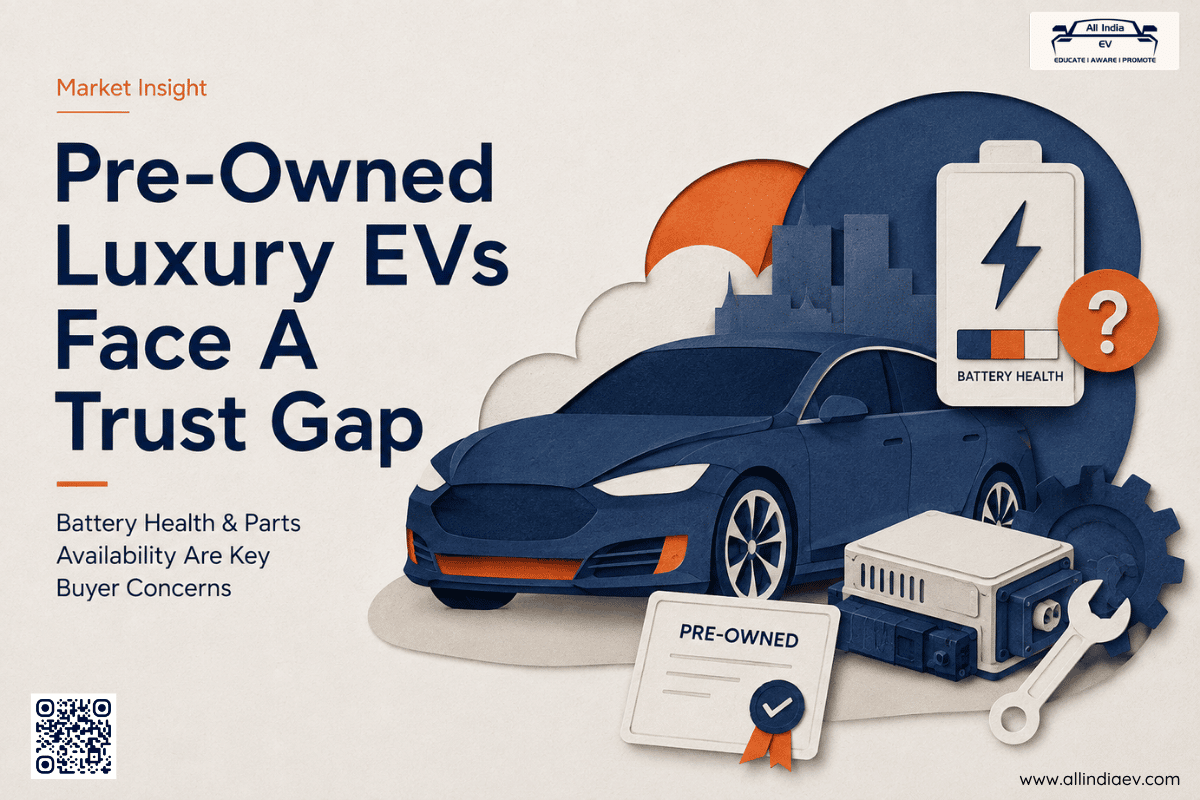
A recent observation from luxury pre-owned vehicle retailer Autobest Emperio offers an interesting signal. According to the company, 85–90% of luxury EV buyers and prospective buyers enquire about replacement-part availability, while virtually every prospective buyer asks about battery health.
At first glance, this appears to be an aftermarket issue.
It is actually a much bigger EV residual-value and ownership-confidence problem.
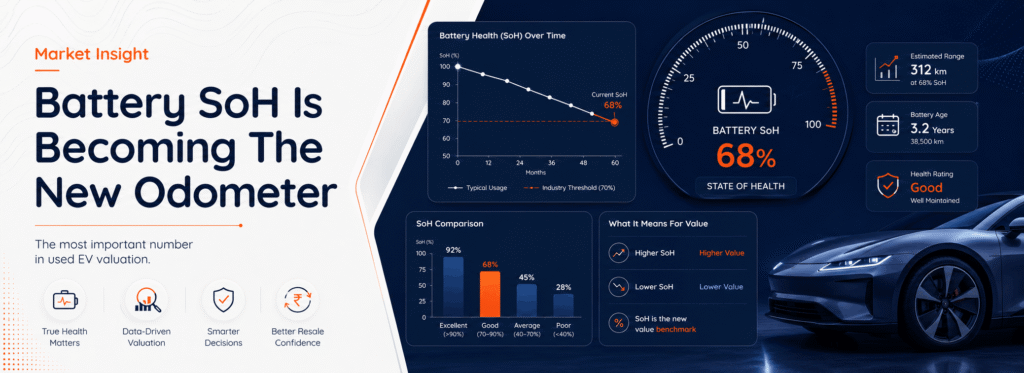
Battery SoH is becoming the new odometer
For an ICE vehicle, buyers have spent decades learning how to evaluate a used car.
Kilometres driven, service history, engine condition, accident record and ownership history provide reasonably familiar indicators of vehicle quality.
EVs change that equation.
A vehicle may have relatively low mileage and look mechanically excellent while its battery has experienced significantly different degradation depending on temperature exposure, charging behaviour, depth of discharge, fast-charging frequency and operating conditions.
That is why prospective buyers are increasingly asking about:
- Battery State of Health (SoH)
- Remaining battery warranty
- Previous charging behaviour
- Expected battery life
- Potential replacement costs
Autobest Emperio says battery condition remains the biggest potential dealbreaker for buyers considering pre-owned luxury EVs.
This creates an important market requirement.
Battery-health certification could eventually become as important to the used-EV market as an odometer reading is today.
Without reliable and standardised battery-health information, buyers are effectively pricing an asset whose most expensive component remains partly invisible.
But the battery is only half the story
Perhaps the more interesting finding is that customers are starting to look beyond the battery.
Major EV components being questioned include onboard chargers, inverters, electric motors, battery-management systems, high-voltage wiring harnesses and thermal-management systems. Premium vehicles add another layer through ADAS components, electronics and air-suspension systems.
The concern is not simply the price of replacing these components.
It is availability.
According to Autobest Emperio’s customer experience, some minor components can take around two to three weeks to source, while major EV-specific components such as modules, chargers and inverters can require four to 12 weeks, depending on sourcing and availability.
For a ₹10 lakh mass-market used vehicle, downtime is inconvenient.
For someone buying a premium or luxury vehicle potentially costing several tens of lakhs or more, an eight-week wait for a component fundamentally changes the ownership proposition.
And this is where India’s EV aftermarket starts revealing a structural gap.
ICE vehicles have an aftermarket. EVs still largely have an OEM ecosystem.
India’s luxury ICE market has developed over decades.
An older Mercedes-Benz, BMW or Audi owner does not necessarily remain completely dependent on the manufacturer’s authorised workshop. Cities such as Delhi, Mumbai, Bengaluru and Pune have independent workshops, specialist technicians, parts importers, refurbished-component suppliers and parallel aftermarket networks.
Luxury EVs do not yet have the same ecosystem.
High-voltage systems require specialised diagnostic equipment and trained technicians. Many electronic components remain closely integrated with OEM software. Replacement parts may need to move through manufacturer-controlled supply chains.
Consequently, ownership risk increases sharply once the original warranty starts disappearing.
This makes the remaining warranty on a pre-owned EV almost a financial instrument in itself.
Two otherwise identical used EVs could potentially command very different valuations depending on battery warranty, drivetrain coverage and documented battery health.
The residual-value question is becoming critical
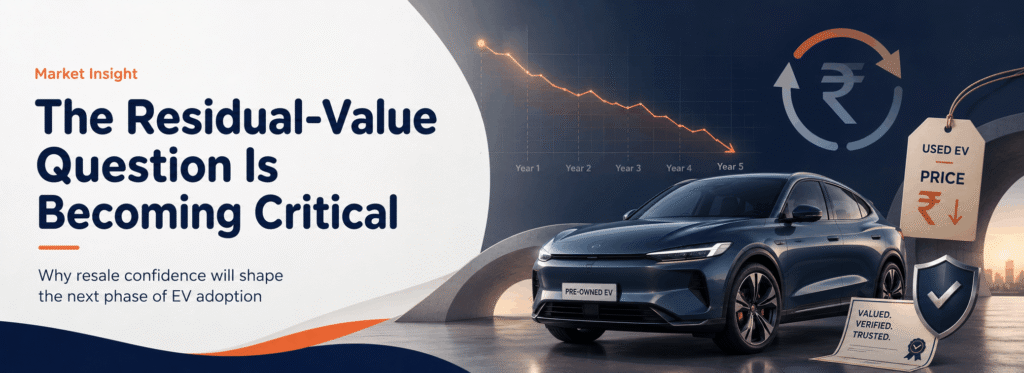
There is another layer underneath all of this: depreciation.
Rapid technology development is unusual for the traditional automobile industry.
A five-year-old ICE vehicle may have slightly lower fuel efficiency and fewer features than the latest model, but the fundamental powertrain technology has not dramatically changed.
EVs are evolving much faster.
Battery chemistry, energy density, charging speeds, thermal-management systems, vehicle efficiency and software architectures can improve significantly between product generations.
That makes predicting the future value of today’s EV considerably harder.
RMI identified precisely this challenge in its 2025 study on India’s EV residual-value market. It argued that greater clarity around the residual value of EVs and their batteries is important not only for consumers but also for financiers because lenders need to estimate how much value can be recovered from an EV in the event of default.
That connects the used-EV market directly with the financing market.
If lenders cannot confidently estimate whether a three-year-old EV will retain 35%, 45% or 55% of its original value, financing becomes more conservative.
Higher perceived residual-value risk can eventually translate into:
higher down payments → lower loan-to-value ratios → higher financing costs → weaker new-EV affordability.
Therefore, solving the used-EV problem could actually help solve part of the new-EV financing problem.
Interestingly, demand appears to be arriving
There are already indications that consumer interest in pre-owned EVs is increasing.
At the NDTV Fuel & Future Summit in July 2026, Big Boy Toyz COO Ritika Jatin Ahuja said enquiries for second-hand EVs had increased by around 40%, while buyers were increasingly seeking buyback assurances.
That number should be treated as a company-reported indicator rather than a nationwide used-EV market growth statistic.
But combined with the Autobest Emperio observations, an interesting pattern emerges.
Consumers are not necessarily rejecting used EVs.
They are asking the market to remove uncertainty.
The buyer wants to know:
How healthy is the battery?
How long is the warranty?
What happens if the inverter fails?
Can the component be sourced?
Who can repair it?
How long will the car remain off the road?
And what will this vehicle be worth three years later?
Those are signs of an asset class entering its second stage of maturity.
The next EV opportunity may be after the first owner
The industry has spent enormous capital building EV manufacturing, charging infrastructure and vehicle financing.
The next layer could emerge around the EV lifecycle economy.
That could include:
- Independent battery-health certification
- Standardised SoH reports
- Extended EV warranties
- Battery refurbishment
- Component remanufacturing
- Specialist EV workshops
- Independent high-voltage diagnostics
- Used-EV financing
- Guaranteed buyback programmes
- Battery residual-value analytics
- Digital vehicle and battery health records
This ecosystem will matter far beyond luxury cars.
Today’s premium EV market is simply reaching the problem earlier because higher vehicle values magnify the financial consequences of battery degradation, component failure and extended downtime.
Eventually, the same questions will reach mass-market electric cars, commercial EVs, electric two-wheelers and fleet vehicles.
All India EV Intelligence View
The important market signal here is not that 85–90% of customers are worried about spare parts. That data comes from one dealership’s enquiry experience and should not be extrapolated to the entire Indian market.
The important signal is what buyers are asking about.
India’s EV conversation is beginning to move from:
“Can I charge this vehicle?”
to:
“Can I confidently own, repair and resell this vehicle?”
That transition matters.
The winners in India’s next phase of EV adoption may therefore not only be companies producing better batteries or longer-range vehicles. They could also be the companies that make an ageing EV measurable, repairable, financeable and resellable.
Because once EVs start entering their second and third ownership cycles, the market will discover that the true value of an electric vehicle is determined not only when it leaves the showroom. It is also determined by how much confidence remains when the first owner hands over the keys.