
The Quick Update
What Happened:
China’s leading battery manufacturers, led by CATL, are accelerating the commercial rollout of sodium-ion batteries for electric vehicles and battery energy storage systems (BESS). The development is drawing attention in India, where companies are also exploring sodium-ion technology but remain in the early stages of commercialization.
The Key Number:
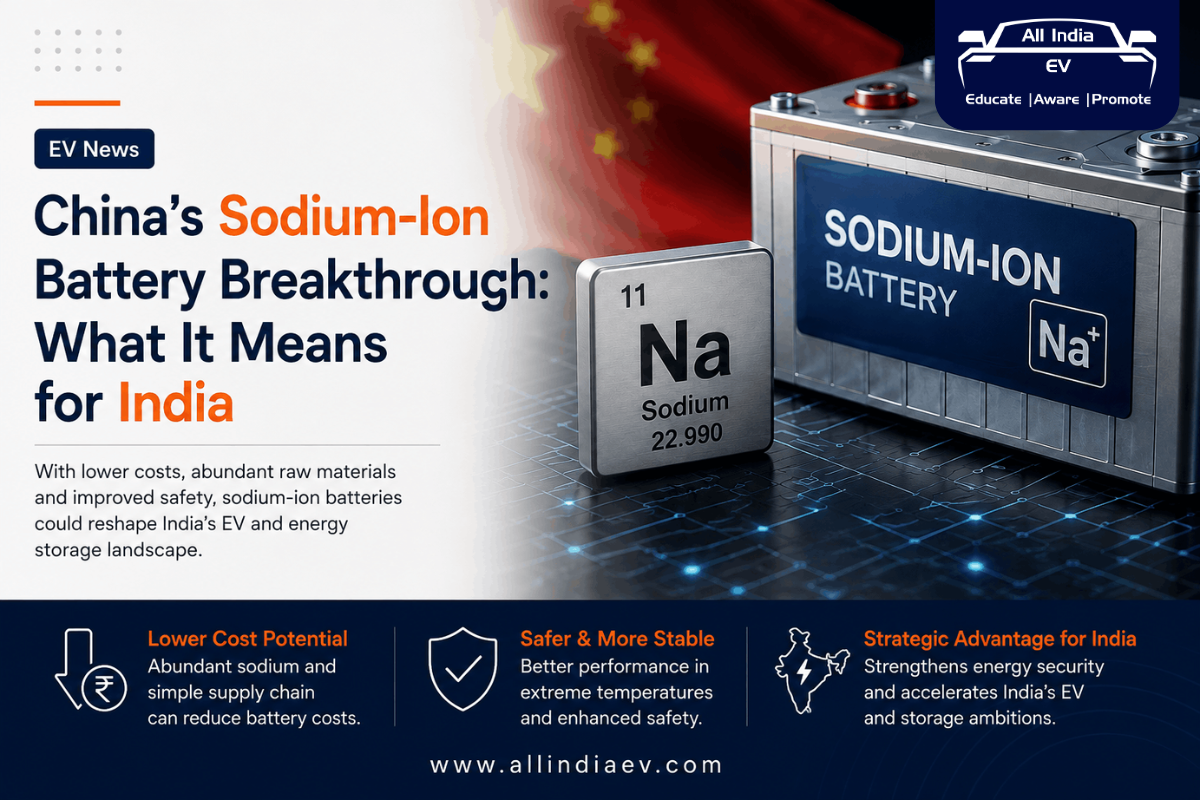
20–30% cheaper — Sodium-ion batteries could cost 20–30% less to manufacture than lithium-ion batteries once economies of scale are achieved, thanks to sodium’s abundance and lower raw material costs.
Why It Matters:
Sodium-ion technology has the potential to diversify battery supply chains, reduce dependence on lithium imports and lower battery costs for specific EV segments and energy storage applications. While it is unlikely to replace lithium-ion batteries entirely, it could become an important complementary chemistry.
The Core News
China’s sodium-ion batteries industry has entered a new commercialization phase, with battery giant CATL preparing to deploy the technology in electric vehicles and battery energy storage systems. Automakers such as Changan are also expected to introduce some of the first production EVs powered by sodium-ion batteries, marking one of the industry’s biggest transitions beyond conventional lithium-ion chemistry.
Growing interest in sodium-ion batteries stems from their lower material costs and greater resource availability. Sodium is significantly more abundant than lithium, making it an attractive alternative for reducing battery production costs and improving supply chain resilience. However, the technology currently delivers lower energy density, requiring larger battery packs to achieve comparable driving ranges. As a result, sodium-ion batteries are considered better suited for entry-level EVs, two- and three-wheelers, commercial vehicles and stationary energy storage than premium long-range passenger cars.
For India, the development represents both a challenge and an opportunity. Domestic companies, including Reliance Industries, KPIT Technologies, GODI Energy and INDI Energy, have announced sodium-ion initiatives, while the government’s ₹18,100-crore Production Linked Incentive (PLI) scheme for Advanced Chemistry Cells remains chemistry-agnostic. Yet commercial-scale manufacturing has largely remained focused on lithium-ion technology. China’s early commercialization could accelerate global adoption, encouraging Indian manufacturers to move faster in developing indigenous sodium-ion capabilities before the technology matures further.
Breaking Down the Update
- Commercial Rollout: CATL plans to commercialize sodium-ion batteries for EVs and battery energy storage systems during 2026.
- Cost Advantage: Sodium is estimated to be over 500 times more abundant than lithium, offering long-term raw material cost benefits.
- Lower Production Cost: Industry estimates suggest sodium-ion batteries could become 20–30% cheaper than lithium-ion batteries at scale.
- Indian Players: Reliance Industries, KPIT Technologies, GODI Energy and INDI Energy are investing in sodium-ion battery development.
- Government Support: India’s ACC PLI scheme allows sodium-ion battery manufacturers to qualify for incentives alongside lithium-ion projects.
- Best Applications: Analysts see the strongest near-term potential in battery energy storage systems, two-wheelers, three-wheelers, commercial vehicles and affordable EVs rather than premium passenger cars.
How sodium-ion batteries Will Help the Indian EV Market
The emergence of sodium-ion batteries could significantly strengthen India’s long-term electric mobility ecosystem by reducing dependence on imported lithium and diversifying battery technologies. Since sodium is widely available and considerably cheaper than lithium, domestic manufacturers could eventually produce more affordable battery packs, particularly for entry-level electric vehicles and commercial mobility applications.
For India’s fast-growing two-wheeler, three-wheeler and commercial vehicle segments, sodium-ion chemistry offers an attractive balance between cost, safety and durability. Although its lower energy density makes it less suitable for premium long-range passenger EVs, many urban mobility applications do not require extremely large battery packs. This creates an opportunity for Indian manufacturers to develop cost-effective products tailored to local market needs.
The technology also complements India’s renewable energy ambitions. Sodium-ion batteries offer strong potential for battery energy storage systems, helping utilities integrate larger volumes of solar and wind power while improving grid stability. Success in stationary storage could also accelerate domestic battery manufacturing capabilities, strengthening India’s broader clean energy supply chain.
With China’s commercialization gathering pace, India has an opportunity to build a competitive domestic ecosystem before global market leadership becomes firmly established. Timely investments in research, manufacturing and supply chains could enable Indian companies to secure an early position in what may become the battery industry’s next major growth segment.
Waay Forward ….
The sodium-ion batteries breakthrough signals that the global battery industry is entering a multi-chemistry era rather than relying solely on lithium-ion technology. While lithium-ion batteries will continue to dominate high-performance EVs, sodium-ion chemistry could reshape affordable electric mobility and large-scale energy storage. For India, the next phase will depend on translating ongoing research into commercial manufacturing, supported by policy incentives, industrial investment and rapid technology development to remain competitive in the evolving battery landscape.