

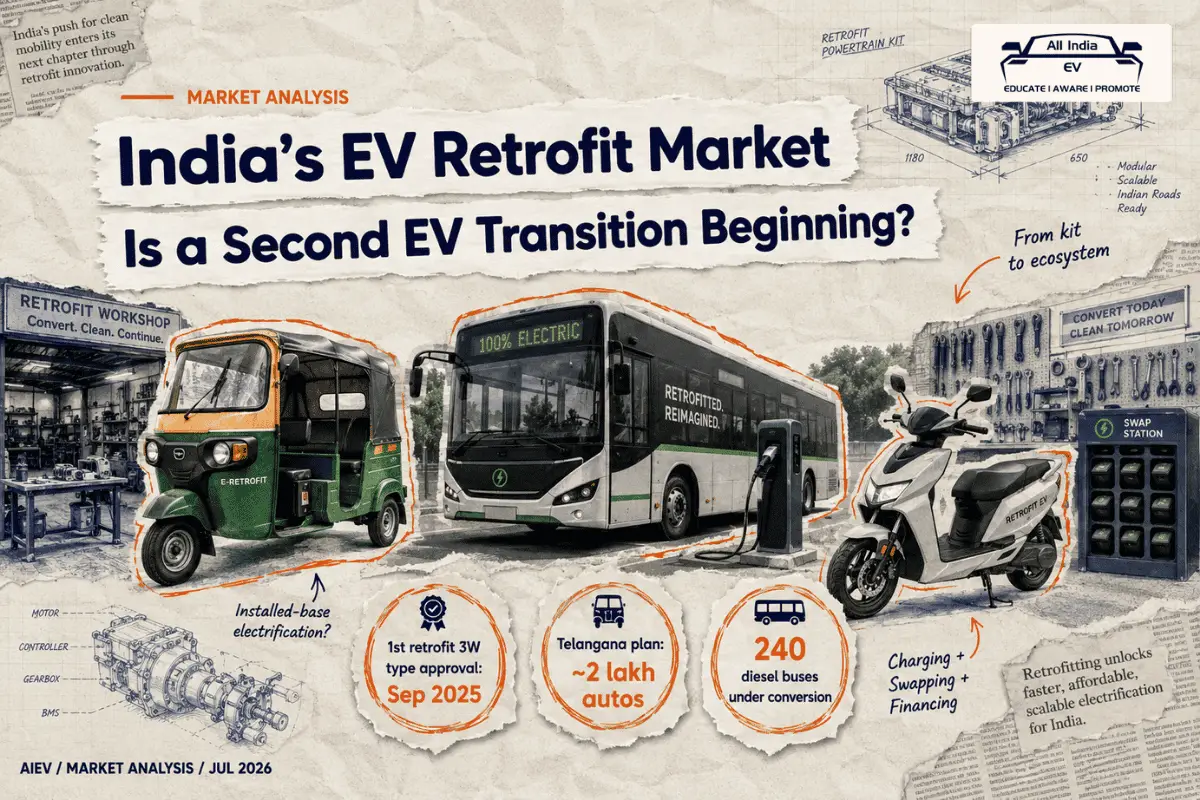
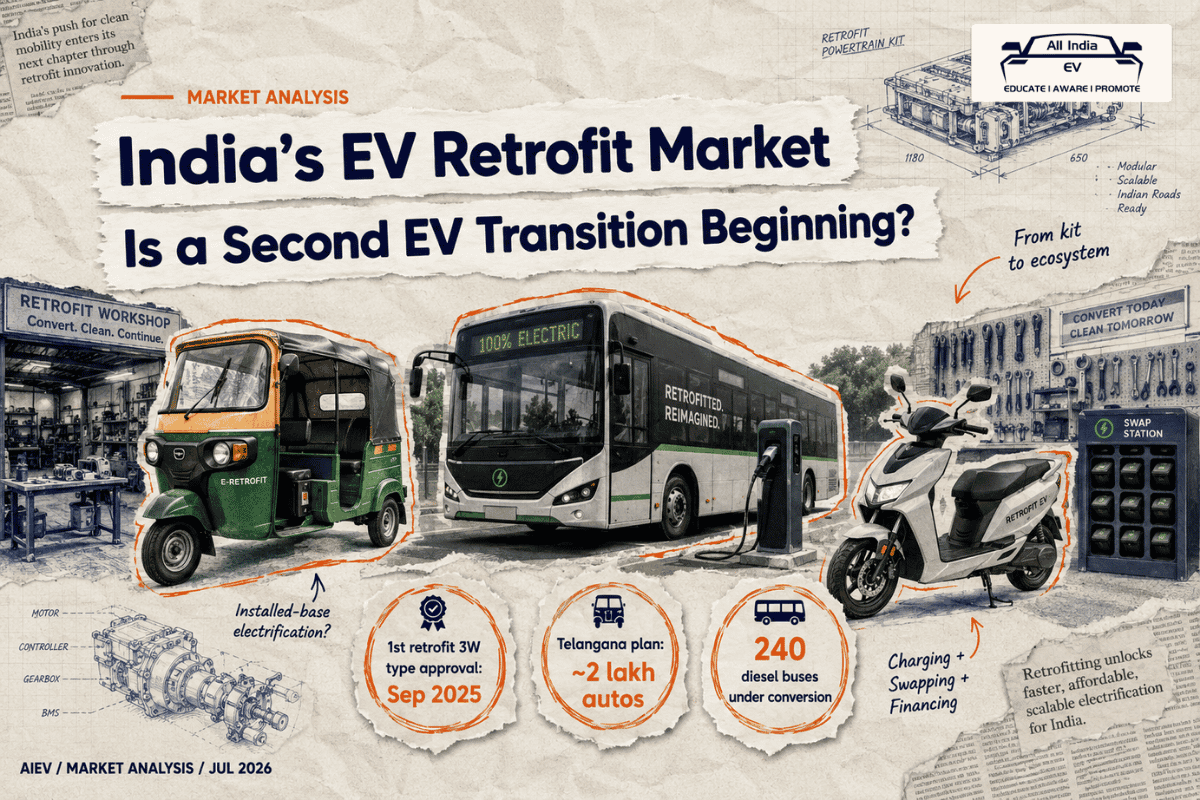
From Exponent and Green Tiger to Compage-Indofast, E-Vidyut and Telangana’s bus and auto programmes, a cluster of developments suggests India may be beginning to electrify its existing vehicle stock — not just replace it with new EVs.
- Start with the date that explains the cluster
- The cluster
- From “kit” to “ecosystem”
- The economics are strongest where vehicles work hardest
- Telangana has moved retrofit from procurement to policy
- Policy has already left breadcrumbs — but only breadcrumbs
- The national architecture still thinks in new vehicles
- A new layer of the industry — and one unanswered question
- The number nobody can produce
- So, is something happening?
For most of the past decade, India’s electric mobility transition has been measured through one primary number: new EV registrations.
How many electric two-wheelers were sold. How many electric three-wheelers entered the market. How many diesel buses were replaced by new electric buses.
But over the past several months, another route to electrification has begun appearing with unusual frequency. Instead of asking vehicle owners to replace an internal-combustion vehicle with a new electric one, companies are increasingly asking a different question:
What if we simply replace the powertrain?
Start with the date that explains the cluster
Retrofitting is not new in India. What is new is that the certification path finally opened.
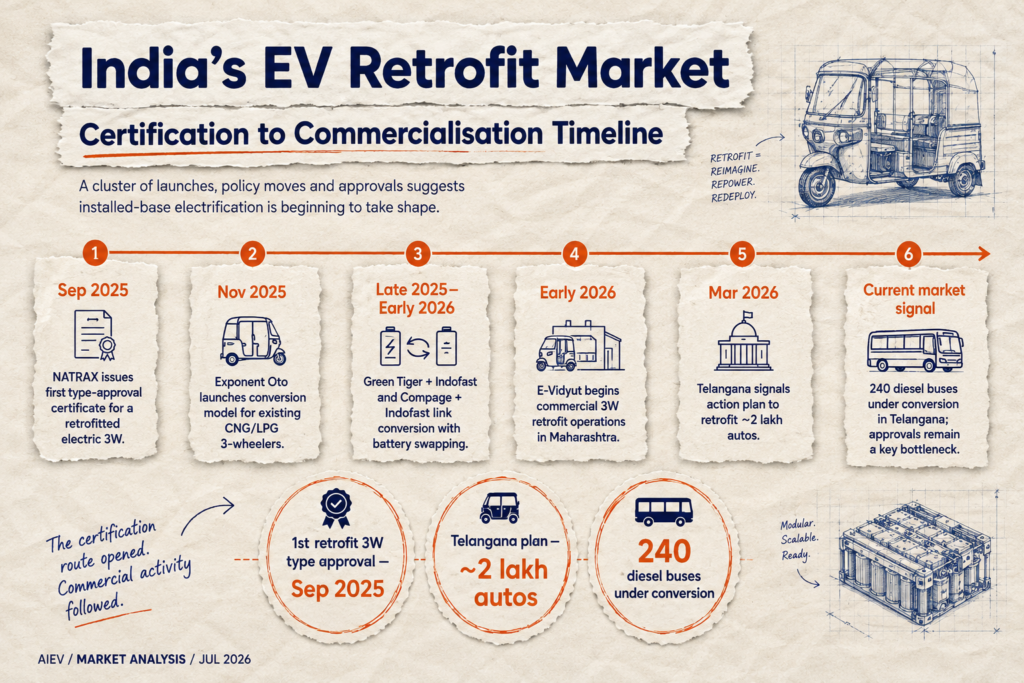
According to the Ministry of Heavy Industries’ 2025-26 annual report, NATRAX — one of the agencies notified under Rule 126 of the Central Motor Vehicles Rules, alongside ARAI, ICAT and VRDE — issued its first type-approval certificate for a retrofitted electric three-wheeler in September 2025.
That date matters more than any single product launch, because almost everything described below happened within a few months on either side of it.
For years, the binding constraint on Indian retrofit was never whether an electric motor could replace an engine. It was whether the resulting vehicle could be legally registered, insured and financed. Kits require type approval under AIS-123, installation must be carried out by an installer authorised by the kit manufacturer, and the RTO must endorse the change of propulsion on the registration certificate. AIS-123 also transfers responsibility for the retrofitted vehicle from the original OEM to the kit manufacturer — a liability shift the Indian market has not yet been tested on at scale.
When a certification route opens, commercial activity follows. That is roughly what the past nine months look like.
The cluster
Exponent Energy launched Exponent Oto in November 2025, converting existing CNG and LPG three-wheelers into EVs. The company pairs conversion with its own rapid-charging ecosystem, claiming a 15-minute full charge, a roughly 24-hour conversion, a 140-150 km real-world range and a five-year or 3,000-cycle warranty, at around ₹1.7 lakh. Exponent estimates operator savings of up to ₹5,000 per month depending on utilisation.
Green Tiger Mobility is attacking a different installed base — petrol scooters — supporting eleven of India’s highest-selling models across Honda, Hero, Suzuki, TVS and Yamaha, in both fixed-battery and swappable configurations, with RTO documentation handled as part of the package. Its partnership with Indofast Energy, a 50-50 joint venture between IndianOil and SUN Mobility, is the structurally interesting part: it begins separating vehicle conversion from energy ownership.
Compage Automation Systems has now launched a three-wheeler retrofit solution, again with Indofast, again combining conversion with swappable-battery access. Compage estimates that electrifying 100,000 three-wheelers running approximately 30,000 km annually could avoid around 1.5 million tonnes of CO₂ over five years — a company projection, not an independently verified lifecycle analysis.
E-Vidyut, backed by Pontaq, has begun commercial three-wheeler retrofit operations in Maharashtra, reporting 30 registrations on its first day and stating plans to expand into six more states within two years.
Commercial fleets are in the picture too, with retrofit work aimed at diesel logistics vehicles in the Delhi-NCR region.
Indofast now explicitly markets retrofit for existing two- and three-wheelers under a “Don’t Scrap. Go Electric” proposition.
One retrofit launch is a product story. Five companies entering four vehicle categories within three quarters, immediately after a certification milestone, is something else.
From “kit” to “ecosystem”
Replacing an engine with a motor and battery was never the hard part.
The owner still needs homologation, registration change, financing, battery warranty, charging or swapping access, servicing, insurance compatibility, and some confidence that the converted vehicle retains residual value.
That is why the recent developments matter more than earlier retrofit attempts. Exponent combines conversion with fast charging and warranty. Green Tiger combines it with RTO support and, through Indofast, battery swapping. Compage enters through another Indofast-linked platform. E-Vidyut is building a registration pipeline rather than selling kits over a counter.
The emerging product is no longer an EV conversion kit. It is becoming an asset-electrification stack — and that distinction is the whole story.
The economics are strongest where vehicles work hardest
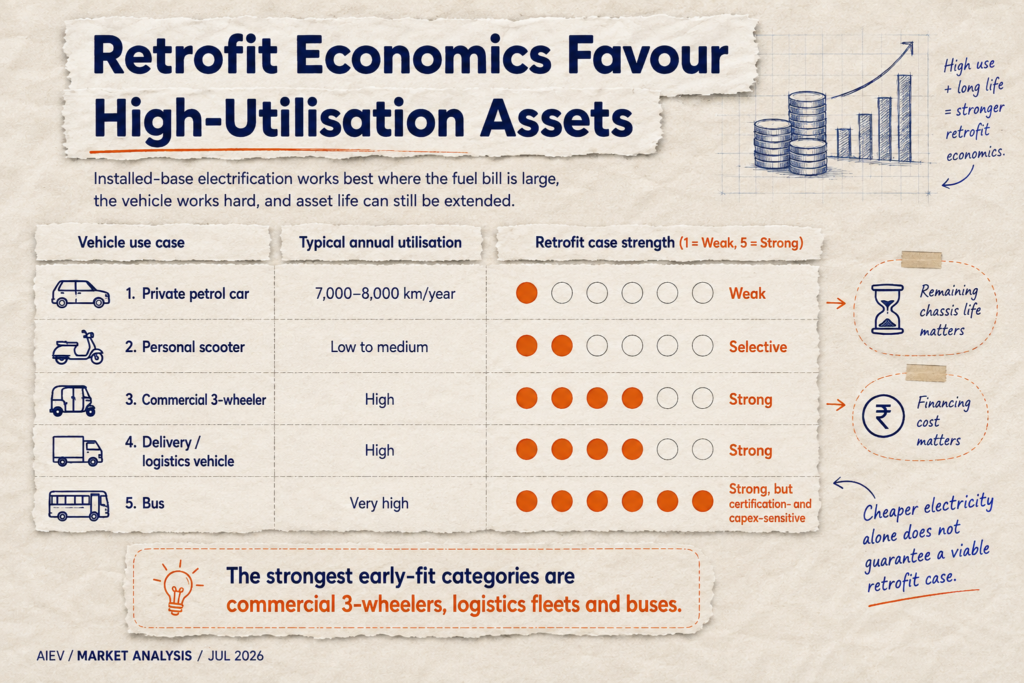
Retrofitting will not make sense for every ICE vehicle.
A privately owned petrol car doing 7,000-8,000 km a year presents a very different business case from a three-wheeler, delivery vehicle or bus running several hours daily. The higher the utilisation of the ICE asset, the larger the fuel bill electricity can displace.
That is why the most serious activity is emerging in commercial three-wheelers, logistics fleets and buses — and it explains why the most consequential development is not coming from a startup at all.
Telangana has moved retrofit from procurement to policy
The Telangana State Road Transport Corporation is converting 240 ageing diesel buses into electric buses — 200 awarded to Sai Green Mobility and 40 to Kalyani Powertrain, following tenders issued in September 2025 and an earlier converted-bus demonstration from the Musheerabad depot.
But the larger signal came in March 2026, when Chief Minister A. Revanth Reddy stated that an action plan to retrofit approximately two lakh diesel and other autos into electric vehicles would be introduced soon — alongside moving 2,800 diesel buses out of Hyderabad, with the stated aim of no diesel buses in the city by December 2026.
Two lakh three-wheelers is not a pilot. It is a state treating installed-base electrification as a policy instrument, in the same city where Exponent, Indofast and Compage are all commercially active.
The bus programme also shows exactly where the friction is.
Nearly a year after contracts were awarded, Telangana Today has reported that the conversion project is still awaiting submission and approval of a fresh prototype, which must then clear ARAI safety and performance testing — pushing deployment into next year, with a target of roughly 30 buses a month once approvals land. TGSRTC officials have maintained there is no delay and the process is on course.
Cost has been debated too. The Times of India has reported retrofit-kit costs of roughly ₹65-70 lakh per bus, along with concerns about battery weight on ageing bus structures. Those figures are specific to this procurement and should not be generalised across the retrofit industry — but they illustrate why retrofit economics cannot be assumed to work simply because electricity is cheaper than diesel.
Vehicle condition matters. Remaining chassis life matters. Battery weight matters. Financing cost matters. Certification timelines matter most of all.
In some cases retrofit unlocks several additional productive years from an existing asset. In others, a purpose-built EV is the better financial and engineering decision. That is precisely why retrofit is likely to become a sophisticated fleet-management judgement rather than merely a cheaper way to buy an EV.
Policy has already left breadcrumbs — but only breadcrumbs
Indian EV policy is not starting from zero on retrofitting.
CEEW’s state policy matrix shows several states incorporated retrofit support: Assam included a 15% retrofitment incentive for eligible electric three-wheelers, Rajasthan a 15% retrofit incentive across specified three-wheeler, four-wheeler and e-bus categories, Chandigarh retrofit incentives for eligible categories, and Tamil Nadu a retrofit incentive of ₹10,000 per kWh for specified categories.
An important caveat: these were introduced between 2021 and 2023, and incentive windows do not remain open indefinitely. Tamil Nadu’s stated period for covered categories extended only to 31 December 2025. These are evidence that states have recognised retrofit as a policy tool — not a claim that every listed subsidy is live in August 2026.
Delhi offers the longest-running precedent. In 2021, it allowed diesel vehicles over ten years old to continue operating and bypass the National Green Tribunal age ban if fitted with an electric kit — the first serious Indian use of retrofit as a regulatory instrument rather than a subsidy. Its Transport Department maintains an official retro-fitment framework listing approved kit manufacturers and vendors. Its draft EV Policy 2.0 reportedly proposes ₹50,000 per vehicle for petrol and diesel car conversions — capped at the first 1,000 vehicles, and still pending Cabinet approval.
That cap is the tell. It is a pilot budget, not a market instrument.
The national architecture still thinks in new vehicles
Here the story becomes more interesting.
India’s central EV incentive architecture remains substantially oriented toward deploying new electric vehicles. Telangana’s experience illustrates the gap: reporting indicates the state’s proposed Hybrid Gross Cost Contract model — under which TGSRTC would retain operations and maintenance rather than fully outsourcing — did not comply with PM E-DRIVE’s standard GCC structure administered through CESL, and so did not qualify for central support. The state’s retrofit proposal sat alongside that same funding conversation, while 2,000 new electric buses were sanctioned for Hyderabad under the scheme without difficulty.
So an unusual situation is developing:
- Certification infrastructure has begun to accommodate retrofit.
- Companies have begun to commercialise it.
- Several state policies already recognise it.
- At least one state is now proposing it at two-lakh-vehicle scale.
- But the national subsidy architecture remains predominantly replacement-oriented.
That disconnect deserves attention, because India’s EV transition does not happen only in showrooms. There is an enormous installed base sitting entirely outside the annual new-vehicle market.
A new layer of the industry — and one unanswered question
If retrofit scales, the winners may not look like traditional vehicle OEMs.
Battery-swapping and charging operators gain a second source of attached demand — one that skips the OEM, the dealer and the new-asset financing entirely. This is why Indofast appears in two of the launches above and why Exponent’s conversion is inseparable from its own charging network.
Financiers would need an entirely new product: lending against the remaining useful life and post-conversion cash flows of a commercial vehicle, rather than against a new asset with a known depreciation curve.
And then the question nobody can currently answer:
What is a five-year-old ICE vehicle worth after receiving a new electric drivetrain and battery pack?
That residual-value market barely exists today. Until it does, retrofit financing stays expensive, and expensive financing caps volumes regardless of how good the technology gets.
The number nobody can produce
There is one more structural problem this sector has to confront.
A retrofit is recorded as an alteration to an existing registration — a propulsion change endorsed on an existing RC — not as a new registration. It therefore never enters the VAHAN new-registration series that this industry uses to measure everything else.
Every other EV segment in India can be tracked monthly. Retrofit cannot. That is why the proxies below are not optional — they are the only instruments available.
So, is something happening?
Probably yes. But calling it a retrofit boom would be premature.
What appears to be happening is market formation. The most important signal is not the number of kits launched. It is the number of surrounding pieces appearing at once: homologation, battery swapping, fast charging, fleet contracts, warranties, RTO integration, public procurement and state-level policy recognition.
Over the next 12 to 24 months, the numbers worth watching are therefore not retrofit announcements. They are:
- Homologated kit platforms — type approvals on record, per category, per company.
- Authorised installer networks — the bottleneck is certified hands, not kits.
- Financed conversions — the first lender to build a product here defines the market.
- Fleet-scale orders, and repeat orders — one operator converting 200 vehicles and then converting 200 more is worth more than any launch event.
- Kilometres accumulated post-conversion — the only real proof of durability.
- RTO alteration data — if states publish propulsion-change endorsements, this segment becomes measurable overnight.
If those numbers begin moving together, retrofitting stops being a small corner of India’s EV industry and becomes a second pathway to electrification.
India’s first EV transition has been a new-vehicle transition. The emerging opportunity is installed-base electrification — and in a country with hundreds of millions of existing vehicles, that would make the real transition substantially larger than new-EV sales numbers alone suggest.
India’s next electric vehicle does not necessarily have to roll out of a new-vehicle assembly line. Some of them may roll out of a conversion workshop.
All India EV distinguishes between company claims and verified data. Emissions estimates, range figures, cost savings and per-unit retrofit costs cited here are as stated by the companies, corporations or publications concerned and have not been independently verified. Policy positions and incentive windows are as of the drafting date and are subject to change.
Follow us on 𝐈𝐧𝐬𝐭𝐚𝐠𝐫𝐚𝐦: https://lnkd.in/gv3WizBK
Follow us on 𝐘𝐨𝐮𝐓𝐮𝐛𝐞: https://lnkd.in/g6XgiqNA
Join our 𝐖𝐡𝐚𝐭𝐬𝐀𝐩𝐩 community: https://lnkd.in/gq-a2q5b