

The 9am Show by All India EV
- 1. Bengaluru’s tax didn’t work the way a tax is supposed to work
- 2. A 10,000-charger number that matters less than what it enables
- 3. Fleet electrification is becoming an uptime business, not a scooter business
- 4. Recycling is becoming a materials-security question, not a waste-management one
- 5. Manufacturing competitiveness is being built into the factory, not added later
- 6. Tata is choosing a direction, not hedging one
- 7. The charging story with no charger in it
- The pattern underneath the news
For four years, the central question in India’s EV market has been simple: can the country create enough demand for electric vehicles?
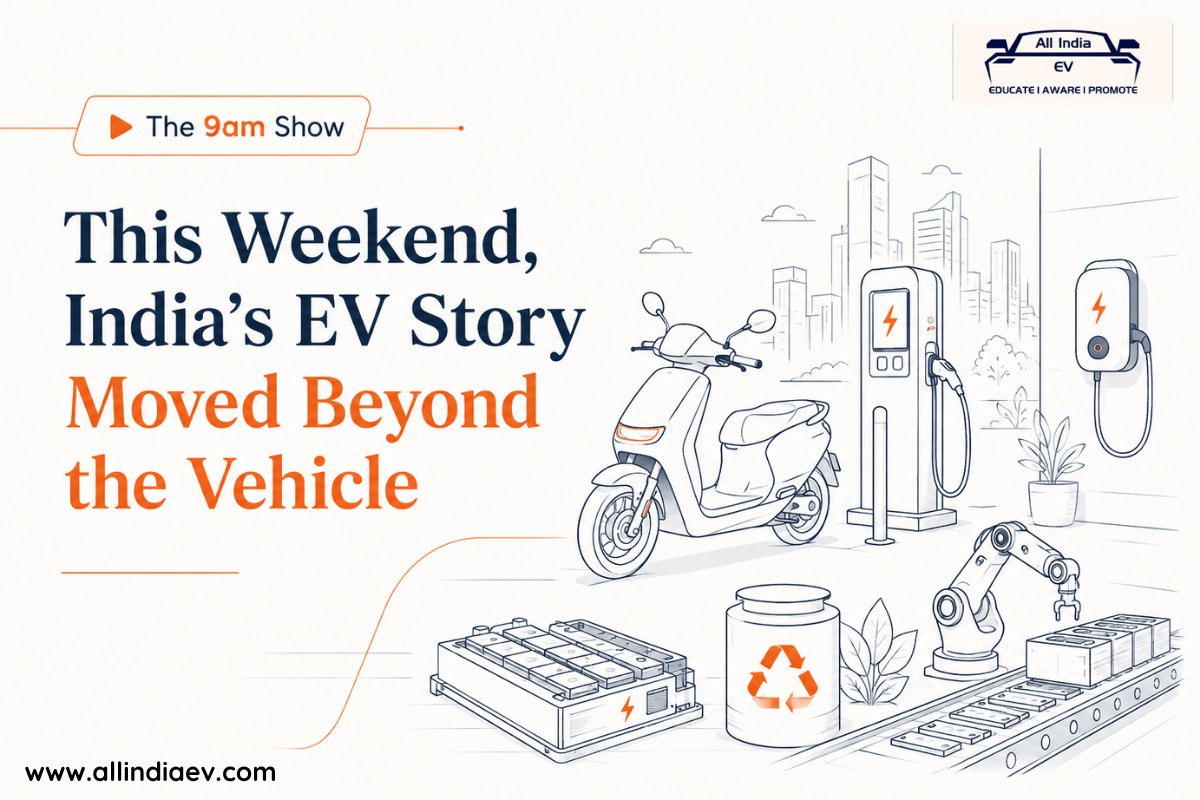
This weekend’s developments suggest that question is no longer the interesting one.
The more urgent question is whether the infrastructure surrounding those vehicles — charging networks, home electrical systems, battery supply chains, factory floors — can scale fast enough to avoid becoming the constraint.
Seven separate developments, read together, make the case.
1. Bengaluru’s tax didn’t work the way a tax is supposed to work
Karnataka introduced a lifetime road tax on electric cars from April 1:
- 5% on EVs priced up to ₹10 lakh
- 8% on EVs between ₹10–25 lakh
- 10% on EVs above ₹25 lakh
The expectation, implicit in any tax, is that demand softens. It didn’t.
Bengaluru registered more than 77,000 battery-electric vehicles between January and the first week of August — already closing in on the 80,033 pure EVs registered in all of 2025.
The explanation isn’t that Bengaluru shrugged off the tax. It’s that the tax barely touched the part of the market doing the work.
More than 70% of the city’s EV adoption comes from electric bikes and scooters, which remain exempt from road tax and continue to beat petrol two-wheelers on running cost.
The real lesson: demand responds unevenly to policy. Where operating economics are already decisive — daily-commute two-wheelers — removing one incentive layer doesn’t reverse the trend.
Bengaluru’s actual constraint is quietly shifting toward apartment charging permissions and electrical infrastructure, not vehicle taxation.
2. A 10,000-charger number that matters less than what it enables
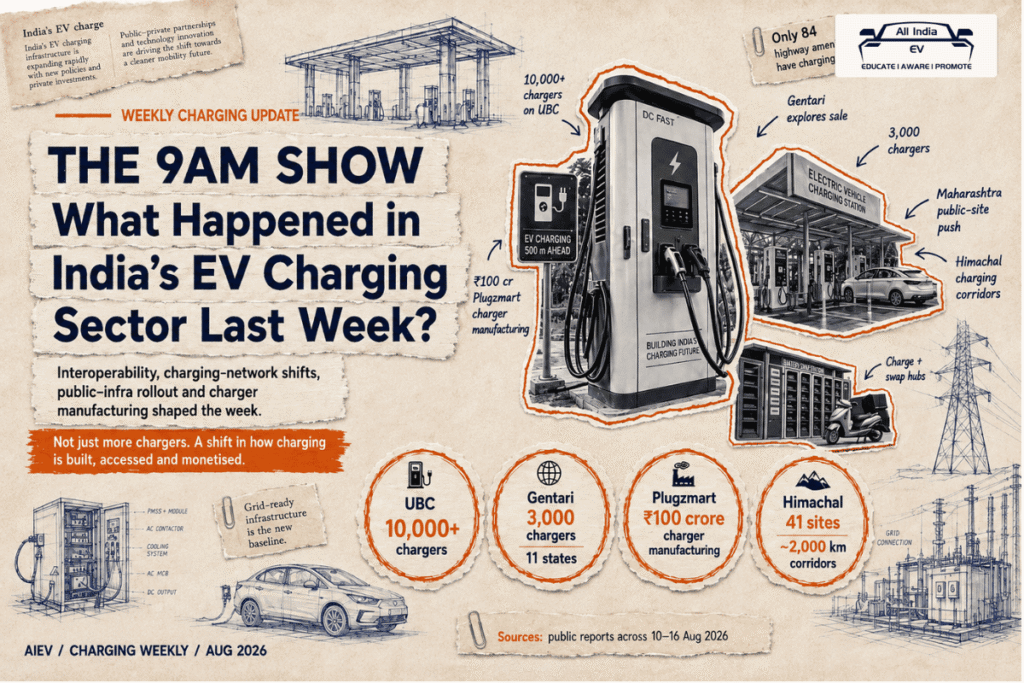
Pulse Energy has become one of the first certified technology enablers for Unified Bharat eCharge (UBC), connecting more than 10,000 chargers across 100+ charge point operators to the network.
Users can now:
- Discover chargers through BHIM
- Pay via UPI
- Skip separate wallets across networks
This is consistent with the Ministry of Heavy Industries’ stated intent for UBC as a common discovery-and-payment layer.
But the charger count isn’t the story.
The story is what happens to a business model built on vertical integration — charger → backend → app → wallet → customer relationship — once discovery and payment become shared public infrastructure.
If that layer separates from the hardware layer, the competitive question for charging companies changes:
- Old question: “How many users downloaded our app?”
- New question: “How reliable is our infrastructure, where are our chargers, and what utilisation and margin can those physical assets generate?”
That’s a healthier question for the sector — and a more uncomfortable one for operators whose edge depended on software lock-in rather than asset performance.
3. Fleet electrification is becoming an uptime business, not a scooter business
EMO Energy and e-Sprinto plan to deploy 8,000 electric scooters this financial year for quick-commerce and last-mile operations, combining:
- e-Sprinto’s vehicle platforms
- EMO’s liquid-cooled ZenPac batteries
- EMO’s charging infrastructure and battery-intelligence stack
The underlying Q1 operating numbers are more telling than the deployment target:
- 93.69 million km covered
- 18.74 million deliveries enabled
- 2,810.7 MWh of energy supplied
- Fleet grew from ~15,800 vehicles in April to 19,000+ by June
This isn’t a vehicle-sales story. It’s a systems story.
For a delivery operator, battery chemistry, thermal management, charging access, predictive maintenance and energy utilisation all collapse into one number that matters: productive kilometres delivered per asset per day.
The companies worth watching in fleet EV are increasingly the ones selling uptime as a managed system — not the ones selling hardware.
4. Recycling is becoming a materials-security question, not a waste-management one
MiniMines Cleantech secured an Indian patent for its Hybrid Hydrometallurgy (HHMR) process, which recovers from end-of-life lithium-ion batteries:
- Lithium, cobalt, manganese, aluminium, copper, nickel
- Spherical graphite at purities of up to 99%
The company has also received ₹4.3 crore in grants from Oil India following process validation, and has an existing collaboration with Maruti Suzuki on battery recycling.
India’s recycling conversation has largely been framed around processing capacity in tonnes. That framing understates what matters.
The real questions:
- How much of each critical material is actually recovered?
- At what purity?
- At what cost?
- Can it genuinely re-enter battery-grade supply chains?
Given how much upstream material India still imports, recycling done at sufficient recovery efficiency stops being a waste-management category and starts becoming part of the country’s critical-material security architecture.
5. Manufacturing competitiveness is being built into the factory, not added later
JSW Greentech is deploying Dassault Systèmes’ DELMIA Apriso manufacturing execution system at its upcoming 90-acre electric bus and truck plant in Chhatrapati Sambhajinagar, integrating production execution, quality control and material traceability from day one.
The relevant detail is sequencing: JSW is building this digital layer into the factory before scaling production — not retrofitting it onto an operation already running.
As India’s EV manufacturing base scales, competitiveness will increasingly be decided by things a buyer never sees:
- Battery traceability
- Component genealogy
- Quality data
- Yield
- Supplier integration
A meaningful share of this battle will be fought quietly on factory floors, where better data compounds into fewer defects, faster ramp-ups and more predictable unit economics.
6. Tata is choosing a direction, not hedging one
Tata Motors Passenger Vehicles CEO Shailesh Chandra reaffirmed the company’s EV-first strategy, while keeping hybrid technology as an option should market conditions eventually demand it.
The numbers support the conviction:
- Electric PVs now exceed 8% of India’s passenger-vehicle market
- Tata projects roughly 10% penetration by end of FY27
- Tata sold more than 34,000 EVs in Q1 FY27 — its highest quarterly volume
- EV share rose from 19% of Q1 PV sales to 24% in July
- Monthly production climbed from ~9,000 to 15,000+ units
This creates a genuine strategic split in the industry.
Several manufacturers still treat hybrids as a necessary bridge between ICE and full electrification. Tata’s position is closer to: the bridge may exist, but we intend to keep walking toward the other side regardless.
Tightening CAFE regulations, which reward fleet-level emissions reductions, only strengthen that bet. The real test arrives as competition intensifies and buyers get more powertrain choices, not fewer.
7. The charging story with no charger in it
An Autocar Professional column by Kazam co-founder and CEO Akshay Shekhar argues that 60–80% of an EV user’s charging in India happens at home.
Yet the math is tight:
- Typical Indian household sanctioned load: below 4 kW
- AC charging load: ~3.3 kW for two-wheelers, up to 7.4 kW for four-wheelers
- Home charging cost: ~₹8/kWh
- Public charging cost: ~₹25/kWh
India has spent considerable energy counting public chargers. It may be time to start counting EV-ready parking spaces instead.
The next real constraint is unlikely to be the absence of another highway fast charger. It’s more likely to be:
- Inadequate sanctioned loads
- Poor earthing
- Apartment-society approvals
- Distribution-transformer limits
- Residential buildings never designed for dozens of vehicles charging at once
Public charging earns the headlines. Home charging will likely decide the pace of mass adoption.
The pattern underneath the news
Taken individually, these are seven unrelated items — a tax, a payments network, a fleet deal, a patent, a manufacturing system, an OEM strategy call, a trade column.
Taken together, they describe a market that has stopped asking whether Indians will buy EVs and started confronting what it takes to support the ones they’ve already bought:
- Charging networks need to interoperate
- Homes need to become electrically ready
- Factories need to become digitally traceable
- Battery materials need to circulate back into the economy
- Fleet vehicles need to produce dependable kilometres, not just exist
- Manufacturers need to commit real capital to a powertrain bet rather than hedge indefinitely
The first phase of India’s EV transition was about proving demand exists.
The second, harder phase — the one now underway — is about whether the systems around that demand can scale without becoming the bottleneck.
That is where the next set of winners in this market will most likely be decided.