

All India EV Intelligence | Capital & Manufacturing Desk
- Exide lithium-ion cell plant investment: the headline number
- Lens One: Capital — Exide’s EESL investment is a programme, not a headline
- Lens Two: Supply — what Exide’s Bengaluru gigafactory has actually built
- Lens Three: Demand — OEM homologation, not capacity, gates Exide’s revenue
- Lens Four: Policy & Positioning — China localisation gap and the competitive clock
- India’s lithium-ion battery market case is not in question — Exide’s unit economics are
- The All India EV Intelligence View
Exide’s latest infusion into its battery subsidiary is not a funding story anymore. It is a signal that the Bengaluru project has moved from “how much money is going in” to “how much commercial output is coming out.” That is a different, and much less forgiving, question.
Exide lithium-ion cell plant investment: the headline number
On August 18, 2026, Exide Industries put roughly ₹200 crore more into its wholly owned lithium-ion subsidiary, Exide Energy Solutions Limited (EESL), through a rights issue. That takes Exide’s cumulative equity investment in EESL to approximately ₹5,102.23 crore. EESL stays 100% owned by the parent.
Taken on its own, this reads like one more large Indian industrial group backing an EV battery bet. That framing misses the more consequential shift underway: Exide is not building a lithium-ion strategy anymore. It is trying to convert a multi-thousand-crore factory into a commercially operating cell business, and that is a fundamentally harder problem than raising and deploying capital.
Lens One: Capital — Exide’s EESL investment is a programme, not a headline
The ₹200 crore did not appear out of nowhere. On January 30, 2026, Exide’s board cleared an additional envelope of up to ₹1,400 crore for EESL, to be released in tranches as the Bengaluru project moved through commissioning toward commercialisation.
Disclosed deployment since then:
| Date | Fresh investment | Cumulative in EESL |
|---|---|---|
| 28 Jan 2026 | ₹50 crore | ₹4,252.23 crore |
| 24 Feb 2026 | ₹100 crore | ₹4,352.23 crore |
| 25 Mar 2026 | ₹450 crore | ₹4,802.23 crore |
| 15 Jul 2026 | ₹99.99 crore | ₹4,902.23 crore |
| 18 Aug 2026 | ~₹200 crore | ₹5,102.23 crore |
Excluding the January 28 tranche, which preceded the fresh approval, roughly ₹850 crore of the ₹1,400 crore envelope has already gone in — about 61% used, leaving close to ₹550 crore still available if Exide draws down the full amount.
The pace matters more than the total. Capital is no longer funding civil construction. It is funding commissioning, customer validation, production stabilisation, and the run-up to commercial ramp. That is not the same category of spend as a plant being built; it is the category of spend that precedes a plant being sold into.
Not “Exide is still building” but “Exide is now paying to prove what it built actually works at scale.”
One caution belongs here: ₹5,102.23 crore is the cumulative investment in EESL as a corporate entity, not the cost of the Bengaluru gigafactory alone. EESL also carries Exide’s existing lithium-ion module and pack business at Prantij, Gujarat, folded in through the 2024 amalgamation of Exide Energy Private Limited, plus working capital and opex funding. The two numbers should not be used interchangeably in any investor note.
Lens Two: Supply — what Exide’s Bengaluru gigafactory has actually built
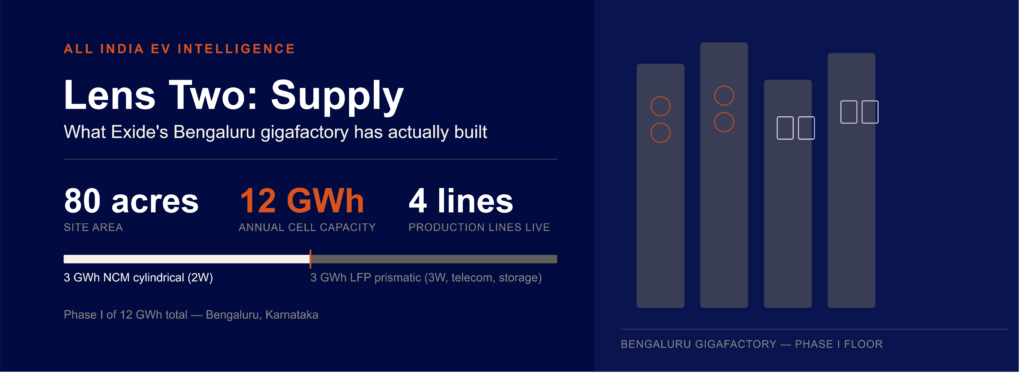
For the Bengaluru project specifically, ICRA’s estimate is the more useful figure: Phase I cost of around ₹5,600 crore, up from an earlier estimate of ₹5,200 crore — roughly a 7.7% cost escalation. ICRA puts incurred project expenditure at around ₹4,800 crore by the end of FY26, with the balance expected through FY27, part of it debt-funded.
The physical asset: an 80-acre facility designed for 12 GWh of annual cell capacity, planned across two 6 GWh phases. Phase I splits roughly into:
- 3 GWh NCM cylindrical capacity, aimed at electric two-wheelers
- 3 GWh LFP prismatic capacity, aimed at three-wheelers, telecom, and stationary storage
Per Exide’s latest investor presentation, all four production lines across Phase I are operationalised. NCM cylindrical samples have been dispatched; LFP prismatic samples have gone out for three-wheeler and telecom applications. Several cell-level certifications are complete.
This is not “under construction” anymore. Cells are coming off the lines. The open question is whether they come off consistently, at the yield, quality, and cost that make them sellable at scale rather than sample-grade.
Timeline discipline, tracked by AIEV Intelligence’s Claims Ledger:
| Source | Date of claim | Commercialisation expectation |
|---|---|---|
| ICRA | Nov 2024 | End of FY25 / early FY26 |
| Exide FY25 Annual Report | FY25 | During FY26 |
| ICRA | Jun 2026 | September 2026 (flagged as delayed vs. earlier view) |
| Exide management, AGM | Jul 2026 | Revenue contribution from Q3 FY27 |
Four successive timeline references, each pushed further right. This is not, by itself, evidence of a troubled project — cell plants genuinely need commissioning, trials, yield optimisation, certification, and customer homologation before serial production is real. But a pattern of slippage is a pattern, and AIEV Intelligence will keep this table live rather than take the latest date as final.
Not “the plant is delayed” but “construction is largely done; commercial execution is still unproven — and the proof keeps arriving later than guided.”
Lens Three: Demand — OEM homologation, not capacity, gates Exide’s revenue
EESL booked ₹157.56 crore turnover in FY26 against a ₹248.16 crore loss after tax, with net worth of approximately ₹3,991 crore. Read correctly, this is not a verdict on the gigafactory — Bengaluru had not entered meaningful commercial production during FY26, and EESL’s current revenue is dominated by the existing module-and-pack business. The real financial test starts in FY27.
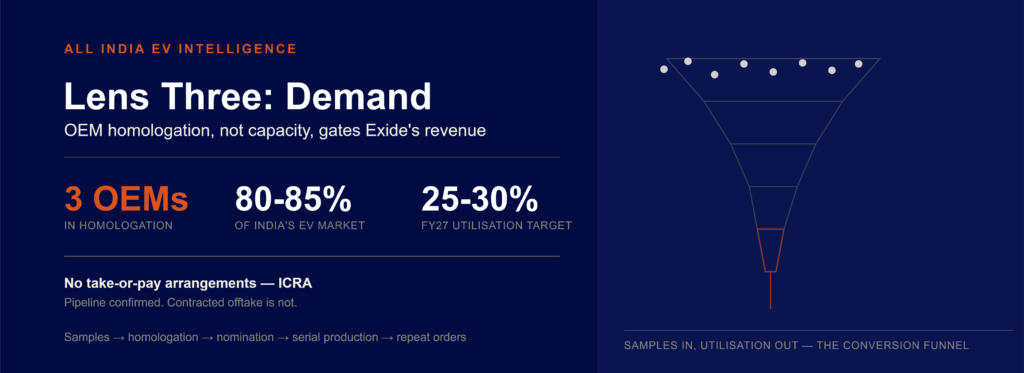
Management is guiding to 25-30% utilisation of the 6 GWh Phase I facility during FY27, achievable, in their framing, through partial utilisation of two operating lines. That utilisation number, not the ₹200 crore infusion, is the figure that should anchor any investor model, because it converts installed capacity into actual revenue.
On the customer side, Exide said during its Q1 FY27 earnings call that it is in homologation with three OEMs representing roughly 80-85% of India’s EV market, while acknowledging it will not capture 100% of their volumes and may operate as one of several suppliers initially. That is a real pipeline. It is not contracted offtake.
Claims Ledger flag: ICRA has explicitly noted that EESL currently holds no take-or-pay arrangements with customers. That single fact reframes the entire commercial story. A gigafactory can be mechanically complete and still economically underused if demand conversion lags. AIEV Intelligence will track this chain as the real scoreboard, not capacity announcements:
samples → homologation → nomination → serial production → repeat orders → utilisation.
Until each link is confirmed, announced capacity and productive capacity remain two different numbers.
One demand pocket worth isolating: management estimates 70-75% of the three-wheeler lithium-ion opportunity it is targeting is aftermarket, largely lead-acid replacement in e-rickshaws. That is a segment where Exide’s existing dealer and distribution network is a genuine structural advantage over a greenfield cell company that has cells but no channel.
Not “Exide has secured its customers” but “Exide has secured conversations with the customers that matter — conversion is still to be proven.”
Lens Four: Policy & Positioning — China localisation gap and the competitive clock
Two structural caveats sit underneath the operational story.
China dependency has not gone away. Exide has acknowledged that initial production still leans significantly on Chinese-linked supply chains — electrolyte, for instance, is being imported through technology partner SVOLT’s established channel, alongside other key materials. The stated target is 50-60% bill-of-materials localisation within two to three years. That splits Exide’s localisation story into two distinct stages: manufacturing the cell in India (largely underway now) and manufacturing the cell from materials made in India (a considerably longer runway). Coverage and investor notes should not collapse these into one “Made in India” claim.
The competitive window is closing, not open-ended. Ola Electric is already producing its 4680-format Bharat Cell against a 5 GWh target. Amara Raja is building toward 16 GWh in Telangana and has commissioned its Customer Qualification Plant, targeting initial commercialisation in 2027. Tata’s Agratas is developing a 20 GWh facility in Sanand. If Exide reaches serial production within FY27, it banks a real early-mover position ahead of several larger projects. If it slips further, that advantage erodes on its own timeline, independent of anything Exide does.
Not “Exide is racing to build capacity” but “Exide is racing to convert existing capacity into revenue before rivals bring their own capacity online.”
India’s lithium-ion battery market case is not in question — Exide’s unit economics are
Exide sizes India’s current lithium-ion battery demand at more than 20 GWh, with a potential rise to 140-150 GWh by 2030 across EV and stationary storage, of which EVs would represent roughly 60-70%. Even by Exide’s own account, domestic cell capacity remains inadequate against this demand, which is why OEMs still lean heavily on imports.
That demand case is not the risk. The risk is manufacturing economics against a Chinese supply base that already has mature upstream materials, scale, and aggressive pricing. Building cells domestically does not, on its own, produce competitive cost. Yield, utilisation, localisation progress, and energy efficiency will decide whether Bengaluru becomes a strategic asset or an expensive piece of stranded industrial infrastructure.
The All India EV Intelligence View
The ₹200 crore should not be read as a fresh strategic headline. It is capital required to carry an already heavily built asset across the commercialisation line.
From 2022 to 2026, the operative question was whether Exide would actually build a large-scale battery-cell factory. The physical evidence now answers that.
The questions that matter from here are harder, and AIEV Intelligence will track each explicitly rather than let the ₹5,100 crore figure stand in for progress:
- Can Exide stabilise manufacturing yields at commercial scale?
- How fast do OEM samples convert into homologated, nominated programmes?
- Does FY27 utilisation actually land in the guided 25-30% range?
- When does cell revenue become meaningful relative to ₹5,100+ crore already deployed?
- Does China-linked material dependency actually decline on the stated two-to-three-year localisation timeline?
- What margins can Indian-made cells sustain once they are priced against imported alternatives?
The number that will matter next is not ₹5,200 crore or ₹5,500 crore of further investment. It is the first meaningful GWh of commercially sold, homologated, repeat-ordered cells. That is where the thesis gets tested, not in the capital infusion column.
FAQ: Exide’s lithium-ion cell plant
How much has Exide invested in its lithium-ion battery plant? Exide Industries’ cumulative equity investment in Exide Energy Solutions Limited (EESL) stands at approximately ₹5,102.23 crore as of August 18, 2026. ICRA separately estimates the Bengaluru gigafactory’s Phase I project cost at around ₹5,600 crore.
Where is Exide’s lithium-ion cell plant located? The Bengaluru gigafactory sits on approximately 80 acres and is designed for 12 GWh of annual cell capacity across two 6 GWh phases. EESL also operates an existing module-and-pack facility at Prantij, Gujarat.
When will Exide’s lithium-ion plant start generating revenue? Exide management has guided to revenue contribution from the Bengaluru facility starting Q3 FY27, with a target of 25-30% utilisation of the 6 GWh Phase I capacity during the year.
What battery chemistries does Exide’s Bengaluru plant produce? Phase I splits into roughly 3 GWh of NCM cylindrical cell capacity for electric two-wheelers and 3 GWh of LFP prismatic capacity for three-wheelers, telecom, and stationary storage.
How does Exide’s cell capacity compare to Ola Electric, Amara Raja, and Agratas? Ola Electric is producing its 4680-format Bharat Cell toward a 5 GWh target. Amara Raja is building 16 GWh in Telangana, targeting 2027 commercialisation. Tata’s Agratas is developing 20 GWh in Sanand. Exide’s Phase I is 6 GWh, scaling to 12 GWh.