

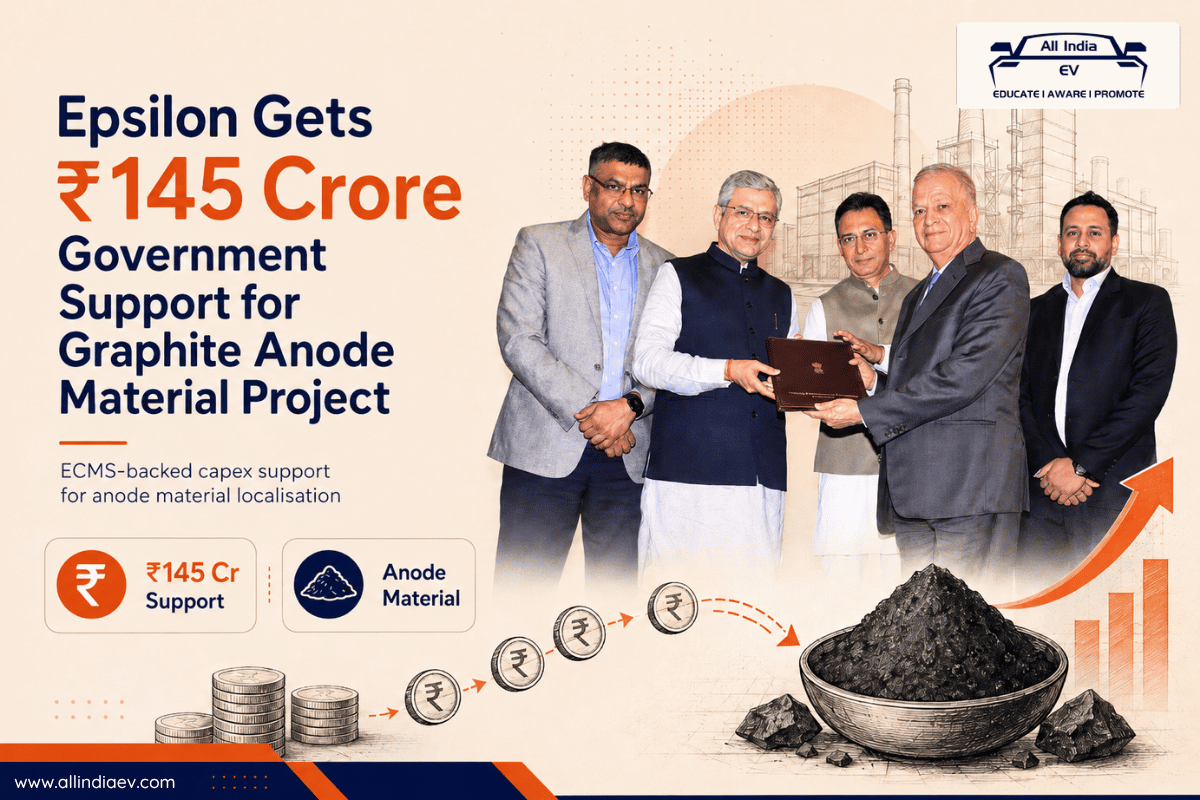
Epsilon Advanced Materials has secured ₹145 crore in capital expenditure support from the Ministry of Electronics and Information Technology for its graphite anode material manufacturing project, strengthening India’s push to localise critical lithium-ion battery materials.
The company’s Epsilon C2GR anode material project has been approved under the Electronics Components Manufacturing Scheme, or ECMS. The incentive represents 25% of the project’s planned capital investment, according to the company. Epsilon is also the only company approved for anode material manufacturing in the latest tranche of ECMS approvals.
Graphite anode material is one of the critical components of a lithium-ion cell and is used across electric vehicles, battery energy storage systems and consumer electronics.
For India’s battery ecosystem, this means localisation is beginning to move beyond assembling battery packs and cells towards manufacturing the materials that go inside those cells.
Epsilon Targets 30,000 Tonnes by 2028
Epsilon plans to scale its graphite anode material production capacity to 30,000 tonnes per annum by 2028, before eventually expanding towards 100,000 tonnes in a second phase.
The company has already commissioned its EAM-ONE customer qualification facility at Vijayanagar, Karnataka, where graphite anode materials can be tested and qualified by potential customers.
Epsilon has also reported securing its first mass-manufacturing order for synthetic graphite active anode material from a cell manufacturer for mobility applications.
The latest government support should therefore help Epsilon bridge the gap between qualification-scale production and larger commercial manufacturing.
Why Anode Localisation Matters for India’s EV Industry
India is simultaneously attracting investment into battery-cell manufacturing from companies including Exide, Amara Raja and several ACC PLI participants.
But establishing gigawatt-hours of cell capacity does not automatically create an independent domestic battery supply chain.
Cell factories still require cathode materials, anode materials, separators, electrolytes and other specialised components. Graphite is particularly important because it remains the dominant commercial anode material used in lithium-ion batteries.
Developing domestic anode manufacturing can therefore reduce import exposure while increasing the amount of value created inside India’s battery ecosystem.
The broader ECMS programme has now approved 106 projects across 30 product categories, representing proposed investment of ₹69,548 crore, according to MeitY.
For Epsilon, the ₹145 crore support is relatively small compared with India’s multi-gigawatt battery-cell investments, but its strategic importance is different.
India’s battery localisation story cannot stop at manufacturing the cell.
If the country wants a genuinely domestic battery value chain, the next battle is increasingly about who manufactures the materials that make those cells possible.
Explore the EV Investment & Funding