

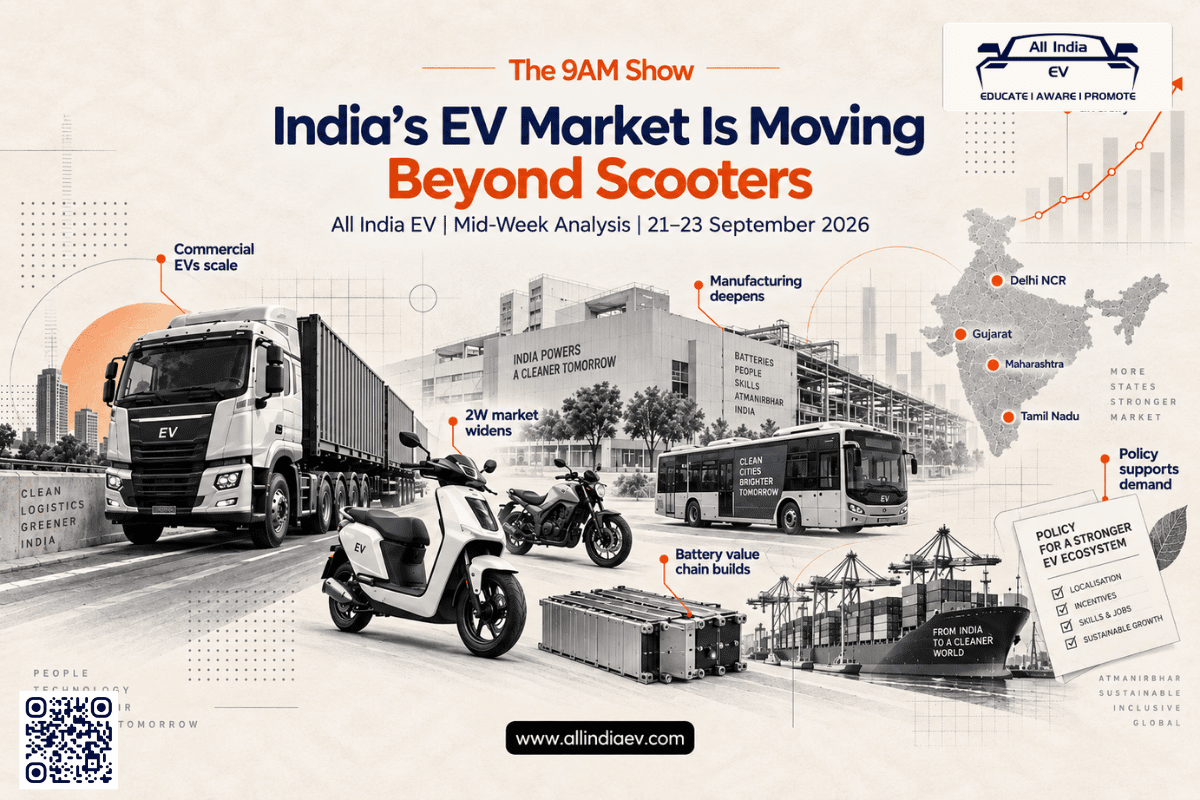
If the first half of this week tells us anything about India’s EV market, it is this: the industry is becoming much broader than electric two-wheelers and charging networks.
- 🚛 Commercial EVs are becoming a much bigger part of the story
- Capital is beginning to follow different EV business models
- Batteries are turning into an industrial opportunity of their own
- Retrofitting is quietly becoming worth watching
- Electric mobility is becoming embedded in public transport
- The electric two-wheeler market is still expanding — but the story is changing
- Manufacturing capacity is spreading beyond incumbent OEMs
- And EV penetration continues to move upward
- What This Means
Between 21 and 23 September, some of the most important developments came from heavy electric trucks, battery materials, new manufacturing capacity, fleet financing, electric buses, retrofits and fresh institutional capital.
Individually, these announcements may look unrelated.
Together, they show an EV industry beginning to build deeper layers of the value chain.
🚛 Commercial EVs are becoming a much bigger part of the story
The strongest signal came from the commercial vehicle segment.
JSW Greentech launched AMPSTAR, its dedicated electric commercial vehicle brand, with plans spanning electric trucks and buses.
The group is backing the business with an initial investment of around ₹2,500 crore and has laid out an ambition to build capacity towards 100,000 commercial EVs annually by 2030.
The important point isn’t simply that another company has entered electric trucks. It is who is entering.
JSW brings manufacturing scale, industrial customers, capital and access to large captive logistics requirements. That makes commercial EVs increasingly interesting not just as vehicles, but as an extension of industrial infrastructure.
At the same time, Montra Electric is targeting roughly $1 billion in annual revenue by 2030, with heavy electric trucks expected to play a major role.
Its 250-truck Rhino deployment with Wonder Cement is also moving the discussion away from pilot fleets and towards commercial utilisation.
The Indian electric truck market is therefore slowly moving through three stages:
prototype → controlled fleet deployment → commercial scale.
The third stage is where the economics will really be tested.
Capital is beginning to follow different EV business models
This week also delivered two very different funding signals.
Premium electric motorcycle maker Ultraviolette raised $85 million in Series E funding, led by Yali Capital and TDK Ventures. That capital will support manufacturing, new products and international expansion.
At almost the opposite end of the EV business model sits Drivn Transition, which raised ₹45 crore from Avaana Capital.
Drivn isn’t trying to become another vehicle brand. Its opportunity sits around commercial EV leasing and fleet electrification.
That distinction matters. India’s EV capital story is beginning to diversify. Investors are no longer looking only at the next electric scooter company.
Capital is increasingly flowing into businesses built around:
- premium EV technology,
- commercial fleet ownership,
- battery technology,
- manufacturing,
- energy systems,
- and specialised mobility platforms.
The next phase of Indian EV investment may therefore create far more specialised companies than the first phase did.
Batteries are turning into an industrial opportunity of their own
Another major theme this week came from batteries.
Maxvolt began work on a ₹700 crore battery manufacturing facility in Aligarh, planned across two 5 GWh phases. If executed as proposed, the project could eventually represent around 10 GWh of annual capacity.
But battery manufacturing isn’t only about assembling cells into packs. PCBL Chemical’s move into conductive carbon and silicon-based anode materials points towards the next layer of the opportunity.
India has spent years discussing battery localisation. The more interesting question now is becoming:
How much of the battery value chain can actually be built domestically?
Cells are one part. Cathodes, anodes, conductive additives, separators, BMS, thermal systems, pack manufacturing and recycling together form a much larger industrial ecosystem.
This week’s developments suggest companies are beginning to attack that value chain piece by piece.
Retrofitting is quietly becoming worth watching
One of the less glamorous but potentially important stories came from Exponent Energy. The company has now completed around 200 ICE-to-electric autorickshaw retrofits in Bengaluru, with those vehicles collectively covering approximately 1.5 million kilometres.
More importantly, Exponent is targeting around 40,000 retrofits over the next two years and plans to expand the model into markets including Delhi-NCR, Chennai and Hyderabad.
India has millions of existing commercial three-wheelers. Replacing every one with a completely new EV is expensive. Retrofitting potentially creates another pathway.
But its success will depend on three things:
conversion economics, reliability and financing.
If those pieces work, retrofits could open an entirely different EV market rather than merely competing with new electric three-wheelers.
Electric mobility is becoming embedded in public transport
Public transport electrification also continued moving forward.
Delhi announced plans for another 150 electric buses, while authorities around the UP International Trade Show planned approximately 500 electric buses for visitor transportation.
Meanwhile, Prasanna Purple outlined an expansion strategy that could take its electric bus fleet substantially higher over the next few years.
The bigger shift here is structural. Electric buses are increasingly moving from isolated demonstration fleets into regular procurement and operating plans. Once that happens, the discussion changes.
Instead of asking whether electric buses work, fleet operators start asking: What routes work best? What utilisation is needed? What financing structure makes sense? How quickly can fleets scale?
Those are much healthier questions for an industry approaching commercial maturity.
The electric two-wheeler market is still expanding — but the story is changing
Two-wheelers haven’t disappeared from this week’s headlines.
Honda announced pricing for the QC3 electric scooter at ₹1.35 lakh, with a 3 kWh battery and 145 km claimed IDC range.
Ather, meanwhile, signed partnerships with four institutions around Chhatrapati Sambhajinagar to develop talent for EV and advanced manufacturing. Ather also established a Hong Kong subsidiary, pointing towards deeper procurement and supply-chain integration in Asia.
And BikeWo Green Tech said it is targeting an operating fleet of around 10,000 EVs in FY27.
But something interesting is happening. Electric two-wheelers remain India’s biggest EV market by volume, yet the industry’s centre of gravity is widening.
The conversation is moving from: Who sells the most scooters?
to: Who controls technology, manufacturing, fleet economics, supply chains and capital?
Manufacturing capacity is spreading beyond incumbent OEMs
Manufacturing announcements this week also came from smaller companies.
Creatara Mobility opened its first manufacturing facility in Faridabad, with reported capacity of approximately 30,000 electric two-wheelers per year.
Meanwhile, Hindustan Motors approached the West Bengal government regarding EV manufacturing at Uttarpara, potentially involving a foreign partner.
These projects are at very different stages and scales. But they reinforce a broader pattern. India’s EV manufacturing map is expanding beyond traditional automotive clusters.
Tamil Nadu, Karnataka and Maharashtra remain major centres, but EV-related investments are increasingly appearing across Uttar Pradesh, Haryana, West Bengal and other states.
That competition between states could become increasingly important as EV manufacturing deepens.
And EV penetration continues to move upward
Perhaps the most useful number this week came from broader vehicle registration data.
FADA-linked analysis showed passenger EV penetration increasing from approximately 3.6% in January to 7.63% in August 2026. Monthly numbers will fluctuate. But the direction matters.
India is gradually moving from an EV market where penetration was concentrated heavily in certain two- and three-wheeler categories towards one where electrification is becoming visible across cars, buses, commercial vehicles and fleet applications.
That makes the industry fundamentally different from even two years ago.
What This Means
The most important EV news this week wasn’t one funding round, one factory or one vehicle launch.
It was the combination.
- JSW and Montra are betting on heavy commercial EVs.
- Ultraviolette is raising serious growth capital.
- Drivn is building around fleet electrification.
- Maxvolt and PCBL are moving deeper into batteries.
- Exponent is testing whether millions of existing ICE vehicles can become an EV opportunity.
And governments and operators continue adding electric buses and demand-side programmes. India’s EV market is therefore entering a more complicated phase.
The first phase was dominated by one question: Can EV adoption scale?
The next phase will be defined by a harder one: Which parts of the EV value chain can become sustainable businesses at scale?
That is the question worth watching now.