

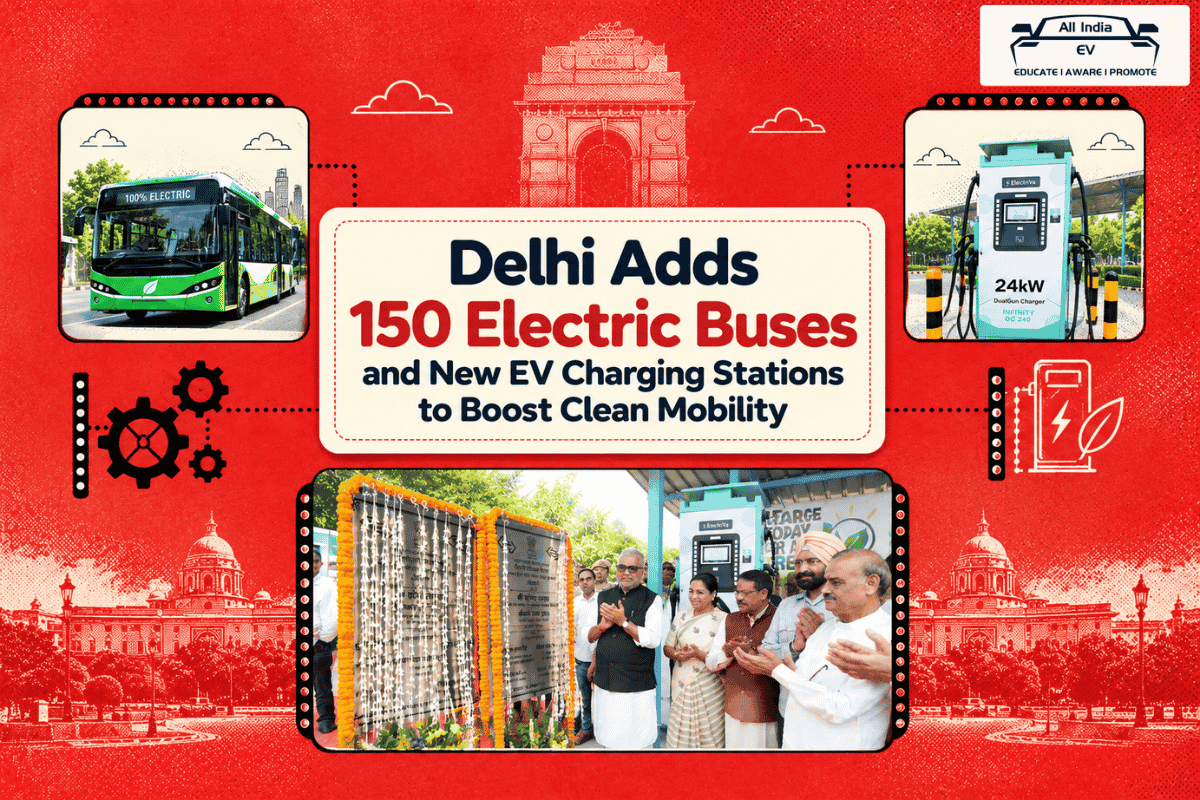
Delhi has taken another major step towards cleaner public transportation with the launch of 150 new electric buses and the inauguration of public electric vehicle (EV) charging stations. The initiative, led by Delhi Chief Minister Rekha Gupta alongside Union Environment Minister Bhupender Yadav on October 13, 2026, aims to strengthen the capital’s public transport network and support efforts to reduce air pollution.
The new buses were flagged off from Swami Vivekanand Inter-State Bus Terminal (ISBT) in Anand Vihar, a key transport hub identified as a major air pollution hotspot. The initiative forms part of the government’s wider push to promote zero-emission mobility and improve urban air quality through cleaner transportation options.
Delhi Expands Its Electric Bus Fleet
The addition of 150 electric buses has increased Delhi’s electric bus fleet to 5,238. The city’s overall bus fleet now stands at approximately 6,988 vehicles, including 1,750 compressed natural gas (CNG) buses. The expansion is expected to improve public transport capacity while supporting the gradual transition towards cleaner mobility.
Delhi’s public transport network plays an important role in meeting the daily commuting needs of millions of residents. Increasing the availability of electric buses can help reduce tailpipe emissions, particularly along busy urban routes and at crowded bus terminals.
Unlike conventional diesel-powered buses, battery-electric buses produce no tailpipe emissions during operation. Their wider deployment can therefore contribute to improved roadside air quality, reduced noise pollution and more sustainable urban transport. However, the overall environmental benefits also depend on electricity generation and vehicle lifecycle impacts.
The Delhi Transport Corporation (DTC) is also expected to expand its total bus fleet to nearly 14,000 vehicles by the financial year 2028–29. This proposed expansion signals a longer-term focus on increasing public transport capacity and improving the availability of cleaner travel options across the capital.
Five Public EV Charging Locations Strengthen Infrastructure
Alongside the bus launch, public EV charging stations were inaugurated at five locations: Swami Vivekanand ISBT Anand Vihar, Nand Nagri depot, Rohini Sector-37 depot, Nangloi depot and Keshopur depot. The facilities are intended to strengthen charging infrastructure and support the growing use of electric vehicles in the city.
The availability of charging facilities at bus terminals and transport depots is particularly important for electric public transport operations. Reliable charging access can help operators manage vehicle schedules, maintain fleet availability and support the deployment of additional electric buses.
The charging network expansion also reflects the need to develop supporting infrastructure alongside the growth of electric mobility. As more electric vehicles enter service, strategically located charging points will be essential for making operations more practical and efficient.
Focus on Anand Vihar Pollution Hotspot
Anand Vihar was a major focus of the government’s pollution-control review due to traffic congestion, road dust, construction activity and waste burning. Authorities have undertaken measures including road paving, removal of encroachments, dust-control measures at construction sites and clearance of illegally dumped construction waste. Greening initiatives are also planned as part of longer-term efforts.
The government also inaugurated 13 new Continuous Ambient Air Quality Monitoring Stations across Delhi, increasing the city’s monitoring network from 47 to 60 stations. These facilities will provide continuous data on air quality and meteorological conditions, supporting pollution assessment and enforcement activities.
What This Means for India’s EV Transition
Delhi’s latest initiative highlights the importance of combining electric public transport expansion with charging infrastructure and air-quality monitoring. Electric buses can reduce local tailpipe emissions on routes where they replace combustion-engine vehicles, while improved charging access can support the reliable operation of larger fleets.
However, the long-term impact will depend on effective fleet management, charging availability, electricity sources and continued action against other pollution sources, including road dust and construction emissions.
For India’s wider EV industry, Delhi’s expansion offers an example of how public transport electrification can be supported through coordinated infrastructure development. As cities seek cleaner and more efficient mobility solutions, investments in electric buses and charging networks are likely to remain important components of urban transport planning.