

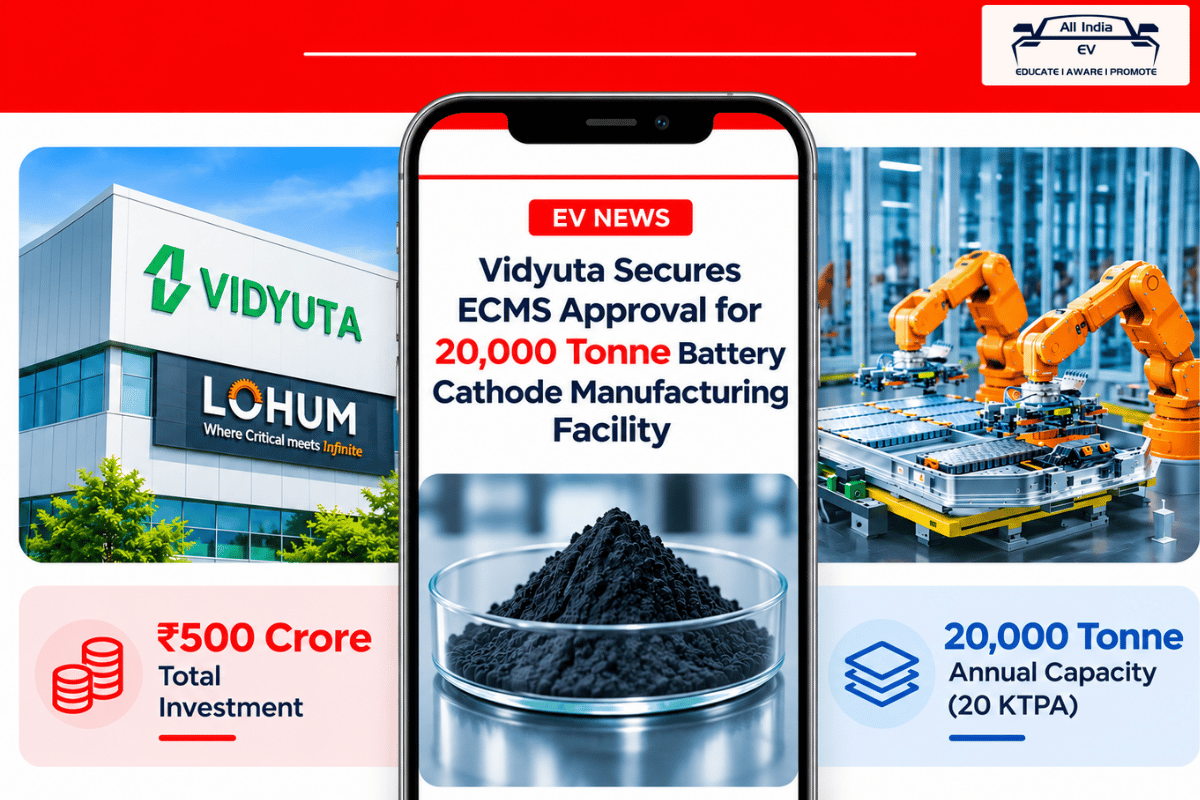
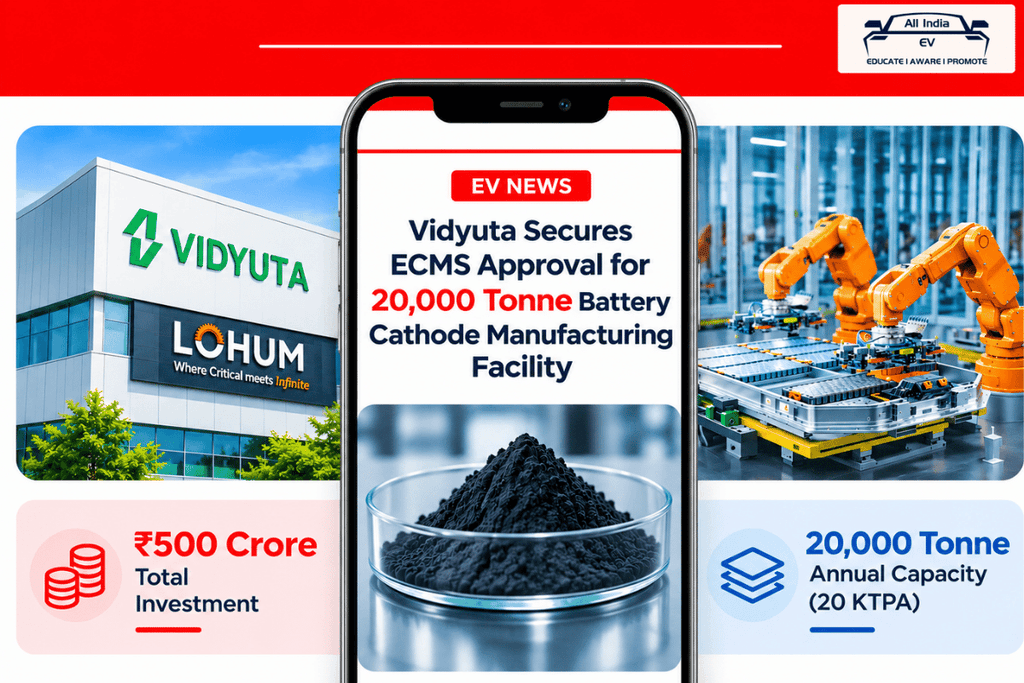
India is taking another significant step towards strengthening its domestic electric vehicle (EV) battery manufacturing ecosystem, with Vidyuta, a subsidiary of battery recycling company LOHUM, receiving government approval to establish a large-scale cathode active material (CAM) manufacturing facility under the Electronics Component Manufacturing Scheme (ECMS).
The proposed project involves a total investment of ₹500 crore and will have an annual manufacturing capacity of 20,000 tonnes (20 KTPA). The company will also be eligible for a capital expenditure-linked incentive of up to ₹125 crore, equivalent to 25% of the proposed investment, under the government-backed scheme.
The approval marks an important development for India’s lithium-ion battery supply chain, as cathode active material is one of the most valuable and technically important components used in battery cells. Vidyuta is reportedly the first lithium cobalt oxide (LCO) cathode active material manufacturer to receive approval under the ECMS.
Focus on Domestic Lithium-Ion Battery Manufacturing
Vidyuta’s proposed manufacturing facility will produce lithium cobalt oxide (LCO) cathode active materials in both polycrystalline and single-crystal formats. This will allow domestic battery cell manufacturers to source different material structures and specifications from a single supplier, depending on their manufacturing requirements.
Cathode active material plays a crucial role in determining the performance, energy characteristics and overall cost of lithium-ion batteries. According to estimates cited by the company from NITI Aayog, cathode active material accounts for nearly half the cost of a lithium-ion battery pack.
The company believes that establishing domestic production capabilities for these materials will help reduce India’s dependence on imported battery components while supporting the country’s expanding electric mobility and energy storage industries.
LOHUM’s Integrated Critical Minerals Supply Chain
The new manufacturing project will be integrated with LOHUM’s existing critical minerals business, creating a connected supply chain from mineral refining to battery material production.
Under this model, lithium, cobalt and nickel refined by LOHUM will be supplied to Vidyuta for manufacturing cathode active materials. The company will also utilise critical minerals recovered through recycling spent lithium-ion batteries.
This integrated approach is expected to strengthen resource utilisation, support battery recycling and reduce dependence on imported raw materials. It could also help establish a more circular battery manufacturing ecosystem in India, connecting battery recycling with the production of new battery components.
LOHUM Founder and CEO Rajat Verma said the approval would help establish domestic manufacturing capacity for LCO cathode active materials, providing Indian cell manufacturers with a local source for an important battery component.
Vidyuta Co-founder and CEO Ankit Sharma also highlighted that the project would strengthen India’s battery supply chain by connecting domestically refined critical minerals with locally manufactured cell materials.
Rising Demand for Battery Materials in India
India’s demand for advanced battery materials is expected to increase significantly as electric vehicle adoption expands across two-wheelers, three-wheelers, passenger vehicles, commercial vehicles and energy storage applications.
According to NITI Aayog estimates cited by the company, India could require approximately 1.93 lakh tonnes of cathode active material annually by 2030 to support the manufacturing of around 100 GWh of advanced chemistry cell batteries.
Against this backdrop, Vidyuta’s proposed 20,000-tonne annual production capacity represents an important addition to India’s emerging battery materials manufacturing ecosystem.
The Electronics Component Manufacturing Scheme, administered by the Ministry of Electronics and Information Technology (MeitY), aims to develop a stronger domestic electronics component manufacturing industry and reduce reliance on imports.
Vidyuta’s approval under the scheme reflects the growing policy focus on strengthening battery component manufacturing in India.
As the country’s EV industry continues to expand, investments in critical battery materials, recycling and domestic manufacturing could play an important role in building a more self-reliant electric mobility ecosystem.