

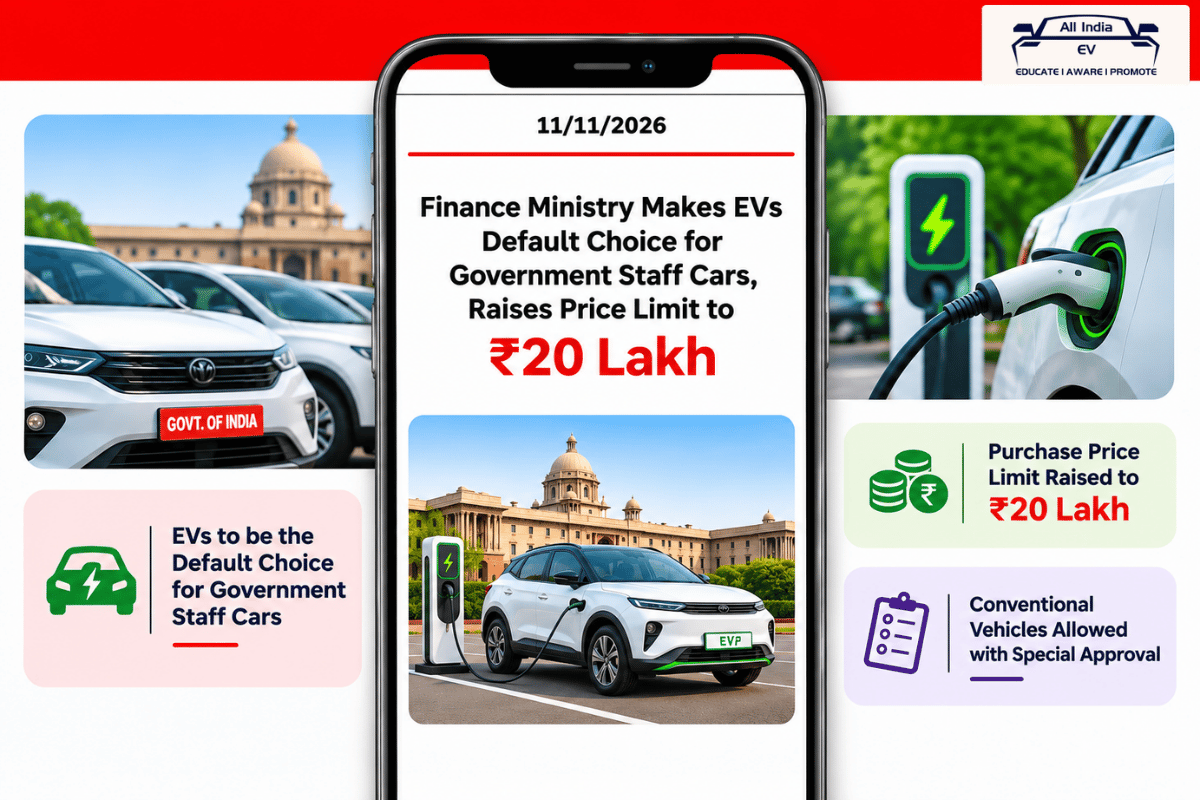
The Government of India has taken another significant step towards accelerating electric mobility by making electric vehicles (EVs) the default and preferred choice for staff car procurement across central government ministries and departments. The Ministry of Finance has also doubled the purchase price ceiling for electric cars to ₹20 lakh, providing government departments with greater flexibility to adopt electric vehicles.
The revised instructions were issued by the Department of Expenditure under the Ministry of Finance through an Office Memorandum dated November 10, 2026. The decision aims to promote sustainable transportation, reduce dependence on fossil fuels and encourage wider adoption of electric mobility across government operations.
Government Departments to Prioritise Electric Cars
Under the revised procurement guidelines, central government ministries and departments will ordinarily be required to purchase electric vehicles whenever their existing internal combustion engine (ICE) staff cars are replaced or retired.
The memorandum clearly states that EVs will be the default and preferred choice for government staff car procurement. This marks an important shift in the government’s approach towards electrifying its official vehicle fleet.
The revised policy also establishes different purchase price limits for electric and conventional vehicles. The Net Dealer Price (NDP) ceiling for electric vehicles has been increased to ₹20 lakh, while the maximum purchase price for petrol, diesel and hybrid vehicles remains ₹10 lakh.
The higher price ceiling is expected to expand the range of electric cars available for government procurement, allowing departments to consider more models based on their operational requirements.
Conventional Vehicles Require Special Approval
Although the government has made EVs the preferred option, the revised guidelines do not completely prohibit the procurement of conventional vehicles.
Ministries and departments can still purchase petrol, diesel or hybrid vehicles if they believe electric vehicles are not practical for their specific operational requirements.
However, such purchases will require a properly justified proposal to the Department of Expenditure. The proposal must receive approval from the Secretary of the concerned administrative ministry or department, along with the concurrence of its Financial Adviser.
The Department of Expenditure will examine these requests and provide relaxations on a case-by-case basis.
Similar approval requirements will apply when departments consider hiring conventional vehicles instead of electric vehicles.
Existing EV Hiring Guidelines to Continue
The Finance Ministry has also clarified that its earlier instructions issued on September 1, 2022, mandating the hiring of electric vehicles by government ministries and departments will continue.
The latest memorandum partially modifies the previous procurement and hiring guidelines, while keeping other existing conditions unchanged.
All government vehicle purchases will continue to follow the General Financial Rules (GFR), 2017, along with applicable procurement regulations.
The revised instructions have come into effect immediately, making EV preference applicable to upcoming government staff car procurement decisions.
Policy Move Could Strengthen India’s EV Market
The latest decision could create additional institutional demand for electric passenger vehicles in India. Government departments adopting EVs for official transportation could encourage greater acceptance of electric cars and demonstrate their suitability for regular fleet operations.
The increase in the procurement ceiling to ₹20 lakh is particularly important, as it provides access to a wider selection of electric vehicles and reflects the evolving pricing of the Indian EV market.
The move could also benefit domestic electric car manufacturers, including Tata Motors and Mahindra & Mahindra, by strengthening opportunities in the government and institutional fleet segments.
Beyond vehicle purchases, the policy could encourage greater investment in charging infrastructure, fleet management and supporting EV services as government departments gradually transition towards electric mobility.
Overall, making electric vehicles the default choice for government staff cars represents an important policy push towards cleaner transportation. With a higher procurement limit and stricter approval requirements for conventional vehicles, the government is reinforcing its commitment to reducing fossil fuel consumption and accelerating India’s transition towards sustainable mobility.