
India’s Production Linked Incentive (PLI) scheme for the automobile and auto component industry has exceeded its five-year investment target, but its performance in generating incremental sales remains significantly below expectations. The latest assessment by NITI Aayog highlights a gap between manufacturing investments and actual market performance, raising questions about the scheme’s long-term impact on India’s automotive and electric vehicle (EV) industries.
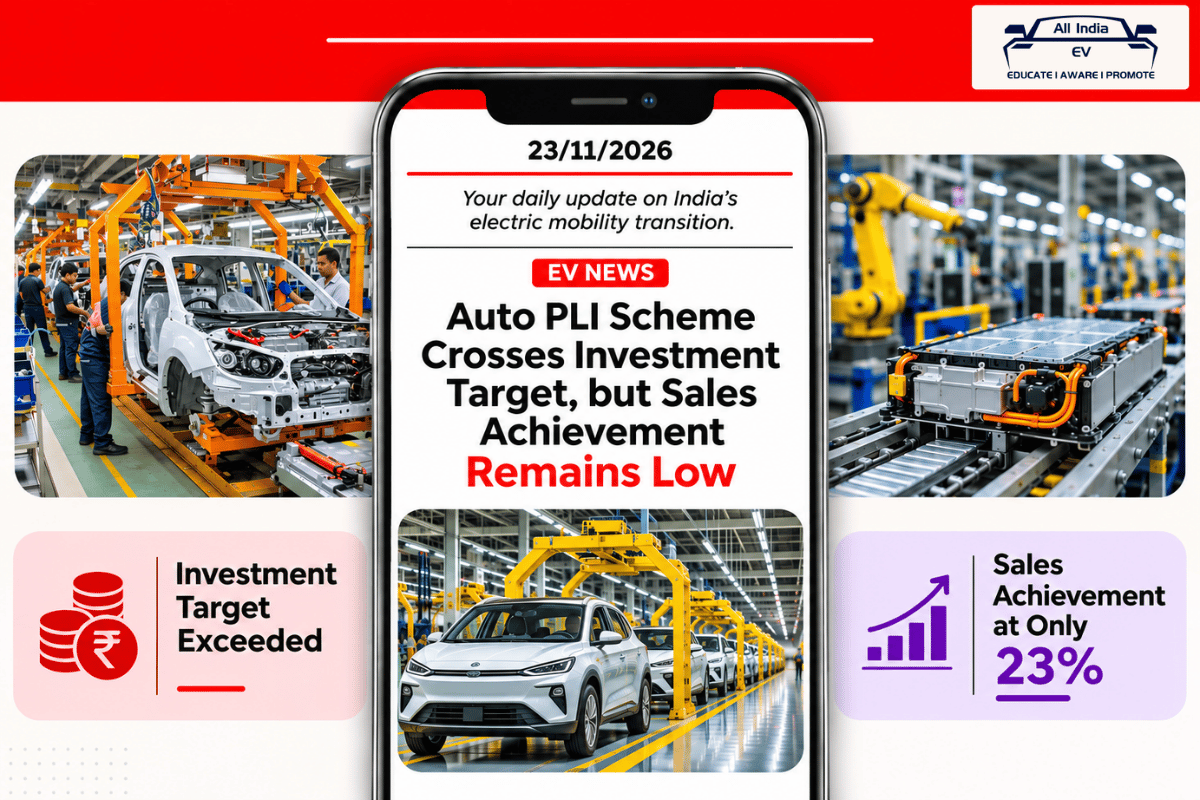
According to NITI Aayog’s Impact Assessment of PLI Schemes, prepared in collaboration with the Indian Institute of Management Ahmedabad, approved applicants reported cumulative investments of ₹44,326 crore as of March 2026. This is 4.3% higher than the original investment target of ₹42,500 crore.
However, incremental sales stood at ₹52,414 crore against the five-year target of ₹2,31,500 crore, representing only 22.6% achievement. Employment generation also remained below expectations, with 67,820 jobs created against the targeted 1,48,147 positions.
Automobile PLI Scheme Supports Domestic Manufacturing
Approved in September 2021 with a total financial outlay of ₹25,938 crore, the automobile PLI scheme aims to strengthen India’s domestic automotive manufacturing ecosystem. Its primary objectives include attracting investments, promoting advanced automotive technologies, reducing import dependence and developing local supply chains.
The scheme operates through two major components: the Champion OEM Incentive Scheme, which supports vehicle manufacturers, and the Component Champion Incentive Scheme, which encourages domestic production of advanced automotive components.
Incentives are linked to incremental sales of eligible products, subject to investment commitments and domestic value addition requirements.
Electric Vehicle Production Records Strong Growth
One of the significant developments under the scheme has been the expansion of incentivised electric vehicle production, particularly in the two-wheeler and three-wheeler segments.
Total incentivised vehicle production increased from 76,838 units in FY2023-24 to 12,84,650 units in FY2024-25. Cumulative production across these two financial years reached 13,61,488 units.
Electric two-wheelers accounted for the largest share, contributing 10,42,172 units. Electric three-wheelers followed with 2,38,385 units, while electric four-wheelers contributed 79,540 units. Electric buses accounted for 1,391 units.
These figures indicate the growing role of electric mobility in India’s automotive manufacturing landscape. However, NITI Aayog has highlighted that the cumulative production data makes it difficult to determine how much of this growth can be directly attributed to the PLI scheme rather than broader industry expansion.
Incentive Disbursements Increase in FY2026
The disbursement of incentives to original equipment manufacturers (OEMs) gained momentum during FY2026. Payments increased to nearly ₹2,000 crore, compared with ₹322 crore in FY2025, indicating faster implementation of the scheme.
Among the major beneficiaries, Bajaj Auto received the highest OEM incentive payout of ₹625.65 crore in FY2026. Tata Motors received ₹403.18 crore, followed by Ola Electric Technologies with ₹366.78 crore, TVS Motor Company with ₹320.51 crore and Mahindra & Mahindra with ₹283.82 crore.
Despite the increase in annual payouts, cumulative incentive disbursements to OEMs and component manufacturers stood at ₹2,386.36 crore as of March 2026, representing approximately 9.2% of the scheme’s total financial outlay.
Localisation Remains a Key Priority
The PLI scheme also focuses on strengthening domestic manufacturing capabilities and reducing dependence on imported automotive technologies.
To qualify for incentives, eligible advanced automotive technology products must meet a minimum domestic value addition (DVA) requirement of 50%.
According to the assessment, eight applicants under the Champion OEM category received DVA certification covering 94 product variants. Another 10 applicants under the Component Champion category secured certification for 37 product variants.
While this progress reflects increasing participation in domestic manufacturing, further improvements in localisation and supply chain development remain important for building a competitive automotive ecosystem.
Export Performance Still Needs Assessment
NITI Aayog’s assessment also highlighted that the scheme’s contribution to India’s automotive export competitiveness cannot yet be properly evaluated due to insufficiently detailed export data.
The report further noted that the automobile industry experienced a pandemic-related slowdown, followed by a strong recovery and subsequent moderation in growth. Since these developments coincided with the PLI scheme’s implementation, establishing a direct connection between the incentives and overall industry performance remains challenging.
What It Means for India’s EV Industry
The automobile PLI scheme has played an important role in encouraging investments and expanding electric vehicle manufacturing in India. The significant production numbers in electric two-wheelers and three-wheelers demonstrate the growing scale of domestic EV manufacturing.
However, the gap between investment achievements and incremental sales indicates that manufacturing capacity alone is not enough. Stronger consumer demand, competitive pricing, technology development, localisation and export opportunities will be essential to convert investments into sustainable business growth.
Going forward, improving commercial performance and increasing domestic value addition will be critical for the scheme to deliver its intended benefits to India’s automotive and electric mobility sectors.