

Electric Buses, Mineral Security and the Next Manufacturing Decisions
India’s EV weekend brought developments across public transport, last-mile mobility, manufacturing and mineral supply security.
- Electric Buses, Mineral Security and the Next Manufacturing Decisions
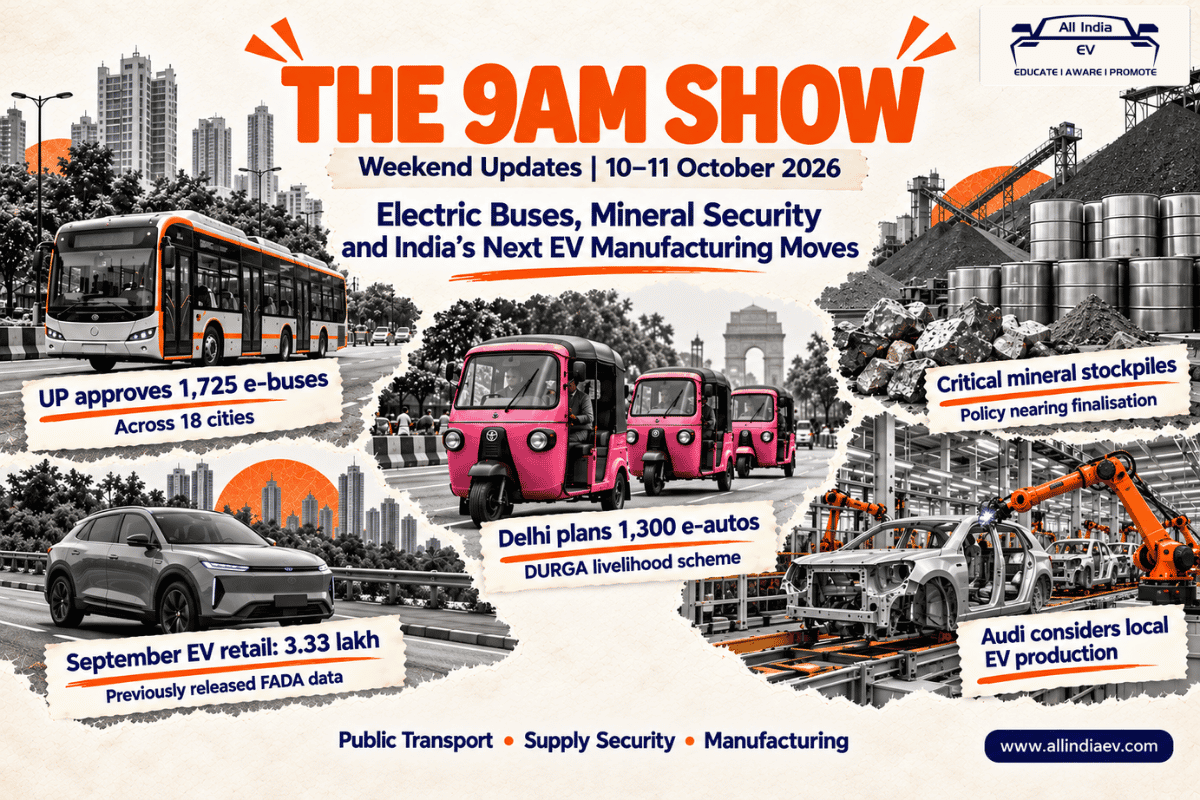
- Uttar Pradesh Approves 1,725 Electric Buses Across 18 Cities
- Delhi Plans 1,300 Electric Autos Under DURGA
- Delhi Reports ₹7.91 Crore in EV Incentive Disbursements
- Maharashtra’s Bike-Taxi Transition Raises Financing Questions
- Mumbai Receives New Olectra Electric Buses
- Delhi Prepares for Another 200 Electric Buses
- India Moves Towards a Critical-Mineral Stockpiling Policy
- Audi Considers Local Production of an Electric Car
- Land Acquisition Remains a Hurdle for Mahindra’s Proposed Project
- September’s Record EV Sales Receive Weekend Attention
- Premium EVs: Tesla Momentum, Volvo’s Launch and Mercedes’ Hybrid Strategy
- Modhera Connects Solar Power with Electric Mobility
- What This Means
Uttar Pradesh’s electric-bus approval creates a substantial opportunity for fleet operators and charging providers. Delhi is linking electric mobility with livelihoods and reporting progress on incentive disbursement. Meanwhile, Audi’s localisation deliberations and land-acquisition concerns around Mahindra’s proposed project highlight two different stages of the manufacturing challenge.
Here is what the weekend’s coverage tells us—and what the industry should watch next.
Uttar Pradesh Approves 1,725 Electric Buses Across 18 Cities
A Saturday report detailed Uttar Pradesh’s approval to operate 1,725 electric buses across 18 cities under the gross cost contract model.
Lucknow and Kanpur will receive 300 buses each, followed by Varanasi with 250 and Gorakhpur with 150. The programme includes nine-metre and twelve-metre buses, with private operators contracted for 12 years.
Operators will procure vehicles, arrange charging infrastructure, deploy personnel and handle maintenance. A specific rollout date has not been announced.
All India EV’s take: This creates demand across an operating ecosystem: vehicles, depot power, chargers, financing and maintenance. The next milestones are procurement, depot readiness and commercially workable contracts.
Delhi Plans 1,300 Electric Autos Under DURGA
Delhi announced plans on Sunday to allocate 1,300 pink electric autos under the DURGA—Driving, Upliftment and Rozgar for Women and Transgender—scheme.
The first phase reserves 1,170 vehicles for women and 130 for transgender beneficiaries. Applications will undergo district-level scrutiny, with online draws where eligible demand exceeds the available quota. Beneficiaries can also access applicable purchase incentives under Delhi’s prevailing EV policy.
All India EV’s take: Vehicle allocation is the starting point. Sustainable livelihoods will depend on affordable financing, accessible charging, maintenance support and sufficient passenger demand.
Delhi Reports ₹7.91 Crore in EV Incentive Disbursements
A separate Sunday update reported ₹7.91 crore disbursed in vehicle purchase and scrapping incentives since 1 July.
The figures include ₹7.61 crore in purchase incentives to 2,707 beneficiaries and ₹29.50 lakh in scrapping incentives to 79 beneficiaries. By 8 October, the policy had received 7,782 applications, including 7,706 relating to two-wheelers.
All India EV’s take: Disbursement is a more useful implementation measure than announced incentives alone. Application volumes and payment volumes should be tracked separately; their difference does not automatically establish a processing backlog.
Maharashtra’s Bike-Taxi Transition Raises Financing Questions
Sunday coverage examined Maharashtra’s reported deadline for bike-taxi operators to move from petrol two-wheelers to EVs by July 2027.
The report identified financing, charging access and regulatory clarity as central challenges, with industry participants calling for phased implementation.
All India EV’s take: A commercially viable transition requires more than replacing the vehicle. Operators and financiers must account for daily earnings, charging downtime, maintenance and the driver’s upfront contribution.
For electric two-wheeler manufacturers and energy providers, the opportunity will depend on how these requirements translate into actual fleet deployment.
Mumbai Receives New Olectra Electric Buses
A Sunday report said nine new Olectra electric buses arrived at BEST’s Magathane depot on Saturday, with 49 expected within a week.
The report describes buses using Blade Battery technology and intended for longer routes. Its headline and body contain different arrival counts, so the confirmed wording here follows the body’s account of Saturday’s nine-bus arrival.
All India EV’s take: The operational evidence to watch is route completion, energy consumption, charging turnaround and vehicle availability. These measures will show how the new buses perform in Mumbai’s demanding operating conditions.
Delhi Prepares for Another 200 Electric Buses
Weekend reporting indicated that Delhi is likely to induct 200 electric buses on 14 October, potentially taking its overall public bus fleet beyond 7,000 vehicles.
The planned addition includes nine-metre and twelve-metre buses. This remains an upcoming induction, rather than a completed weekend deployment.
All India EV’s take: Growing fleets also increase demands on depots, electricity connections, charging schedules and maintenance teams. Fleet expansion should be assessed alongside service frequency and buses available for daily operation.
India Moves Towards a Critical-Mineral Stockpiling Policy
Saturday reporting quoted Mines Secretary Keshav Chandra saying a critical-mineral stockpiling policy could be finalised within about a month.
The government is considering reserves covering up to six months of demand, with ₹500 crore earmarked under the National Critical Minerals Mission. The final mineral list, reserve size and procurement arrangements remain undecided.
The report also identified processing parks being developed in Gujarat, Maharashtra, Andhra Pradesh and Odisha.
All India EV’s take: Stockpiles could provide a buffer during supply disruptions. Longer-term resilience will require progress in processing, recycling and domestic component manufacturing alongside access to raw materials.
Audi Considers Local Production of an Electric Car
In a Sunday PTI interview, Audi India Brand Director Balbir Singh Dhillon said the company is contemplating a locally made battery electric car, with a decision expected in the next couple of months.
Audi also outlined an ambition to increase its share of India’s overall luxury-car market from approximately 8% to 15–16% over three to five years. This is a company-wide target, rather than an EV-specific forecast.
All India EV’s take: The next announcement needs to establish the model, production scope and timeline. Local assembly and deeper component localisation have different implications for pricing and Indian suppliers.
Land Acquisition Remains a Hurdle for Mahindra’s Proposed Project
Sunday reporting said Nashik industrial representatives sought Maharashtra Chief Minister Devendra Fadnavis’s intervention over approximately 350 acres at Advan in Igatpuri for Mahindra & Mahindra’s proposed EV manufacturing project.
According to those representatives, the first phase envisages approximately ₹5,000 crore of investment, while acquisition has been delayed for nearly 14 months. These remain reported project plans, rather than commissioned capacity.
All India EV’s take: Manufacturing commitments become tangible through land availability, approvals, construction and production. This story highlights why execution milestones deserve as much attention as investment announcements.
September’s Record EV Sales Receive Weekend Attention
Sunday coverage revisited FADA’s September retail figures: 3,33,634 EVs, representing approximately 74% year-on-year growth.
| Segment | September 2026 retail |
|---|---|
| Electric two-wheelers | 2,07,314 |
| Electric three-wheelers | 86,024 |
| Electric passenger vehicles | 36,108 |
| Electric commercial vehicles | 4,188 |
Electric commercial vehicles grew strongly year on year but declined 10.9% from August. These figures were released before the weekend; Sunday’s article provided fresh coverage of that earlier dataset.
All India EV’s take: Strong aggregate growth should not obscure differences between segments. Festive demand, fleet economics and vehicle availability affect each category differently.
Premium EVs: Tesla Momentum, Volvo’s Launch and Mercedes’ Hybrid Strategy
A Sunday report citing VAHAN recorded 294 Tesla registrations in September, compared with 117 in August. This is a reported registration count; it does not establish how much growth came from individual variants.
Volvo’s EX90 electric SUV and ES90 electric sedan are scheduled for their India launch on Monday, 12 October. Weekend previews establish the launch schedule; final Indian prices should follow the official announcement.
Separately, Mercedes-Benz India CEO Santosh Iyer told PTI that luxury customers could accept a 5–6% premium for plug-in hybrids, citing flexibility and ownership confidence. Mercedes reported 16% growth in its EV portfolio during January–September. Plug-in hybrids remain a separate powertrain category from battery EVs.
Modhera Connects Solar Power with Electric Mobility
Saturday coverage highlighted EV adoption and solar-supported charging in Gujarat’s Modhera.
The broader solar-village infrastructure includes a 6 MW solar plant, 15 MWh battery energy storage system, and an EV charging station near the Sun Temple. These are existing infrastructure elements supporting the mobility transition, rather than newly announced weekend capacity.
All India EV’s take: Modhera offers a useful example of connecting local electricity generation, storage and mobility. Replication will depend on utilisation, operating costs and dependable access to charging.
What This Means
Our reading of the weekend is that India’s EV opportunity is expanding across several fronts simultaneously.
Bus programmes create demand for integrated fleet operations. Last-mile schemes require a workable livelihood model. Manufacturing plans need execution on the ground. Mineral security requires both short-term buffers and long-term industrial capability.
For founders, investors and policymakers, the next useful question is how much announced demand becomes vehicles in service—and how reliably those vehicles operate.
The 9AM Show — All India EV’s Monday review of India’s EV weekend.