

Monday, 9 November 2026 | Weekend edition: 7–8 November
- 1. Electric two-wheelers: Volume growth meets new applications
- 2. Electric passenger vehicles: Strong registrations and a premium-market watchlist
- 3. Electric commercial vehicles: Force prepares the Traveller for electrification
- 4. Electric three-wheelers: The transition already has substantial scale
- 5. EV charging equipment: Exicom sharpens its India focus
India’s EV market generated a varied mix of headlines over the weekend. Electric ambulances moved closer to commercialisation, a luxury electric MPV appeared ahead of its India debut, and removable scooter batteries found an application beyond mobility.
October registration reports also provided a clearer picture of demand across vehicle categories. Alongside these developments, weekend coverage examined electric deliveries, charging equipment, battery materials and electric-bus infrastructure.
This edition brings those stories together by segment. Publication dates fall within 7–8 November; where reports revisit an earlier announcement, that distinction is stated.
1. Electric two-wheelers: Volume growth meets new applications
Electric two-wheelers remained the largest contributor to India’s EV volumes. A FADA-based report published on 7 November recorded 2,24,064 electric two-wheeler registrations in October, representing 48.49% year-on-year growth.
The numbers underline the segment’s importance to the wider transition. Electric scooters and motorcycles provide the volumes needed to support manufacturing, dealerships, service capacity and component localisation. However, registration growth alone cannot explain ownership satisfaction or the financial health of individual manufacturers. Those require separate examination.
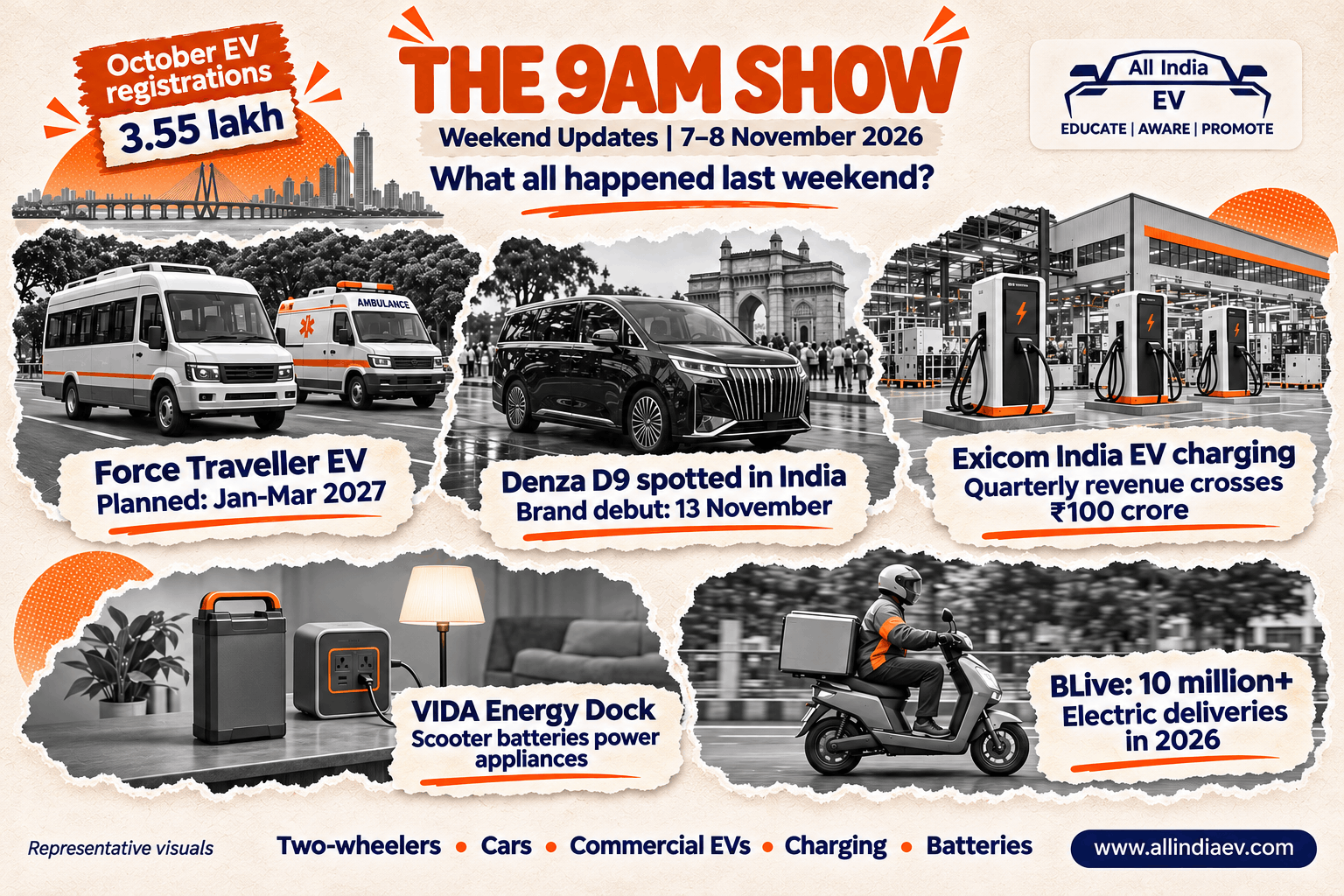
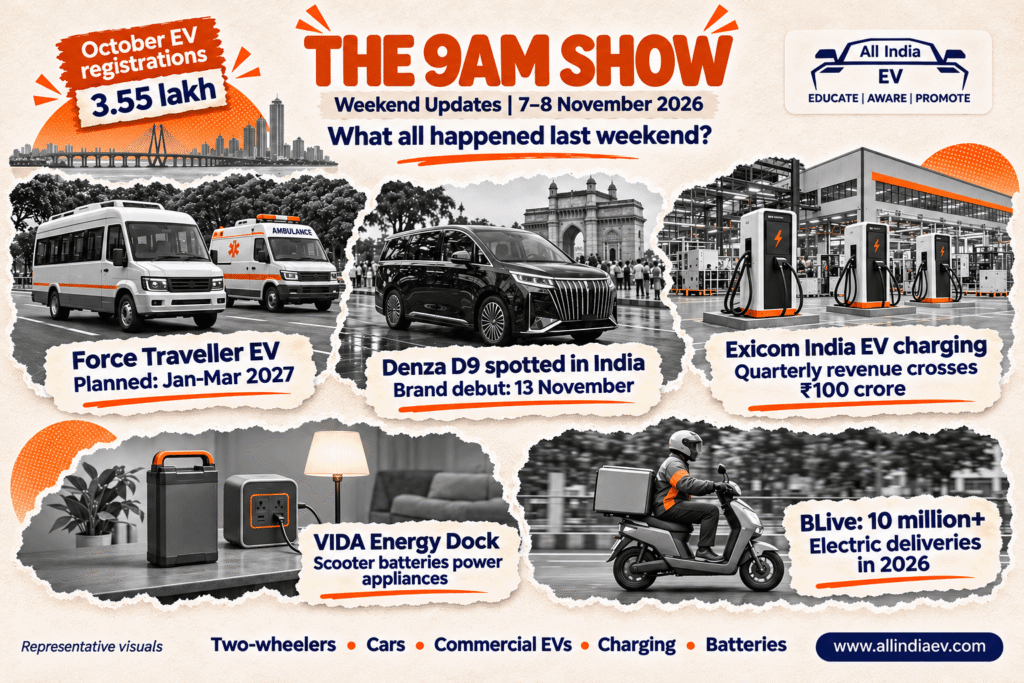
The weekend’s more distinctive product story involved Hero VIDA’s Energy Dock, showcased at EICMA. The accessory allows compatible removable scooter batteries to supply electricity to household devices.
It introduces an additional use for a battery that would otherwise spend much of its time parked inside a vehicle. For consumers, that could make removable batteries more useful during outdoor activities or temporary power interruptions.
The commercial questions concern compatibility, output, pricing and availability. Until those details are established for Indian buyers, the Energy Dock is best understood as a product development worth tracking rather than an immediately available household backup solution.
2. Electric passenger vehicles: Strong registrations and a premium-market watchlist
October’s electric passenger-vehicle registrations reached 37,049 units, growing 76.47% year-on-year, according to FADA-based reporting published over the weekend.
RushLane’s manufacturer analysis placed Tata Motors first with 14,669 registrations, followed by Mahindra and JSW MG Motor. The figures offer another indication that electric cars are attracting a broader customer base as the available product range expands.
For industry readers, these figures also require discipline. Registration totals can vary between reports because of extraction dates, manufacturer classifications and reporting scope. Monthly comparisons should therefore use a consistent dataset rather than combine numbers from different snapshots.
At the premium end, Denza’s D9 luxury MPV was spotted in Mumbai ahead of the brand’s planned 13 November India debut. The sighting followed the appearance of a Denza Z9 GT in the country.
The D9 is available internationally with different powertrain options. India specifications, pricing and delivery plans remain awaited, so overseas specifications should not automatically be presented as confirmed Indian features.
Its arrival nevertheless makes luxury electric people carriers an interesting category to watch. Rear-seat comfort, charging convenience and ownership support will influence how buyers assess these vehicles alongside established luxury MPVs.
3. Electric commercial vehicles: Force prepares the Traveller for electrification
One of the weekend’s strongest business developments came from Force Motors, which plans to introduce Traveller-based electric vehicles in January–March 2027.
An electric ambulance is expected among the initial offerings. The company said the vehicles had completed development and were undergoing final testing and homologation. An electric version of the Urbania is also under development.
Force Motors is investing ₹3,000 crore across capacity, engineering, electrification, hybrid driveline technology and digitisation. This should be described as a broader investment programme, rather than an allocation exclusively for EVs.
The Traveller’s applications make this development significant. School transport, employee mobility, healthcare and tourism involve different operating patterns, even when they use similar vehicle platforms.
Predictable daily routes can simplify battery sizing and charging schedules. Variable tourism routes create a different challenge, particularly when vehicles travel long distances or operate away from dependable charging facilities.
Our reading: Commercial adoption will depend on matching each electric variant to a suitable duty cycle. Fleet buyers will evaluate acquisition cost, usable range, payload, charging downtime and service availability together.
4. Electric three-wheelers: The transition already has substantial scale
Electric three-wheelers continued to demonstrate the depth of India’s commercial electrification. FADA-based reporting put October registrations at 88,570 units, an increase of 24.76% year-on-year.
An AFP feature published on 8 November examined the transformation through manufacturing operations and driver experiences, including Mahindra Last Mile Mobility’s role in the market.
The report described an industry producing electric three-wheelers at substantial scale while highlighting the practical questions facing buyers: financing, charging access and confidence in battery life.
This segment deserves attention beyond its monthly rankings. For an owner-driver, the purchase is a livelihood decision. Lower energy expenditure must translate into dependable daily earnings after financing, maintenance and charging costs.
The business opportunity therefore extends across vehicle sales, accessible credit, after-sales service and battery support. Strong demand creates room for expansion, but consistent uptime determines whether that expansion benefits the operator.
5. EV charging equipment: Exicom sharpens its India focus
Weekend reporting on Exicom’s Q2 FY27 results highlighted consolidated revenue of ₹388.3 crore and a milestone for its domestic charging operations: India EV-charging revenue exceeded ₹100 crore in a single quarter.
The company also advanced a proposed divestment of Tritium at an indicative $85 million enterprise valuation. The proposed transaction remains conditional, with due diligence and definitive agreements still relevant to completion.
Exicom intends to retain access to TRI-FLEX technology through a perpetual licence. The weekend reports followed an announcement made earlier in the week.
The development raises a broader industry question: where can charging-equipment companies deploy capital most effectively?
Demand spans residential AC chargers, public DC infrastructure and higher-power equipment for commercial fleets. Each market has different procurement cycles, service requirements and working-capital needs.
For Indian suppliers, the opportunity increasingly includes installation support, remote monitoring, maintenance and long-term equipment performance. Revenue growth is valuable, but customers ultimately judge charging hardware by availability and reliability.
6. Electric buses: Depot readiness becomes central to deployment
A GreentechLead analysis published on 8 November examined the infrastructure opportunity surrounding India’s electric-bus expansion.
Its discussion covered charging depots, transformers, grid connections, high-capacity chargers and energy-management systems under PM-eBus Sewa. The article reviewed an existing programme; it did not announce a new weekend funding allocation.
The operational relationship is straightforward: buses, chargers and electricity supply must become available together.
A depot needs sufficient sanctioned power, suitable circulation space and charging schedules aligned with service timetables. Operators also need maintenance arrangements that help restore equipment quickly when a charger becomes unavailable.
For infrastructure companies, this creates opportunities beyond supplying individual machines. Depot planning, electrical engineering, software integration and maintenance can all influence fleet performance.
Our assessment: The most useful measure of progress is the number of buses consistently operating scheduled services, supported by dependable charging.
7. Battery technology: Epsilon’s anode announcement attracts further coverage
Battery materials featured in Saturday’s reporting through Epsilon Advanced Materials’ Epsil silicon-graphite composite anode material.
The company says the material could enable 20–30% additional EV range without increasing battery-pack size. Although covered on 7 November, Epsil was originally announced on 4 November. It should therefore be treated as continued coverage of an earlier development.
The announcement highlights the importance of materials engineering in battery development. Vehicle performance depends on the capabilities of the cells inside the pack, alongside thermal management, electronics and mechanical design.
However, a material-level improvement does not automatically produce an equivalent improvement in a finished vehicle. Commercial relevance depends on integration, durability, manufacturing consistency and cost.
For India’s battery ecosystem, the story is worth following through customer qualification and commercial adoption. Those milestones will show how the claimed benefits translate into production cells and vehicles.
8. Electric fleets and last-mile delivery: BLive reports a milestone
BLive reported enabling and tracking more than 10 million electric deliveries during 2026, according to a company announcement dated 6 November and published by EV Update Media on Saturday.
The company highlighted its fleet-management technology and expansion through BLive NXT, which supports local entrepreneurs and fleet operators in Tier 2 and Tier 3 markets.
The distinction between deliveries and vehicles matters. This milestone describes delivery activity supported by the business, rather than the size of its vehicle fleet.
For the sector, expansion beyond major cities will test how well electric delivery models adapt to local demand. Vehicle availability, rider support, maintenance and charging must work together.
Our reading: The next stage of fleet growth will depend on repeatable operating economics. Entrepreneurs need enough delivery demand and dependable vehicle utilisation to sustain the business after the initial deployment.
9. State-wise adoption: Regional markets need different strategies
Saturday’s Financial Express coverage identified Uttar Pradesh, Maharashtra and Karnataka as leading EV markets. Uttar Pradesh recorded 47,165 registrations in October, representing 13.31% of nationwide sales.
The report highlighted a regional distinction: three-wheelers drive northern markets, while two-wheelers dominate southern states.
This changes how businesses should interpret market leadership. A state with high total EV registrations may present a very different opportunity for an electric-car dealership, a battery-swapping operator or a commercial charging developer.
Product planning and infrastructure investment need to follow the local vehicle mix, customer profile and operating pattern.
For All India EV, this remains a central editorial priority: understanding where adoption is happening, which segments are driving it, and what businesses need to make that growth sustainable.
Next on our watchlist: Denza’s India debut, Force Traveller EV homologation progress, VIDA Energy Dock availability, and developments in Exicom’s proposed transaction.
All India EV | Tracking the businesses, technology and infrastructure shaping India’s electric mobility market.