

India’s EV Market Gains Momentum. Can the Ecosystem Keep Pace?
- Festive sales show EVs gaining ground
- Piaggio’s plans raise the competitive stakes in electric scooters
- Electric buses extend their intercity footprint
- E-truck financing moves toward the resale-value question
- Battery localisation needs engineering depth
- Consumer confidence remains a separate challenge
- All India EV’s View
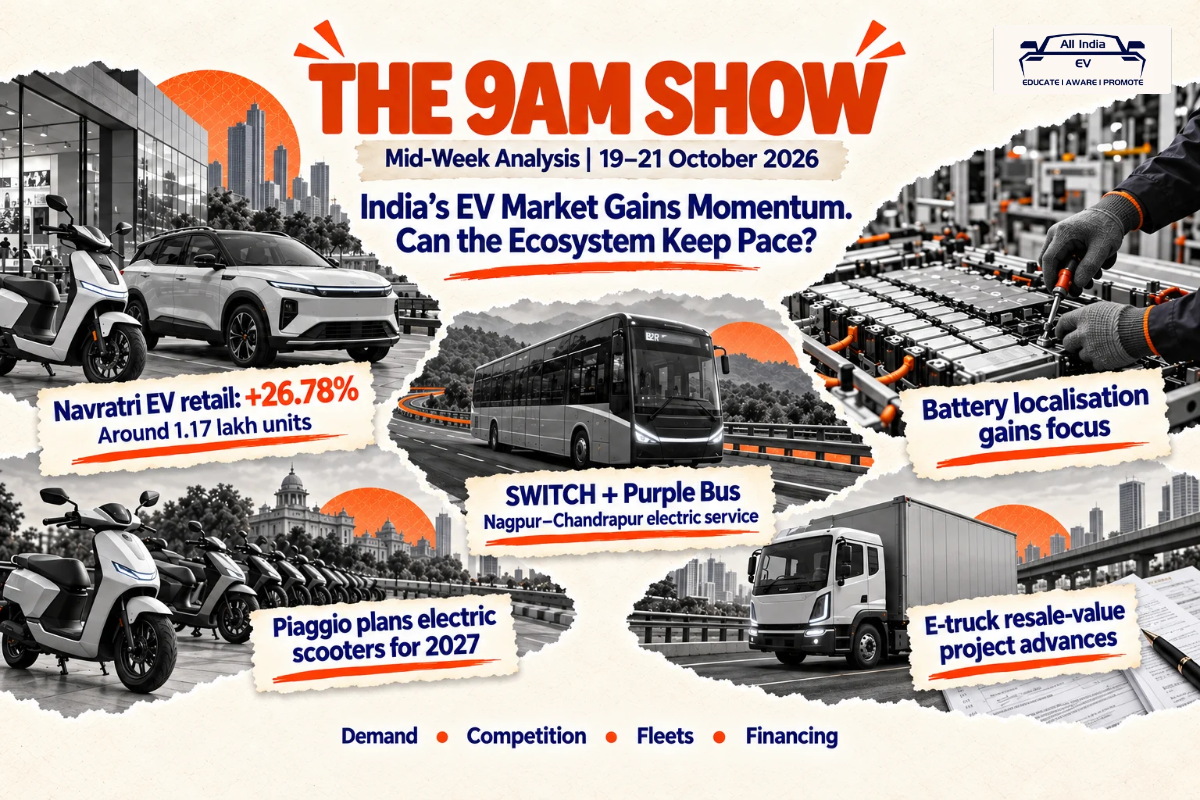
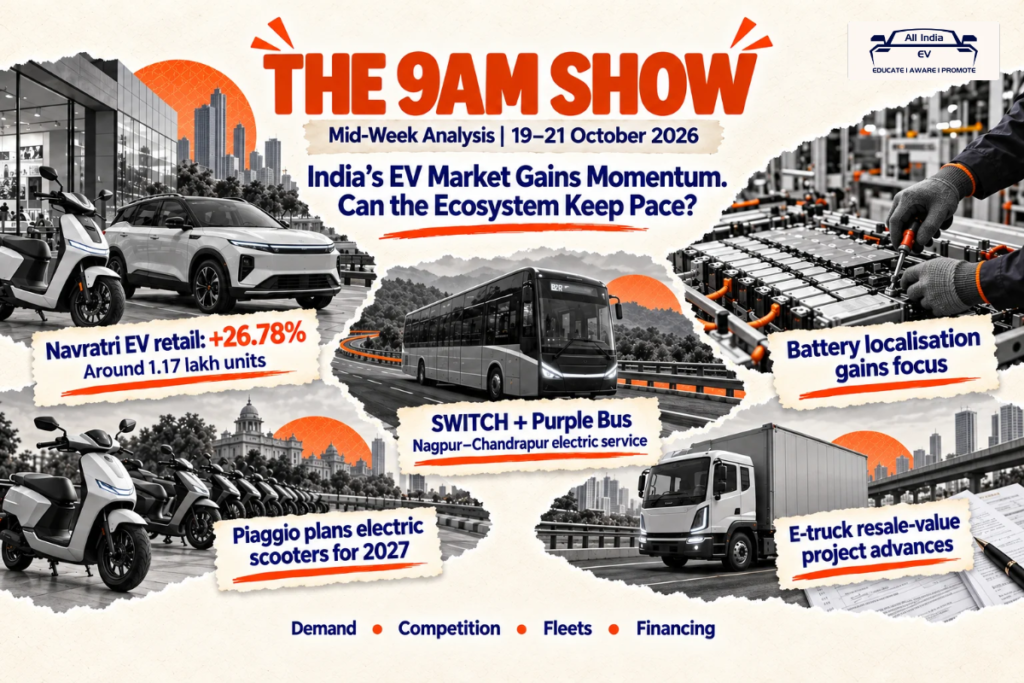
India’s EV market delivered an encouraging festive-season signal this week.
Electric vehicle retail grew even as the wider automobile market recorded a year-on-year decline. Piaggio outlined plans to enter the mass-market electric scooter segment. Electric intercity buses expanded into Vidarbha, while a new project moved forward to address the uncertainty surrounding electric trucks’ resale values.
These developments point to a market expanding across consumer purchases, public transport, commercial fleets and financing.
But growth brings a more demanding test: can manufacturers, suppliers, financiers and service networks support the next stage of adoption?
Festive sales show EVs gaining ground
FADA’s provisional Navratri figures showed EV retail growing 26.78% year-on-year to approximately 1.17 lakh units. EVs accounted for around 10.5% of total vehicle retail, compared with approximately 7.7% a year earlier.
Over the same period, overall automobile retail declined 6.52%. Electric two-wheelers recorded 75,758 units, up 33.41%, while electric passenger vehicles reached 12,305 units, growing 25.97%. Electric commercial vehicle retail nearly doubled to 1,288 units.
The figures suggest that electric mobility continued to attract buyers during an uneven festive market.
However, the comparison needs context. Navratri lasted ten days this year against eleven in 2025, while last year’s GST changes influenced purchase timing. These are provisional festive-period figures; sustained momentum will become clearer after Diwali.
For the industry, the immediate opportunity is to convert this interest into completed purchases and a dependable ownership experience.
Piaggio’s plans raise the competitive stakes in electric scooters
Piaggio plans to enter India’s mass-market electric scooter segment in 2027, using an India-specific platform offering both electric and internal combustion powertrains.
The company is targeting an overall product range of ₹85,000–₹1.3 lakh, with premium electric variants toward the upper end. Piaggio said the platform was developed with EV requirements considered from the outset. These are future product plans, rather than a vehicle launch during the reporting period.
Our reading is that competition will increasingly depend on how well manufacturers combine price, daily usability, distribution and service.
A competitive launch price can bring buyers into a showroom. Financing availability, delivery timelines and confidence in repairs can determine whether those enquiries become sales.
For existing electric scooter manufacturers, another established automotive company preparing its entry adds pressure to strengthen the entire customer experience.
Electric buses extend their intercity footprint
SWITCH Mobility and Purple Bus introduced electric services on the Nagpur–Chandrapur route, with coverage reporting an initial deployment of six buses, forming part of a 50-bus order for operations in Vidarbha.
The SWITCH EiV12m intercity coaches offer 45 pushback seats and a claimed range of 350 km per charge.
The significance extends beyond the flag-off.
Intercity operations require vehicles to meet route schedules consistently. Operators must match range with actual passenger loads, charging stops, turnaround time and maintenance requirements.
As these services accumulate operating experience, they can provide a stronger basis for future procurement decisions. Reliable operations and repeat orders will tell us more about commercial readiness than launch announcements alone.
E-truck financing moves toward the resale-value question
One of the less visible developments this week could have longer-term implications for electric freight.
The Mitigation Action Facility selected India’s DERISK—E-Truck Residual Value Insurance project, implemented by the World Resources Institute, for its Detailed Preparation Phase. The initiative addresses financing barriers associated with uncertainty over electric trucks’ future resale values. It has not yet launched as a commercially available insurance product.
For a fleet buyer, the purchase decision extends beyond the cost of electricity and the vehicle’s advertised range.
The buyer also needs to assess borrowing costs, battery condition over time, maintenance exposure and the value of the truck when it leaves the fleet.
Greater confidence in residual values could help lenders and operators evaluate these vehicles more consistently. The practical outcome will depend on how the proposed mechanism is designed, priced and implemented.
Battery localisation needs engineering depth
Coverage during the period also examined Varroc’s proposed partnership with France-based Forsee Power.
The arrangement envisages Varroc taking a 45% equity stake and management and operational control, subject to approvals. Electric three-wheeler battery packs are the initial focus, with ambitions to expand across other vehicle categories. The underlying announcement was made on 16 October, with follow-up reporting during this week’s window.
The broader industry implication is that localisation must support batteries designed for specific operating conditions.
A delivery vehicle, passenger three-wheeler and intercity bus place different demands on their battery systems. Pack durability, thermal performance, repairability and integration with the vehicle all influence operating economics.
As deployment grows, suppliers that can support these requirements consistently will become increasingly important to manufacturers and fleet operators.
Consumer confidence remains a separate challenge
Strong festive sales do not mean that buyer concerns have disappeared.
Bain’s survey found that 52% of Indian consumers sceptical about battery electric vehicles cited battery reliability as a purchase barrier. Insufficient charging infrastructure followed at 44%, with charging time at 43%.
The survey also found that 82% of respondents who had test-driven a BEV would consider purchasing one, compared with 66% among those who had not. This shows an association between product experience and purchase consideration, rather than establishing that test drives alone caused the difference.
For manufacturers, these findings support a practical approach: explain battery warranties clearly, demonstrate charging requirements and give buyers meaningful experience with the vehicle.
Confidence grows when customers understand how ownership will work in their own circumstances.
All India EV’s View
The developments reported between 19 and 21 October show an EV market advancing on several fronts.
Festive retail indicates growing adoption. Piaggio’s plans point to further competition. Intercity bus deployment is expanding operational experience, while the DERISK project addresses a financing issue that can influence electric truck purchases.
The next phase will reward companies that connect these pieces effectively.
For the months ahead, All India EV will be watching sales after the festive season, delivery timelines, fleet repeat orders, financing terms and service performance.
Those indicators will help establish how much of today’s momentum becomes durable market growth.