


Amazon surpasses 10,000 EVs in India, targets 100,000 vans by 2040 to accelerate global fleet growth & net zero goals
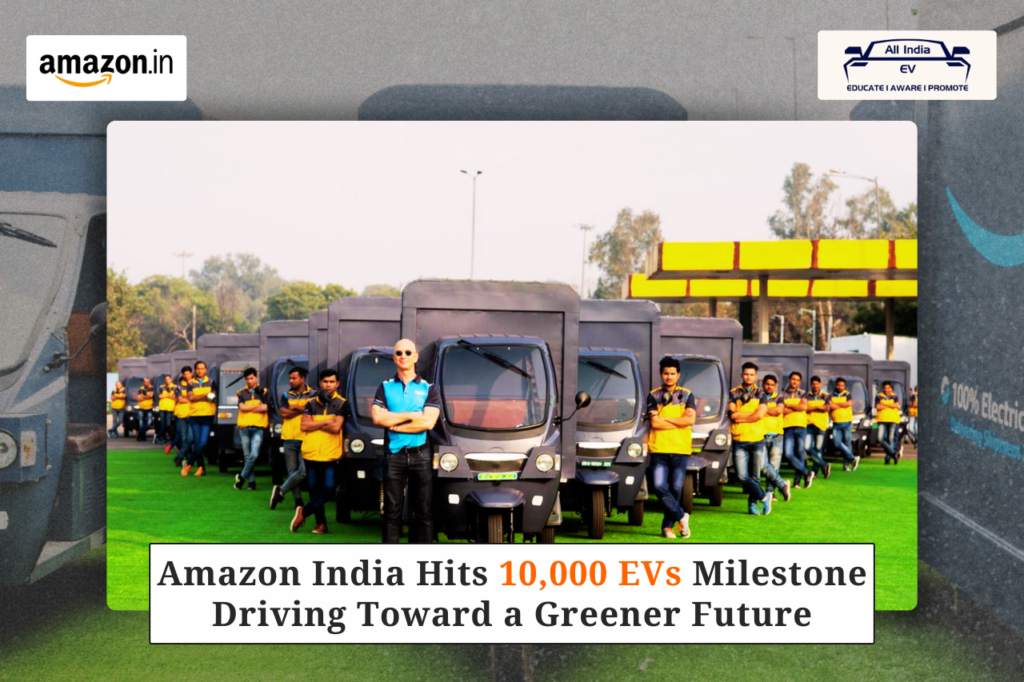
Amazon India has achieved a major milestone by deploying more than 10,000 electric vehicles (EVs) in its delivery fleet in 2024 — a full year ahead of its 2025 target. This achievement underscores Amazon’s commitment to decarbonising logistics and advancing its 2040 net-zero carbon goal.
A Global Climate Strategy Anchored in EVs
Amazon’s sustainability roadmap places transportation electrification at the core of its climate strategy. The company is focused on optimising its logistics network to reduce unnecessary transport, accelerating the shift to EVs where feasible, and exploring lower-carbon fuel solutions for segments not yet ready for electrification.
With millions of packages delivered daily across the globe, vehicle electrification is a critical lever in Amazon’s decarbonisation efforts. The company has committed to deploying at least 100,000 electric delivery vans globally by 2030, with 10,000 in India by 2025.
In 2024, Amazon rapidly expanded its fleet to more than 31,400 electric vans worldwide, including 24,000 from Rivian, up from 19,000 the previous year. Globally, EVs enabled Amazon to deliver 1.5 billion packages in 2024 alone.
Kara Hurst, Chief Sustainability Officer at Amazon, said:
“The diverse nature of our business allows us to test new sustainability solutions across industries. When we discover a solution in one area, we can quickly adopt it across our business, helping us move faster toward our sustainability goals.”
More EV News

She added, “The path to being a more sustainable company will never be linear. While we are firm on our goals, our approach will continuously evolve with emerging challenges and opportunities.”
Building Charging Infrastructure at Scale
The rapid scale-up of EVs requires robust charging infrastructure. In 2024 alone, Amazon installed 11,770 new chargers, bringing its total to 24,000 chargers across 50 delivery stations, creating the largest private charging network in the US.
Similar projects are underway across Europe and Asia, ensuring that future fleet expansion runs smoothly without disruption.
Amazon is also electrifying its middle-mile network — the segment that connects fulfilment centres to delivery hubs. This includes light, medium, and heavy-duty electric goods vehicles (eHGVs).
In early 2025, Amazon announced its largest order of zero-tailpipe-emission trucks with over 200 Mercedes-Benz eActros 600 vehicles for its European operations. Once deployed, these trucks are expected to transport 338 million packages annually. By the end of 2025, 300 middle-mile EVs will operate in the UK, followed by Germany in 2026.
Prime Air and Drone Sustainability
Amazon’s sustainability efforts also extend into Prime Air, its electric drone delivery service, designed with safety and innovation at its core.
- Drones fly between 115 and 400 feet, avoiding ground obstacles and conventional air traffic.
- The system includes a Safe Contingent Landing (SCL) feature, enabling drones to land safely during unexpected events such as weather changes, emergency air traffic, or technical issues.
- Equipped with cameras, radar, and advanced perception systems, drones assess surroundings in real time to find safe landing spots.
- The new MK30 drone underwent rigorous testing, including simulated system failures, confirming its ability to adapt under pressure. SCLs are not emergency events but planned safety measures, demonstrating Amazon’s proactive approach to safe and sustainable aerial logistics.
Electrification On-Site and in Heavy Transport
Beyond last-mile delivery and drones, Amazon is also electrifying on-site vehicles. By 2024, the company had deployed 360 electric yard hostlers across North America, making it one of the world’s largest fleets of this kind. These vehicles move trailers around fulfilment centres, reducing emissions within logistics hubs.
At the same time, Amazon continues to scale heavy-duty transport electrification. Despite technical and cost challenges, the company is pursuing collaborations with governments and private sector partners to expand EV access and infrastructure.
Challenges on the Road to Scale
While Amazon’s progress has been impressive, scaling EV adoption remains complex. Operations vary across regions, each with unique challenges such as land availability, energy dependence, trade policies, financing constraints, and local regulatory environments.
To overcome these barriers, Amazon is:
- Partnering with policymakers to enable supportive EV policies.
- Collaborating with private players to strengthen supply chains.
- Investing in R&D to bring down costs of fleet electrification.
India at the Heart of Amazon’s Sustainability
Amazon’s early completion of its 10,000 EV target in India highlights the country’s central role in its sustainability strategy. With India emerging as one of the fastest-growing EV markets, Amazon’s investment in electrification strengthens both its logistics capabilities and its alignment with national goals on clean mobility.
Looking ahead, the company is expected to continue expanding its EV footprint, building infrastructure, and experimenting with new technologies like drones and heavy-duty e-trucks to further cut emissions.