
All India EVAll India EVAll India EV
Notification
Font ResizerAa
  • Home
  • EV News
  • EV Launch
  • Market Insights
  • Investments & Funding
  • Guest Articles
  • EV Engineering
  • Contact
Reading: Telangana Crosses 2 Lakh EV Sales Mark, Boosted by Zero Tax Policy
Share
All India EVAll India EV
Font ResizerAa
  • Home
  • EV News
  • EV Launch
  • Market Insights
  • Guest Articles
  • EV Engineering
  • Contact
Search
  • Home
    • Home 1
    • Home 2
    • Home 3
    • Home 4
    • Home 5
  • Home
  • Categories
    • Electric
  • Categories
  • Shows
    • Rap
  • More Foxiz
    • Blog Index
    • Contact
  • Bookmarks
    • Customize Interests
    • My Bookmarks
  • More Foxiz
    • Blog Index
    • Sitemap
Have an existing account? Sign In
Follow US
Home » Blog » Telangana Crosses 2 Lakh EV Sales Mark, Boosted by Zero Tax Policy
Milestone

Telangana Crosses 2 Lakh EV Sales Mark, Boosted by Zero Tax Policy

Sunita
By
Sunita
Last updated: 30 July 2025
Share
4 Min Read
SHARE

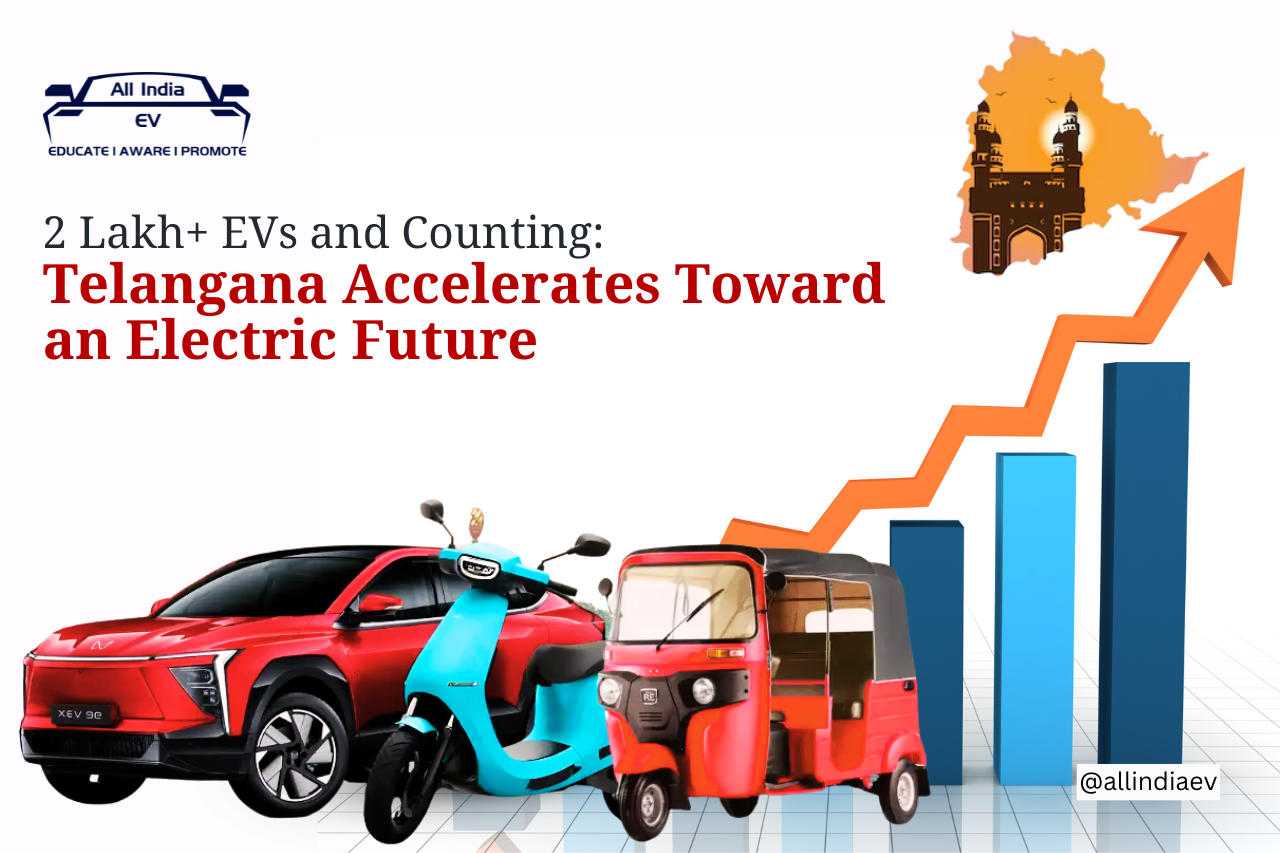
Telangana’s Zero Tax EV Policy Drives 2 Lakh+ Sales as Hyderabad Leads in Rapid Electric Vehicle Adoption

Contents
  • Two-Wheelers Lead the Transition
  • Policy in Effect Till 2026 — With No Vehicle Limit
  • Commercial Segment Gains Momentum
  • A Model for Other States

Telangana has emerged as a frontrunner in India’s electric mobility revolution, registering a sharp surge in electric vehicle (EV) sales following the implementation of a state-wide 100% exemption on road tax and registration fees. In just seven months since the EV policy rollout in November 2024, the state has recorded the sale of over 50,000 electric vehicles, bringing the total registered EVs in the state to over 2 lakh.

This marks a dramatic jump from 1.25 lakh EVs registered in FY 2023–24, highlighting the impact of targeted fiscal incentives and proactive state policy.


Two-Wheelers Lead the Transition

The data reveals that electric two-wheelers dominate the market, accounting for more than 37,000 units sold since the policy’s launch. Electric four-wheelers, including 1,153 electric taxis, make up around 10,000 of the newly registered EVs. The trend reflects both growing consumer awareness and increasing availability of EV models across segments.

The state’s zero-tax policy, which eliminates both road tax and registration charges for all categories of electric vehicles, has made EV ownership significantly more affordable and attractive to buyers.


Policy in Effect Till 2026 — With No Vehicle Limit

Introduced in November 2024, the Telangana EV policy is designed to remain in force until December 31, 2026. The benefits apply across a wide range of vehicle types:

  • Electric two-wheelers and four-wheelers
  • Commercial taxis
  • Three-seater e-rickshaws
  • Electric light goods carriers
  • Electric tractors and buses

Notably, the scheme does not impose a cap on the number of vehicles that can benefit from the exemptions — a move that ensures unrestricted access for individuals and businesses alike.

More EV News

India’s Electric Vehicle Revolution
India’s Electric Vehicle Revolution: Cumulative Sales Hit 7.98 Million Milestone in 2025
Mercedes-AMG Sets 25 World Records, Proves EVs Can Match Supercar Performance
MAHLE India Recognized for Cutting-Edge Intelligent Thermal Management System
India’s First Indigenous Wireless EV Charger Unveiled by VNIT Nagpur & C-DAC
Amazon India Surpasses 10,000 EV Milestone Ahead of Schedule, Accelerating Sustainability Push

Commercial Segment Gains Momentum

Telangana is also witnessing strong growth in the commercial EV segment, particularly in electric three-wheelers (e3Ws). The issuance of 20,000 new permits for e3Ws has added a major boost to shared and last-mile transport solutions in both urban and semi-urban regions.

“The exponential rise in EV adoption across Hyderabad and beyond clearly reflects the success of Telangana’s forward-looking policy,” said Venugopal Rao Nellutla, an electric mobility industry expert.
“However, to scale this momentum further — especially in rural and underserved communities — the state must introduce targeted subsidy schemes through SC, ST, and minority welfare corporations. These initiatives would improve the financial viability of EVs and increase their social acceptance,” he added.


A Model for Other States

Telangana’s comprehensive EV policy could serve as a model for other Indian states seeking to accelerate electric mobility adoption. By combining financial incentives, ease of registration, and a focus on inclusive access, the state has demonstrated how government support can drive large-scale behavioral shifts toward sustainable transport.

As India aims to electrify its mobility sector and reduce transport emissions, Telangana’s success story is a timely reminder of what’s possible with clear policy direction and consistent execution.


Join All India EV Community

Click here for more such EV Updates

BYD Unveils
BYD Unveils Dual Battery Roadmap With 10,000-Cycle Sodium Cells and Solid-State Push
EV Sales Surge 61% YoY in November, Even as Many Carmakers See Monthly Declines
At 154.7% growth, EV switch picks up speed in Bengal
EV Registrations Cross Two Million in 2025, Marking a Milestone for India’s Clean Mobility Push
Chandigarh to Launch India’s First Solar-Powered EV Charging Hub at IT Park

Sign Up For Daily Newsletter

Be keep up! Get the latest breaking news delivered straight to your inbox.
Loading
By signing up, you agree to our Terms of Use and acknowledge the data practices in our Privacy Policy. You may unsubscribe at any time.
Share This Article
Facebook Whatsapp Whatsapp LinkedIn Copy Link Print
Leave a Comment

Leave a Reply Cancel reply

Your email address will not be published. Required fields are marked *

Follow US
XFollow
InstagramFollow
YoutubeSubscribe
LinkedInFollow
EV push could raise import bill faster than it cuts crude oil dependence initially
15 May 2026
Musashi India signs LOI with Kinetic Green for 2W EV powertrain supply
15 May 2026
What: Eicher has completed a Kashmir-to-Kanyakumari (K2K) endurance run using its fully loaded Eicher Pro X EV commercial truck, positioning the campaign as a real-world validation of electric logistics capability in India. The company claims the vehicle became the first and fastest electric commercial vehicle to complete the route under loaded operating conditions. The Number: The Eicher Pro X EV covered over 4,000 km in six days across diverse terrain and temperature conditions ranging from approximately -2°C to 40°C, while setting four India Book of Records milestones during the journey. The Impact: The Eicher Pro X EV Kashmir Kanyakumari run directly addresses one of the biggest concerns in India’s electric commercial vehicle segment — operational reliability over long distances. The campaign also highlights the growing viability of public charging infrastructure for commercial EV deployment. The Core News VE Commercial Vehicles, through its Eicher Trucks and Buses division, has launched a proof-focused electric mobility campaign centred around the Eicher Pro X EV’s successful Kashmir-to-Kanyakumari expedition. The campaign, branded around the “#XpertHaiTohPossibleHai” initiative, is aimed at demonstrating practical commercial EV readiness instead of relying solely on specification-based marketing claims. The vehicle reportedly completed the Srinagar-to-Kanyakumari route while operating under fully loaded conditions, travelling through highways, plains, ghats, urban corridors, and varying climate zones. Eicher stated that the vehicle depended on public charging infrastructure accessed through the MyEicher App ecosystem during the expedition. The company used third-party validation through the India Book of Records to independently verify route compliance, charging stops, distance covered, and operational conditions. The campaign reflects a broader shift underway in India’s commercial EV industry, where manufacturers are increasingly focusing on operational economics, fleet confidence, uptime assurance, and infrastructure reliability rather than only announcing vehicle launches. Long-haul and mid-mile logistics remain one of the most difficult electrification segments due to concerns around charging availability, payload impact, range predictability, and route downtime. Eicher’s demonstration appears strategically designed to reduce these concerns for fleet operators evaluating electric truck adoption. Breaking Down the Update • The Eicher Pro X EV completed a Kashmir-to-Kanyakumari expedition under loaded commercial operating conditions • The journey covered more than 4,000 km in six days across multiple terrain conditions • Eicher claims the run established four India Book of Records milestones • Public charging infrastructure was used throughout the route via the MyEicher App ecosystem • The campaign focused on proving operational reliability instead of conventional promotional messaging • The route included highways, mountainous regions, urban corridors, and coastal stretches • The initiative targets commercial fleet operators evaluating electric logistics deployment • The campaign aligns with India’s broader decarbonisation and green logistics objectives How Eicher Pro X EV Kashmir Kanyakumari run will help Indian EV Market The Eicher Pro X EV Kashmir Kanyakumari run could become an important reference point for India’s electric commercial vehicle sector because it focuses on real operational validation instead of controlled test conditions. One of the largest barriers to electric truck adoption in India has been fleet operator hesitation around range reliability, charging access, payload capability, and uptime consistency during long-distance movement. By completing a loaded multi-state logistics route using public charging infrastructure, Eicher is attempting to demonstrate that electric commercial vehicles can gradually move beyond short urban delivery applications into more demanding logistics operations. This is particularly important for India’s mid-mile and intra-city freight segments, where electrification potential remains significant but operational confidence is still developing. The campaign also indirectly highlights improvements in India’s charging infrastructure ecosystem. Commercial EV adoption depends heavily on charger availability, route planning tools, energy management systems, and service support networks. Demonstration runs like this help validate ecosystem readiness for fleet operators who typically evaluate vehicles based on total operational efficiency rather than environmental positioning alone. If more OEMs begin showcasing real-world logistics deployment data instead of laboratory claims, the Indian commercial EV sector could move faster toward practical fleet electrification and wider private-sector adoption. Conclusion & Next Steps The Eicher Pro X EV Kashmir Kanyakumari run reflects a growing maturity in India’s electric commercial vehicle market, where operational proof is becoming more valuable than launch announcements alone. The next challenge will involve scaling charging reliability, lowering fleet transition costs, and ensuring consistent uptime performance under commercial deployment conditions. As electric logistics adoption expands, real-world validation exercises like this are likely to become increasingly important for fleet decision-making across India’s freight sector
Eicher sets new EV benchmark with K2K campaign
15 May 2026
All India EV: Edition 49
What all happened in April 2026?
Click Here
All India EV

Daily EV Industry updates for you…

Categories

  • EV News
  • EV Launch
  • Investments & Funding
  • Market Insights
  • Guest Articles
  • EV Engineering

Quick Links

  • Community
  • Content Services
  • Branding Services
  • My EV Charger
  • Substack

© Developed and Managed by “The Energy Log”

Welcome Back!

Sign in to your account

Username or Email Address
Password

Lost your password?

Not a member? Sign Up