
All India EVAll India EVAll India EV
Notification
Font ResizerAa
  • Home
  • EV News
  • EV Launch
  • Market Insights
  • Investments & Funding
  • Guest Articles
  • EV Engineering
  • Contact
Reading: By 2030, around 83% Indian buyer’s will go for electric vehicles
Share
All India EVAll India EV
Font ResizerAa
  • Home
  • EV News
  • EV Launch
  • Market Insights
  • Guest Articles
  • EV Engineering
  • Contact
Search
  • Home
    • Home 1
    • Home 2
    • Home 3
    • Home 4
    • Home 5
  • Home
  • Categories
    • Electric
  • Categories
  • Shows
    • Rap
  • More Foxiz
    • Blog Index
    • Contact
  • Bookmarks
    • Customize Interests
    • My Bookmarks
  • More Foxiz
    • Blog Index
    • Sitemap
Have an existing account? Sign In
Follow US
Home » Blog » By 2030, around 83% Indian buyer’s will go for electric vehicles
EV News

By 2030, around 83% Indian buyer’s will go for electric vehicles

Ankit Sharma
By
Ankit Sharma
ByAnkit Sharma
Follow:
Last updated: 24 September 2024
Share
3 Min Read
SHARE

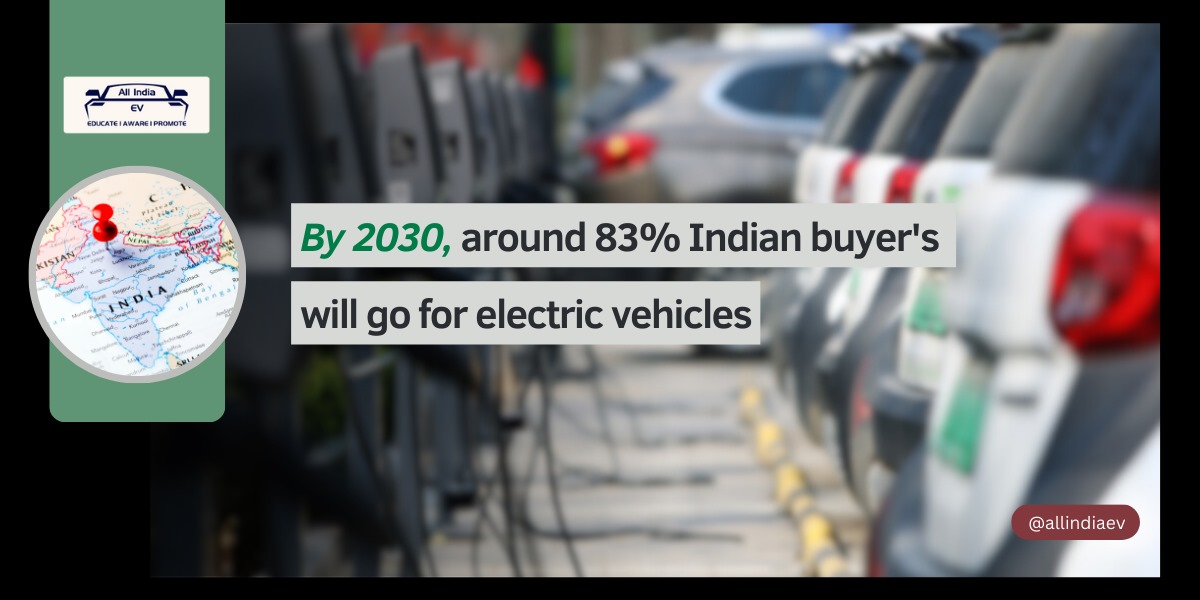
By 2030, around 83% Indian buyer’s will go for electric vehicles

A new survey reveals that most Indian consumers are embracing electric vehicles. In fact, a mind-boggling 83% of potential car buyers said they would like to own only an electric car by 2030.

According to a study done by Urban Science and The Harris Poll of 1,000 Indian consumers, consumers are ready and willing to pay up to 49% more for an electric car compared to a similar gasoline or diesel. This means that, in short, electric vehicles are rapidly becoming mainstream for Indian drivers.

India Electric Vehicle Charging Industry: Brighter Future

India is ready for some serious growth in the EV-charging sector, courtesy of changes such as increasing adoption and pro-government policies. The country presently has over 6,000 charging stations; however, that figure should increase to 100,000 by 2027.

While prospects are optimistic, India still has to bridge the gap with regard to the volume of production and technological advancements compared with China for some essential EV components such as lithium-ion batteries, electric motors, and charging infrastructure. The ultimate hegemony by the Chinese may hinder faster advancements by Indians in the EV market.

India’s EV Sector: A $20 Trillion Transformation

The electric vehicle industry is a flagship pillar of sustainable transportation that India’s government wants to focus on its fast growth. Transport Minister Nitin Gadkari recently forecasted that the EV industry may hit $20 trillion by 2030. He further projected that Indian annual EV sales may cross the 10 million mark by 2023. That is pretty ambitious targets, and it is going to be a significant change in India’s transportation landscape with immense potential for it to shine as a greener future.

More EV News

CATL Unveils Naxtra: A Sodium Battery Breakthrough That Could Redefine EV Mobility
Delta Fuels Innovation with New India HQ and R&D Center
Wardwizard Innovations and Triton EV Form Strategic Partnership to Advance Electric Vehicle Manufacturing
Government Reduces Subsidies for Electric Three-Wheelers Amid Surging Sales
Atul Greentech: Jio’s Advanced IoT Technology

The electric vehicle (EV) sector in India is poised for significant growth, with the potential to create a staggering 50 million jobs. This optimistic forecast comes as the country’s EV adoption rate continues to rise, currently standing at 2% for passenger vehicles and 6% across all vehicle categories.

With a total of 30 lakh electric vehicles are registered in India. As more consumers embrace EVs, driven by factors like environmental concerns and cost-effectiveness, the sector is expected to play a pivotal role in India’s economic development and energy transition.

Join All India EV Community

Click here for more such EV Updates

ChargeZone charges EV Industry with Battery Passport System
EXEDY Invests in Omega Seiki for Advanced EV Development
India’s Electric Vehicle Sector Draws ₹2.23 Lakh Crore Investment But Faces Massive Funding Gap
Tata Power Reaches Landmark of Installing 60,000 EV Home Chargers Across India
Citroën and BluSmart Mobility Collaborate to Boost India’s Electric Fleet with 4,000 ë-C3 Vehicles
TAGGED:EVEV India

Sign Up For Daily Newsletter

Be keep up! Get the latest breaking news delivered straight to your inbox.
Loading
By signing up, you agree to our Terms of Use and acknowledge the data practices in our Privacy Policy. You may unsubscribe at any time.
Share This Article
Facebook Whatsapp Whatsapp LinkedIn Copy Link Print
Leave a Comment

Leave a Reply Cancel reply

Your email address will not be published. Required fields are marked *

Follow US
XFollow
InstagramFollow
YoutubeSubscribe
LinkedInFollow
OHM Automotive joins hands with KINWIN and CHTC to introduce CATL battery-powered electric buses in India
19 May 2026
Annapurna Finance Partners with Piaggio Group India for Sustainable Mobility
19 May 2026
What: The Bhubaneswar Municipal Corporation (BMC) has decided to deploy electric vehicles for official staff movement as part of its urban sustainability and clean mobility strategy. The move is linked to the city’s broader push toward low-emission municipal operations. The Number: BMC has already floated an Expression of Interest (EOI) process for EV deployment and fleet engagement under its civic mobility transition programme. The Impact: The Bhubaneswar civic body EV adoption plan could accelerate municipal fleet electrification across tier-2 Indian cities, especially where urban governance bodies are under pressure to reduce fuel costs and urban emissions. The Core News The Bhubaneswar civic body EV adoption initiative reflects a growing trend among Indian municipal administrations to electrify official transport fleets. According to reports, staff members of the Bhubaneswar Municipal Corporation will increasingly use electric vehicles for official duties as the city administration attempts to align governance operations with sustainability targets and cleaner urban mobility policies. The transition is strategically important because municipal fleets operate daily within dense urban zones where fuel consumption, emissions, and maintenance costs directly impact civic expenditure. Unlike private EV adoption, government fleet electrification creates predictable utilisation cycles, making electric mobility economically more viable over time. BMC’s move also complements Bhubaneswar’s Smart City infrastructure programme, which has increasingly focused on integrated urban transport modernisation and sustainable city operations. The development comes at a time when Indian cities are gradually shifting beyond symbolic EV announcements toward operational deployment models. Several urban local bodies are now evaluating EVs not only for environmental reasons but also for lifecycle cost savings, lower fuel dependency, and simplified fleet management. Bhubaneswar’s decision could become a reference model for other municipal corporations looking to electrify internal administrative transport without immediately requiring large-scale public EV infrastructure rollouts. Breaking Down the Update • Bhubaneswar Municipal Corporation staff will use EVs for official work • The move is linked to the city’s sustainability and clean mobility objectives • BMC has initiated EOI processes related to EV engagement and deployment • The programme aligns with Bhubaneswar Smart City initiatives • Municipal fleet electrification can reduce long-term fuel and maintenance expenditure • Government-led EV adoption improves visibility and institutional acceptance of electric mobility • Tier-2 cities are increasingly becoming active participants in India’s EV transition How Bhubaneswar civic body EV adoption will help Indian EV Market The Bhubaneswar civic body EV adoption initiative could strengthen India’s municipal EV ecosystem by demonstrating how local governments can become early institutional adopters of electric mobility. Unlike private consumers, civic administrations operate predictable fleets with fixed routes and regular usage cycles, making EV economics easier to optimise. Municipal EV deployment also creates secondary market opportunities across charging infrastructure, battery servicing, fleet software, telematics, and maintenance operations. As more civic bodies shift toward electric fleets, demand for fleet-oriented EV platforms is expected to rise, especially in compact passenger mobility and utility transport segments. The Bhubaneswar civic body EV adoption model is particularly relevant for India’s tier-2 and tier-3 cities where pollution levels, fuel costs, and operational inefficiencies are increasing but large-scale metro-style transit systems remain limited. Electrifying government vehicles can help build confidence in EV reliability while simultaneously reducing public-sector fuel expenditure. Another important factor is policy signalling. When municipal administrations themselves adopt EVs, it improves institutional confidence among businesses, contractors, and urban residents. This can indirectly support broader EV adoption in public transport, delivery fleets, sanitation vehicles, and administrative mobility services across India. Conclusion & Next Steps The Bhubaneswar civic body EV adoption programme now moves into the implementation phase, where procurement quality, charging infrastructure readiness, and operational efficiency will determine long-term success. If executed effectively, the initiative could become an important template for municipal fleet electrification in India’s emerging smart cities.
Bhubaneswar civic body staff to use EVs for official work
19 May 2026
All India EV: Edition 49
What all happened in April 2026?
Click Here
All India EV

Daily EV Industry updates for you…

Categories

  • EV News
  • EV Launch
  • Investments & Funding
  • Market Insights
  • Guest Articles
  • EV Engineering

Quick Links

  • Community
  • Content Services
  • Branding Services
  • My EV Charger
  • Substack

© Developed and Managed by “The Energy Log”

Welcome Back!

Sign in to your account

Username or Email Address
Password

Lost your password?

Not a member? Sign Up