

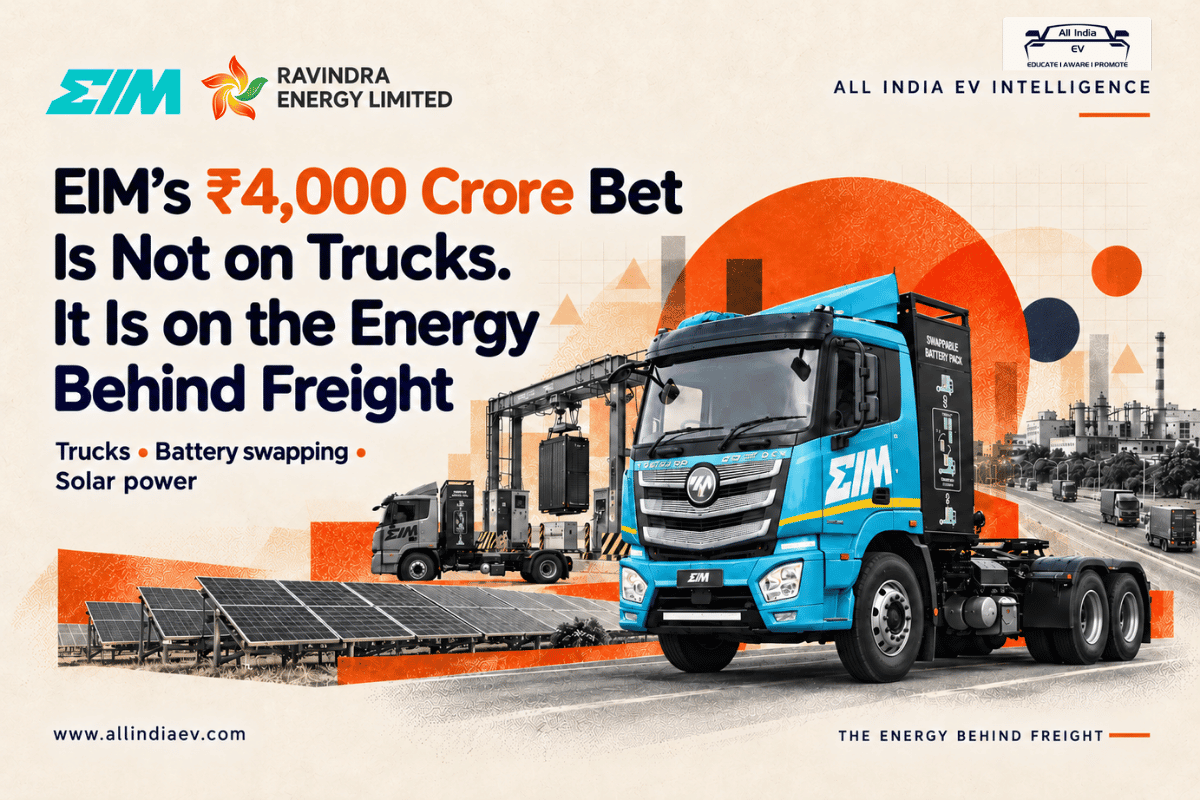
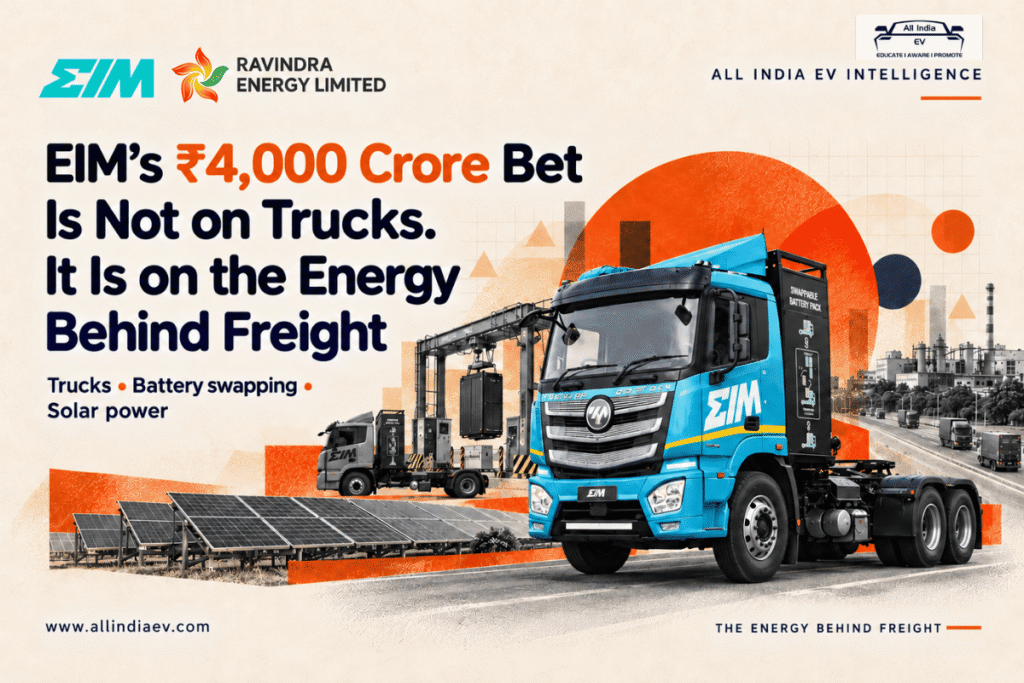
Energy In Motion’s Talegaon plant, battery-swapping network and proposed merger with Ravindra Energy point to a different model for electrifying Indian trucking: sell the vehicle, keep the battery, control the energy, build the corridor.
- Not a factory story. An energy-network story.
- EIM’s answer: take the battery out of the truck purchase
- Corridor by corridor, not everywhere at once
- What the ₹4,000 crore actually buys
- Claims Ledger
- The Four Lenses
- Demand: anchored routes, not open highways
- Supply: Indian assembly on Chinese core technology
- Capital: the merger and the SPV are the real innovation
- Policy: support exists, uptake does not yet
- The risks, and the numbers that will expose them
- Utilisation is the whole game
- BaaS moves battery risk to EIM. It does not remove it.
- Execution across seven roles at once
- The AIEV watchlist
- AIEV Intelligence View
- Sources
The short version: EIM is committing ₹3,500 to 4,000 crore across trucks, battery packs, swap stations and solar. The factory is the smallest part of the thesis. The real bet is that EIM stays economically attached to every truck it sells, through every battery swap and every unit of electricity consumed. The metric that will decide whether this works is not trucks sold. It is swaps per station per day.
Not a factory story. An energy-network story.
India’s electric-truck market is still tiny. That is exactly why EIM’s expansion deserves scrutiny.
The company is inaugurating an electric heavy-truck plant at Talegaon near Pune, rated at around 5,000 heavy commercial vehicles per shift a year, with an adjacent lithium-ion pack line of roughly 2.4 GWh a year (BusinessLine via TradingView). Those numbers frame it as a manufacturing story.
It is not. EIM does not want to earn only when a truck leaves the gate. It wants recurring revenue from the battery and the energy behind that truck for its whole working life. If that model holds, it changes both the economics of electric freight in India and the way e-truck companies get built.
The problem is not building an e-truck. It is getting a fleet to buy one.
Electric trucks already exist. The harder problem is the purchase decision. A logistics company does not buy a tractor because it is cleaner. It buys one because the truck can move freight reliably enough to return its capital.
Three variables dominate that decision: upfront cost, utilisation and downtime. Electric trucks are weak on all three. Large batteries make them expensive. Charging takes productive hours off the vehicle. A thin charging network turns range anxiety into an operating loss.
Policy uptake shows how early this is. PM E-DRIVE carries a ₹500 crore allocation targeting 5,643 e-trucks, yet the scheme dashboard showed only 283 e-trucks registered under it in FY27 as of 13 October 2026. That is scheme-supported volume, not the full market, but the gap between target and uptake is the point.
The prize is large. The government notes that diesel trucks are about 3% of India’s vehicle population but roughly 42% of transport greenhouse-gas emissions (PIB). The opportunity is obvious. The commercial model is not.
EIM’s answer: take the battery out of the truck purchase
Under its Maitryi battery-subscription model, a fleet operator buys the electric tractor without the battery. EIM says separating vehicle and battery ownership can cut upfront acquisition cost by up to 40%. The operator then pays for battery and energy access through EIM’s battery-as-a-service (BaaS) network.
This is not a financing trick. It moves risk. A conventional e-truck buyer takes on the truck, the battery, degradation risk, residual-value risk and the charging problem. Under Maitryi, much of the battery risk sits with the infrastructure provider. The operator buys the productive asset; EIM holds the energy asset behind it.
Scale makes that matter. EIM’s Ashwa tractor comes with a 282 kWh or 350 kWh pack, against the 30 to 60 kWh common in passenger EVs, and the company says a swap takes under seven minutes. Seven minutes is close to the operating logic of a diesel refuel. The product EIM is really selling is not an electric truck. It is uptime.
Corridor by corridor, not everywhere at once
EIM runs eight swap stations today and plans 40 by March 2027, covering about 5,000 km of highway and port routes. The longer plan calls for roughly 160 stations, 6,000 trucks and 7,280 packs by FY29-30.
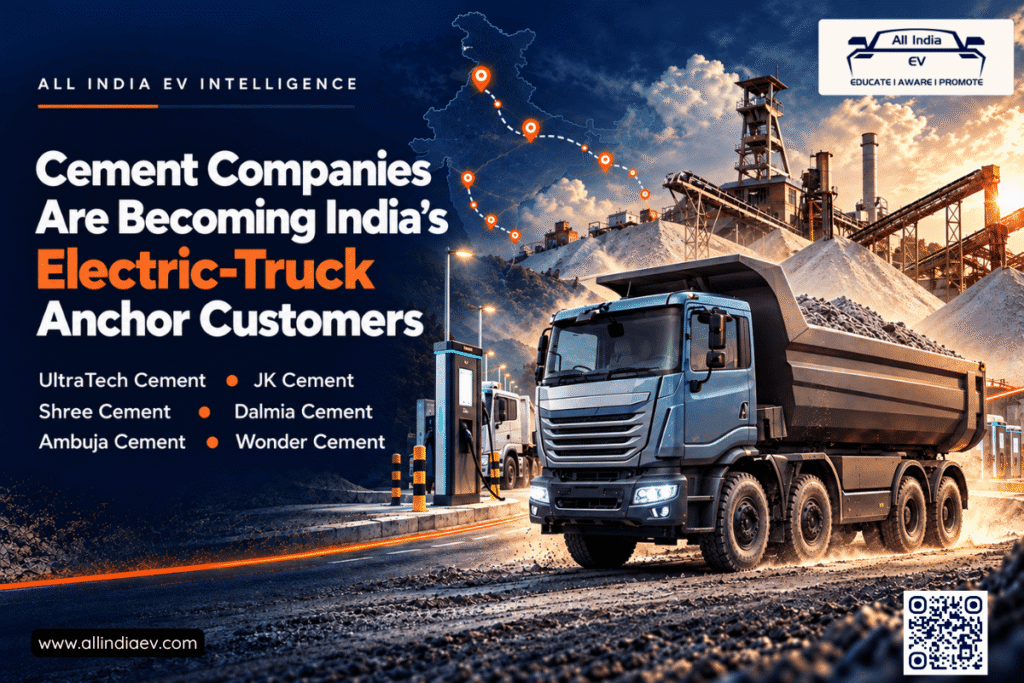
That footprint signals where electric heavy trucking works first: predictable, return-to-base routes. Ports to container freight stations. Cement, steel and power plants. Mines. Industrial corridors. These are EIM’s stated target customers.
A swap station on a fixed industrial route is not a public fast charger waiting for traffic. Its demand can be anchored by contract. India’s e-truck transition may look less like passenger-EV charging and more like industrial infrastructure, where the energy asset follows contracted freight.
What the ₹4,000 crore actually buys
The capex is a network, not a production run. The FY29-30 targets as presented to investors:
| Component | FY29-30 target |
|---|---|
| Electric trucks | 6,000 |
| Battery packs | 7,280 |
| Swap stations | 160 |
| Solar capacity | ~400 MWp |
| Network capex | ₹3,500 to 4,000 crore |
| Equity requirement (next 3 years) | ₹800 to 1,000 crore |
Each layer has a job. The truck acquires the customer. The battery earns subscription revenue. The swap station creates lock-in and uptime. Electricity is a second revenue line. Solar lowers the cost of that electricity. Software ties it together. If the chain holds, the economics beat selling trucks alone. If one link fails, the whole model gets harder.
Claims Ledger
Most of the headline numbers in this story are company targets or company disclosures, not independently verified operating data. The ledger separates them.
| Claim | Figure | Status | Source |
|---|---|---|---|
| Talegaon truck capacity | ~5,000 HCVs per shift per year | Company-reported | BusinessLine |
| Battery-pack capacity | ~2.4 GWh per year | Company-reported | BusinessLine |
| Upfront cost cut via Maitryi | Up to 40% | Company claim | BusinessLine |
| Swap time | Under 7 minutes | Company claim | BusinessLine |
| Swap stations | 8 today; 40 by Mar 2027; ~160 by FY29-30 | Company target | Investor presentation |
| Fleet and packs | 6,000 trucks, 7,280 packs by FY29-30 | Company target | Investor presentation |
| Tractors sold | 500+ (BusinessLine) vs 452 invoiced (Sept presentation) | Conflicting | BusinessLine; Investor presentation |
| Ravindra Energy operating RE | 228.87 MWp at Mar 2026 | Regulatory filing | REL Letter of Offer, Jun 2026 |
| Merger swap ratio | 209 REL shares per 100 EIM shares | Company-announced, subject to approvals | BusinessLine |
| Battery cells | Imported for the foreseeable future | Regulatory filing | REL Letter of Offer |
| PM E-DRIVE e-truck uptake | 283 registered in FY27 vs 5,643 target | Official data | PM E-DRIVE dashboard |
| MHCV swap station cost | ₹70 to 150 lakh before batteries | Independent research | CEEW |
| Solar output vs fleet demand | ~600-700 GWh vs ~548 GWh a year | AIEV estimate | AIEV calculation |
One line deserves a flag. BusinessLine reports more than 500 tractors sold by September; the September investor presentation cites 452 invoiced. The gap may be timing or definition, since sales, deliveries and invoicing are not the same thing. As EIM approaches the public market through Ravindra Energy, it should report orders, vehicles invoiced, vehicles registered, vehicles operating and vehicles actively on the BaaS network separately. Only the last two tell us whether the network model is scaling.
The Four Lenses
Demand: anchored routes, not open highways
EIM’s demand case rests on concentrated, contracted freight: port drayage, cement, steel, mining and power-plant logistics. That is the right place to start. Utilisation on a fixed route can be planned, which is the precondition for swap economics.
The test is whether fleet operators see a genuine total-cost-of-ownership advantage over diesel once subscription fees are included. A 40% lower sticker price means little if the monthly battery and energy bill erases it. EIM has not yet published a per-km or per-tonne-km comparison against diesel on a named corridor. That is the disclosure that would convert this from a pitch into a proof.
Supply: Indian assembly on Chinese core technology
EIM holds an exclusive technology licence from Beiqi Foton; Ravindra Energy’s filings describe six-year exclusivity for specified electric heavy cargo vehicles. Ravindra’s June 2026 Letter of Offer also states that EIM’s trucks currently use imported battery packs and that cells will stay imported for the foreseeable future, with pack assembly localising progressively from FY27.
Using proven Chinese technology is not unusual. China has the deepest electric-CV and battery ecosystem in the world, and licensing shortens development time sharply. But Talegaon localises vehicle assembly, and the pack line localises pack assembly. Cells and much of the core vehicle technology remain external. The open question is whether EIM uses scale to localise engineering, or remains an Indian manufacturing and operating layer on top of Chinese core technology.
Capital: the merger and the SPV are the real innovation
The proposed all-share merger with Ravindra Energy puts the electricity generator and the freight platform in one listed entity. EIM shareholders receive 209 REL shares per 100 EIM shares; REL’s existing 49.54% stake in EIM is cancelled; the listed company is to be renamed Energy In Motion, subject to approvals. REL reported 228.87 MWp of operating renewable capacity at March 2026 and says it will use that experience to supply EIM’s BaaS operations.
For an e-truck operator, electricity is fuel. Owning or contracting generation reduces exposure to public charging tariffs on its largest recurring input. This is an attempt to integrate the chain from generation to battery to wheel.
The solar target is not decorative. As an AIEV estimate, 400 MWp in India might generate around 600 to 700 GWh a year depending on site. If 6,000 trucks averaged 250 kWh a day, annual fleet demand would be about 548 GWh. Real consumption, operating days, charging losses and generation profiles will vary, but at full scale electricity is one of the largest inputs in the business, not a side line.
Financing may matter as much as technology. EIM estimates ₹800 to 1,000 crore of fresh equity over three years, plans to monetise existing renewable assets over 18 to 24 months, and will house batteries, swap stations and charging assets in an infrastructure SPV, EIM Megaplex, able to raise project-level debt. If those assets can be financed against contracted cash flows, the equity burden falls sharply. India does not only need cheaper electric trucks. It needs financeable electric-truck infrastructure.
Policy: support exists, uptake does not yet
PM E-DRIVE’s e-truck allocation is real, but 283 registrations against a 5,643-truck target shows how early adoption remains. For EIM the more consequential policy levers may sit outside the vehicle scheme: state open-access rules, power banking, grid-connection timelines and tariff treatment for swap stations. Solar produces by day; trucks need energy around the clock. Vertical integration does not remove electricity-market complexity. It gives EIM more tools to manage it, and policy decides how useful those tools are.
The risks, and the numbers that will expose them
Utilisation is the whole game
Swapping pays only when assets are busy. An idle swap station is not infrastructure. It is stranded capital. CEEW estimates MHCV swap stations at ₹70 to 150 lakh each before batteries (CEEW). Add battery inventory, land, grid connection, chargers, power equipment, software, maintenance and working capital.
EIM’s 7,280 packs for 6,000 trucks implies about 1.21 packs per truck. That float is what makes a seven-minute swap possible. It is also capital sitting outside any vehicle. Battery productivity matters as much as truck productivity.
BaaS moves battery risk to EIM. It does not remove it.
The fleet operator is relieved of battery risk; EIM or its SPV absorbs it. That means degradation, replacement timing, second-life and residual value, financing cost, thermal performance in Indian heat and pack utilisation. Heavy trucks running high daily mileage on aggressive cycles stress packs hard. REL has set up a battery technology group on lifecycle, safety and tropical operation, but real-world data is not yet public.
Execution across seven roles at once
The model asks EIM to be an OEM, battery operator, charging company, electricity buyer, renewable developer, software platform and infrastructure financier simultaneously. Vertical integration can build strong economics. It also multiplies the ways to fail.
The AIEV watchlist
| Metric | Why it matters |
|---|---|
| Swaps per station per day | The single best read on whether the ₹4,000 crore network earns a return |
| Vehicles operating on the BaaS network | Separates real network usage from invoiced sales |
| Pack degradation at 100,000, 200,000 and 500,000 km | Actual Indian heavy-duty data, not claimed cycle life |
| Cost per tonne-km vs diesel on a named corridor | Whether subscription pricing genuinely undercuts diesel |
| Share of energy from own or contracted RE | Whether the Ravindra integration lowers fuel cost in practice |
| Project debt raised in EIM Megaplex | Whether lenders will finance batteries apart from trucks |
| Localised content beyond pack assembly | Whether dependence on Foton and imported cells narrows |
AIEV Intelligence View
EIM’s plan matters because it represents a different theory of how India electrifies freight. The traditional OEM model is to build an electric truck and sell it. EIM’s model is to build the truck, finance the battery separately, control the energy, build the swap network and keep earning after the vehicle leaves the factory.
That is far more ambitious and far harder. The Talegaon plant is the least uncertain part of the story; capacity is easy to announce. What is unproven is whether swap stations on anchored corridors reach utilisation high enough to service ₹3,500 to 4,000 crore of network capex, whether packs hold up under Indian heavy-duty cycles, and whether lenders will fund batteries independently of trucks.
Our read: the strategy is directionally right for Indian heavy freight, and the Ravindra merger gives it a credible energy leg that pure-play e-truck OEMs lack. But today it is a set of targets backed by a few hundred tractors and eight stations. Until EIM reports swaps per station per day, BaaS-active vehicles and real degradation data, investors should treat the network economics as a hypothesis, not a result.
The company that wins Indian electric freight may not be the one that sells the most trucks. It may be the one that delivers the lowest dependable cost per tonne-kilometre.
To do that, owning the truck may no longer be enough. A winner may need to own, or at least control, the battery, the charging stop and the electricity behind it.
Sources
- BusinessLine report via TradingView: EIM advances ₹4,000 crore electric freight plan
- Ravindra Energy Letter of Offer, June 2026
- Investor Feed: Ravindra Energy investor presentation summary
- PM E-DRIVE dashboard
- PIB release on truck emissions
- CEEW: Challenges and benefits of battery-swapping policies