


India’s electric vehicle financing ecosystem has grown fast enough that the easy questions have been answered.
The hard ones about utilisation cycles, monsoon risk, anchor concentration, battery degradation, and the real meaning of ‘recovery’ in an asset class with no deep resale market, are now what separate operators who scale from those who bleed.
All India EV reached out to industry leaders and practitioners building portfolios in this space for their unfiltered assessment of where EV B2B financing stands today, and what the next phase demands. Here is what they had to say.
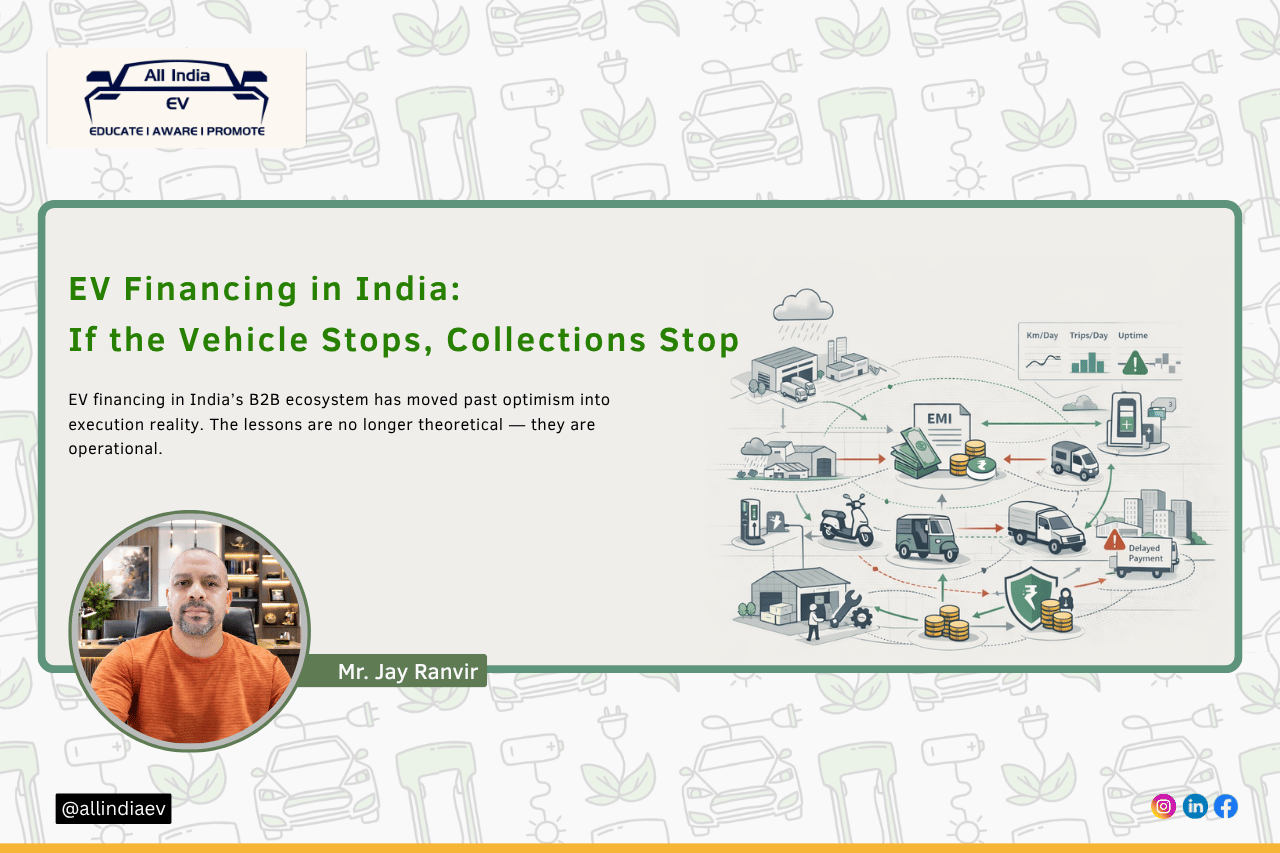
Electric vehicle (EV) financing in India’s B2B ecosystem has reached an inflection point where growth is no longer the challenge, asset quality is.
The most important shift for leasing companies is this:
EV financing is not collateral-led lending; it is utilization-led cash flow financing. If the vehicle runs, the EMI comes.
If it stops, collections stop, immediately. This single principle defines portfolio performance more than borrower intent, credit bureau scores, or even asset ownership.
More EV News

Across segments—2W delivery, 3W passenger, 3W cargo, 4W passenger, and 4W cargo—default behavior is now clearly understood and sharply differentiated.
- In 2W delivery fleets, default volatility is structurally high, with stressed pools often crossing 8–12% delinquency levels, driven by gig worker churn and weak asset attachment.
- In 3W passenger, income is highly cyclical, with 20–40% earnings compression during monsoon months, directly impacting repayment capacity. In 3W cargo, the risk lies in thin margins and informal contracts, where even a 10–15% drop in utilization can push operators into stress.
- In 4W passenger fleets, delayed corporate payments and high fixed costs create liquidity pressure despite stable demand.
- In 4W cargo—the most scalable segment—risk emerges from overestimated utilization, anchor concentration, and aggressive leverage, where even a 15–20% drop in trips per day can disrupt cash flows.
The conclusion is unambiguous: default risk in EV financing is a function of utilization variance, not borrower behavior.
The monsoon effect is the most predictable and yet most underpriced risk across EV portfolios. It is not a seasonal inconvenience, it is a systemic stress event.
During monsoons, 3W passenger earnings can fall by up to 40%, 2W delivery volumes drop materially, and in 3W/4W cargo fleets, trip efficiency declines due to congestion, route disruption, and longer turnaround times.
At the same time, waterlogging impacts charging access, battery performance, and uptime, compounding revenue loss.
For leasing companies, this translates into a clear operational reality: a 25–30% drop in utilization for even two billing cycles is a leading indicator of delinquency. Portfolios that failed to price or structure for this seasonality have already shown disproportionate stress.
A second structural failure in early EV financing models has been cash flow misalignment.
Fleet operators earn in cycles, daily trips, weekly settlements, or delayed anchor payouts—while lease obligations remain fixed. This mismatch becomes most visible during stress periods such as monsoons or contract disruptions, leading to artificial delinquencies even in otherwise viable fleets.
The risk is not always credit weakness, it is structural misalignment.
The correction is clear and non-negotiable: repayment must align with cash generation. Leading leasing companies are moving toward cycle-based EMI scheduling, flexible repayment frequencies, and revenue-linked structures.
This is not a concession to borrowers, it is a necessary redesign to match the operating reality of EV assets.
The industry has also learned, often the hard waythat collateral recovery is not a viable fallback strategy. EVs, particularly in 2W and 3W segments, have weak resale markets and high value dependency on battery conditions.
Even in 4W cargo, liquidation values are uncertain and time-consuming to realize. Repossession without redeployment leads to value erosion. The strategic shift is therefore clear:
Recovery = redeployment, not repossession.
The objective is to keep the vehicle earnings, not to recover a depreciating asset.
he most critical systemic risk sits at the anchor level. In 3W cargo, 4W passenger, and 4W cargo fleets, leasing companies are not underwriting individual operators; they are indirectly underwriting large e-commerce, logistics, and corporate clients.
Payment delays, contract renegotiations, or volume reductions at the anchor level can trigger portfolio-wide stress events. Concentration risk is therefore not theoretical—it is operational. The only sustainable mitigation is anchoring diversification, direct payment visibility, and where possible, escrow-linked structures.
Escrow and tripartite mechanisms have now moved from optional to essential. Where properly implemented, they can reduce default probability materially by ensuring priority capture of cash flows at source. H
However, weak execution, delayed reconciliation, lack of system integration, or contractual gaps—has been a major failure point in earlier portfolios. The principle is simple: control cash flow, not borrower behavior.
A defining advantage of EV financing is still underutilized in parts of the industry—is data visibility through telematics.
Unlike ICE vehicles, EVs provide real-time data on kilometers run, trips per day, idle time, charging patterns, and battery health.
This data directly correlates with revenue generation. A 20–30% drop in daily kilometers or trips sustained over 10–15 days is often an early warning signal of stress. Leasing companies that integrate this into their collection systems can shift from reactive follow-ups to predictive intervention, significantly reducing slippage.
Field strategy has also evolved. Traditional repossession-heavy models are inefficient in EV ecosystems.
The more effective approach is controlled intervention including route reallocation, operator substitution, and hub-level asset control—followed by rapid redeployment if required. In cargo segments, particularly 4W cargo, the ability to shift vehicles across routes, clients, or geographies is a key determinant of recovery outcomes. The faster the asset is redeployed, the lower the loss.
Battery risk remains central to asset performance. Degradation, downtime, and service delays directly translate into revenue loss.
In high-utilization segments like 4W cargo, even 2–3 days of downtime per month can materially impact EMI coverage ratios. Early portfolios underestimated this risk. The correction has been through OEM-backed service structures, AMC contracts, battery warranties, and emerging battery leasing models, all aimed at improving uptime predictability.
Intricately linked to this—and often under-negotiated in early EV financing, is the role of Service Level Agreements (SLAs) with OEMs, which are now a critical risk control lever for leasing companies.
EV asset performance is directly dependent on OEM responsiveness, and weak service support has been a hidden driver of defaults. therefore, As must therefore include clearly defined parameters: maximum turnaround time (TAT) for breakdown resolution (ideally 24–48 hours for critical issues), guaranteed spare parts availability at city hubs, and minimum uptime commitments (typically 90–95% for commercial fleets).
Battery-related clauses are especially critical—these should cover performance guarantees (range retention), time-bound warranty claim processing, and replacement timelines.
Additionally, SLAs should define penalty or compensation structures for prolonged downtime, ensuring OEM accountability aligns with the leasing company’s financial risk.
OEM performance is not an operational detail — it is a direct determinant of collection efficiency.
Regulatory and policy variability adds another layer of risk. Subsidy changes, state-level EV policies, and permit regulations can alter vehicle economics and demand viability overnight. Portfolios built on static policy assumptions have already faced stress.
Leasing companies must therefore incorporate policy sensitivity into both underwriting and ongoing monitoring, treating regulation as a dynamic variable.
Restructuring has become a strategic tool, not a distress signal, in EV financing. A substantial proportion of defaults are temporary and operational—driven by seasonality, contract gaps, or short-term disruptions. Targeted interventions such as short moratoriums, tenure extensions, or step-up repayments can restore cash flow alignment.
The key is discipline: support viable operators, exit structurally weak ones early.
Finally, performance management in EV financing requires a shift from static credit metrics to dynamic operational dashboards. Traditional indicators like DPD are lagging signals. Leading leasing companies now track utilization (km/day, trips/day), uptime, revenue per asset, anchor concentration, battery health, and service downtime linked to OEM performance in real time.
These are the true leading indicators of portfolio quality.
Read More: Catch up on All India EV’s related coverage on India’s evolving commercial EV subsidies and battery swapping policies at All India EV