
All India EVAll India EVAll India EV
Notification
Font ResizerAa
  • Home
  • EV News
  • EV Launch
  • Market Insights
  • Investments & Funding
  • Guest Articles
  • EV Engineering
  • Contact
Reading: Local vs. MNC Culture in the Automotive Industry: Strategy, Decision-Making & Timely Execution
Share
All India EVAll India EV
Font ResizerAa
  • Home
  • EV News
  • EV Launch
  • Market Insights
  • Guest Articles
  • EV Engineering
  • Contact
Search
  • Home
    • Home 1
    • Home 2
    • Home 3
    • Home 4
    • Home 5
  • Home
  • Categories
    • Electric
  • Categories
  • Shows
    • Rap
  • More Foxiz
    • Blog Index
    • Contact
  • Bookmarks
    • Customize Interests
    • My Bookmarks
  • More Foxiz
    • Blog Index
    • Sitemap
Have an existing account? Sign In
Follow US
local vs. MNC culture
Home » Blog » Local vs. MNC Culture in the Automotive Industry: Strategy, Decision-Making & Timely Execution
Guest Articles

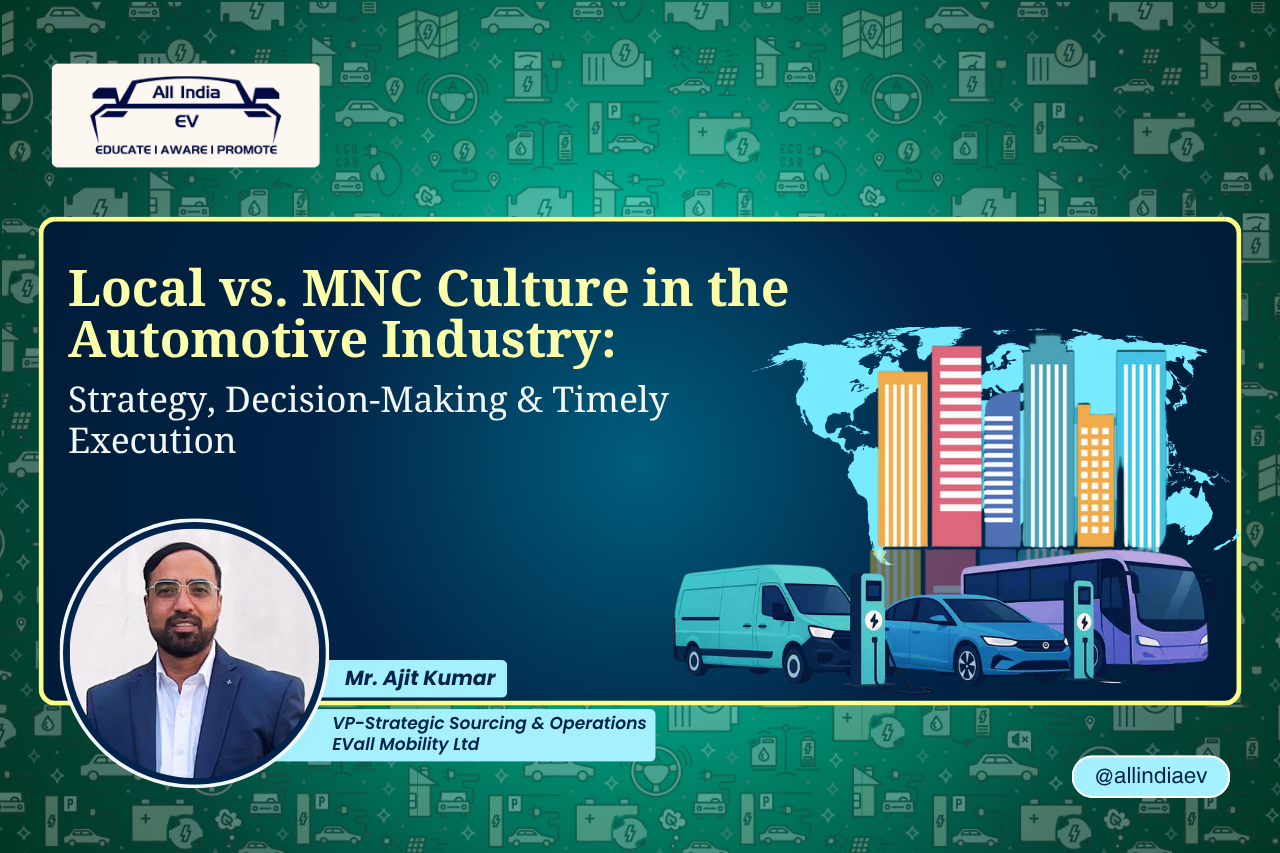
Local vs. MNC Culture in the Automotive Industry: Strategy, Decision-Making & Timely Execution

Sunita
By
Sunita
Last updated: 7 October 2025
Share
7 Min Read
SHARE

In the automotive sector, where precision engineering meets unforgiving timelines, the cultural and strategic differences between local companies and multinational corporations (MNCs) shape not just how projects are executed—but whether they succeed at all. From tooling investments to supplier selection, every decision reflects a deeper philosophy about quality, speed, and sustainability.

Cultural DNA: Speed vs. Structure

AspectLocal ComapnaiesMultinational Corporations-MNC
Work CultureEntrepreneurial, flexible, hustle- drivenProcess-oriented,                                              compliance- heavy
Team DynamicsFlat     hierarchies,            founder-led decisionsMatrix structures, cross-functional teams
Communication StyleDirect, informal, rapidFormal, layered, globally aligned
Risk AppetiteHigh—willing to pivot fastModerate  risk  managed  through protocols

Local companies often operate with a “get-it-done” mindset, while MNCs emphasize governance and global alignment. This contrast becomes especially visible in how each approaches product development and supplier integration.


Strategic Orientation: Market Pulse vs. Global Playbook

·       Local Companies:

o   Prioritize market entry speed, often at the cost of long-term robustness.

o    Strategy evolves with real-time feedback—agile but reactive.

o    Innovation is frugal, focused on cost containment.

  MNCs:

More EV News
How was 2023 for ChargeUp?
Park. Power. Repeat. – How Watt Wave is Making EV Charging Wireless and Worry-Free
ShEV – Arti Rathour Sales & Strategic Partnerships at ZEVpoint
Challenges in the Adoption of Electric Autos in India
Delhi EV Policy 2026: The Real Gap Is Not in Vision, But in Making EVs Work on the Ground

· Operate with long-term roadmaps and global benchmarks.

·  Invest heavily in R&D, tooling, and validation cycles.

·  Innovation is structured, with rigorous testing and compliance.

Decision FactorLocal CompaniesMNCs
Project ApprovalQuick, centralizedMulti-tiered, HQ involvement
Vendor SelectionRelationship-driven, flexible termsCompliance-heavy,                                     globalsourcing norms
Change ManagementAdaptive, informalStructured,  often                        requiringglobal sign-off

Product Quality & Technology Integration: The Hidden Fault Line

One of the most critical—and often overlooked—differences lies in how each type of company approaches product quality and technology integration:

Local Companies & Startups

  • Often accept parts “as-is” to avoid tooling investment, leading to poor fitment, inconsistent tolerances, and downstream failures.
  • Compromise on specs to meet price targets, especially in early-stage EV startups aiming for rapid market entry.
  • Skip validation cycles, relying on supplier assurances rather than rigorous testing.
  • Technology adoption is patchy—limited thermal modeling, weak BMS integration, and minimal lifecycle analysis.

This approach may yield short-term gains, but it’s a ticking time bomb. Several startups have launched with compromised products, only to face recalls, customer dissatisfaction, and eventual shutdown. The market punishes shortcuts—especially in safety-critical domains like braking systems, battery packs, and thermal management.

MNCs

  • Invest in tooling, jigs, and fixtures to ensure repeatability and precision.
  • Follow APQP, PPAP, and DFMEA rigorously to mitigate risks.
  • Use digital twins, simulation tools, and predictive analytics for early fault detection.
  • Prioritize supplier development—training, audits, and joint engineering reviews.

While this adds time and cost upfront, it builds resilience and brand trust. MNCs understand that in automotive, quality is not a department—it’s a culture.


Case in Point: EV Battery Pack Integration

  • A local startup might accept off-the-shelf battery modules with mismatched connectors, skip thermal validation, and launch with a basic BMS. The result? Field failures, overheating, and warranty nightmares.
  • An MNC would co-develop the pack with suppliers, run thermal simulations, validate under extreme conditions, and ensure compliance with AIS-156 and ISO standards.

Startups often fall into the trap of:

  • Launching prematurely to attract investors or meet grant deadlines.
  • Overpromising on specs without backend engineering support.
  • Underinvesting in tooling, leading to poor manufacturability.
  • Ignoring field feedback, mistaking early traction for product-market fit.

This leads to a vicious cycle: poor quality → customer complaints → rework costs → cash burn →shutdown.


Bridging the Gap: A Hybrid Blueprint

To succeed, especially in emerging markets, companies must blend agility with discipline:

  • Invest in modular tooling to balance flexibility and precision.
  • Adopt digital validation tools like FEA, CFD, and battery simulation.
  • Build supplier capability, not just contracts.
  • Create cross-functional “tiger teams” for rapid problem-solving.

Real-Life Examples: Startup Struggles vs. MNC Discipline

1.  GoMechanic – Rapid Growth, Rapid Collapse

What happened: GoMechanic, once a promising auto service startup, expanded aggressively across India. However, it collapsed in early 2023 after admitting to financial misreporting and unsustainable operations.

Why it matters: The company scaled too fast without robust internal controls, supplier discipline, or service consistency. Despite investor backing, the lack of operational maturity led to its downfall.

2.  BluSmart – EV Ride-Hailing with a Hard Brake

  • What happened: BluSmart pioneered India’s first 100% electric ride-hailing service, operating its own EV fleet with no surge pricing and high customer satisfaction. By 2025, it had completed over 25 million rides and scaled to 8,700 EVs.
  • Why it matters: Despite its success, BluSmart abruptly shut down operations following a financial scandal involving its leasing partner Gensol Engineering. Allegations of fund diversion and regulatory action led to investor pullout and operational collapse.

3.  Tork Motors – Engineering Promise, Market Reality

  • What happened: Tork Motors, a Pune-based EV startup, showcased strong engineering credentials and prototypes. However, commercial rollout was delayed multiple times due to tooling challenges and supplier readiness.
  • Why it matters: Despite technical capability, the lack of manufacturing scale and supplier integration slowed execution. It’s a classic case of engineering promise not translating into timely delivery.

These examples show that startups often fall into the trap of prioritizing speed, visibility, and investor optics over engineering discipline, supplier integration, and financial transparency. The result? Field failures, reputational damage, and in some cases, complete shutdown.

Conclusion:

In automotive, the road to success isn’t paved with shortcuts. Local companies bring speed and market intimacy; MNCs bring structure and quality. The future belongs to those who can integrate technology, respect engineering discipline, and still move fast.

One of the most critical—and often overlooked—differences lies in how each type of company approaches product quality and technology integration.
Join All India EV Community

Click here for more such EV Updates

TVS Sensing Solutions Redefining Sensor Technology for Electric Vehicles
Norway EV Industry Growth: Their Journey to Electric Dominance
From Fuel Bills to Family Savings: How BMR EV Is Empowering India’s Everyday Heroes
Recycling and Resource Circularity: The Next Frontier for India’s EV Industry
EKA Mobility and Chartered Speed Limited aims to Deploy 1,750 Electric Buses in Bengaluru under PM E-Drive

Sign Up For Daily Newsletter

Be keep up! Get the latest breaking news delivered straight to your inbox.
Loading
By signing up, you agree to our Terms of Use and acknowledge the data practices in our Privacy Policy. You may unsubscribe at any time.
Share This Article
Facebook Whatsapp Whatsapp LinkedIn Copy Link Print
Leave a Comment

Leave a Reply Cancel reply

Your email address will not be published. Required fields are marked *

Follow US
XFollow
InstagramFollow
YoutubeSubscribe
LinkedInFollow
Haryana cabinet approves new rules: No petrol, diesel vehicles for cab aggregators in NCR
21 May 2026
Ultraviolette and Bolt.Earth Expand Type-6 DC Fast Charging Infrastructure Across India
Ultraviolet and Bolt. Earth Expand Type-6 DC Fast Charging Infrastructure Across India
21 May 2026
What: India’s finance ministry has directed public sector banks, insurers, and financial institutions to reduce operational spending and accelerate adoption of electric vehicles across official fleets. The move is part of a wider austerity push linked to rising global economic uncertainty and fuel-related risks. The Number: The directive impacts major public institutions including State Bank of India, Bank of Baroda, and Life Insurance Corporation of India, covering millions of employees and thousands of operational vehicles nationwide. The Impact: The policy signals a new phase of institutional fleet electrification in India, where EV adoption is now being tied directly to fiscal discipline, fuel import management, and public-sector operational efficiency. The Core News India’s finance ministry has formally instructed state-run financial institutions to implement strict expenditure controls while simultaneously accelerating EV adoption for official transport operations. The directive from the Department of Financial Services asks organisations to replace petrol and diesel vehicles used at head offices and branch operations with electric vehicles “as far as possible.” The order comes amid growing concern over the economic impact of prolonged geopolitical instability in West Asia, which threatens to increase crude oil prices, widen India’s import bill, and pressure the rupee. Alongside the EV transition mandate, the government has also pushed virtual meetings, reduced foreign travel, and tighter administrative spending controls across public-sector institutions. For India’s EV ecosystem, the directive is strategically important because it expands demand visibility beyond state transport undertakings and government departments into the financial sector itself. PSU banks and insurers operate one of the country’s largest distributed office networks, including regional offices, branch fleets, field operations, and administrative mobility services. Even a phased transition could create a sizeable procurement pipeline for electric passenger vehicles, charging infrastructure providers, and fleet management companies. Breaking Down the Update • The Department of Financial Services issued the austerity and EV adoption directive to PSU banks, insurers, and financial institutions. • The government wants petrol and diesel vehicles used in official operations to be progressively replaced by EVs wherever operationally feasible. • The policy push follows Prime Minister Narendra Modi’s appeal for fuel conservation and controlled discretionary spending amid global energy uncertainty. • The directive also mandates greater use of video conferencing to reduce travel-related operational expenditure. • The move could indirectly support domestic EV OEMs, leasing firms, and charging infrastructure operators through institutional procurement demand. • The banking and insurance sector may emerge as a new enterprise fleet electrification category in India’s EV transition roadmap. How PSU banks EV adoption will help Indian EV Market The expansion of PSU banks EV adoption could create a strong institutional demand layer for India’s electric mobility sector. Public sector banks and insurers operate thousands of branch offices across urban, semi-urban, and rural India. Their transition to EV fleets can generate predictable procurement volumes for domestic automakers, especially in the electric sedan, compact SUV, and commercial mobility segments. Beyond vehicle sales, the policy may also accelerate deployment of workplace charging infrastructure at bank headquarters, zonal offices, and regional branches. This can support charger utilisation economics while helping normalise EV infrastructure in tier-2 and tier-3 cities. Another important impact is signalling. When large state-linked financial institutions adopt EVs as operational assets rather than pilot projects, it improves confidence across the broader enterprise mobility market. Private banks, NBFCs, and insurance firms could eventually follow similar fleet transition models to reduce long-term fuel and maintenance costs. PSU banks EV adoption also aligns with India’s larger energy security strategy. Lower petroleum consumption in institutional fleets directly supports efforts to reduce crude import dependence while stabilising operational expenditure during periods of volatile global oil prices. Conclusion & Next Steps The government’s push toward PSU banks EV adoption reflects a broader shift where EV deployment is increasingly being linked with macroeconomic resilience rather than only sustainability targets. Execution, however, will depend on procurement timelines, charging infrastructure readiness, and operational suitability across
India directs state-run banks, insurance firms to cut costs, shift to EVs
21 May 2026
All India EV: Edition 49
What all happened in April 2026?
Click Here
All India EV

Daily EV Industry updates for you…

Categories

  • EV News
  • EV Launch
  • Investments & Funding
  • Market Insights
  • Guest Articles
  • EV Engineering

Quick Links

  • Community
  • Content Services
  • Branding Services
  • My EV Charger
  • Substack

© Developed and Managed by “The Energy Log”

Welcome Back!

Sign in to your account

Username or Email Address
Password

Lost your password?

Not a member? Sign Up