
All India EVAll India EVAll India EV
Notification
Font ResizerAa
  • Home
  • EV News
  • EV Launch
  • Market Insights
  • Investments & Funding
  • Guest Articles
  • EV Engineering
  • Contact
Reading: More range per charge or more years per battery? What matters in EV?
Share
All India EVAll India EV
Font ResizerAa
  • Home
  • EV News
  • EV Launch
  • Market Insights
  • Guest Articles
  • EV Engineering
  • Contact
Search
  • Home
    • Home 1
    • Home 2
    • Home 3
    • Home 4
    • Home 5
  • Home
  • Categories
    • Electric
  • Categories
  • Shows
    • Rap
  • More Foxiz
    • Blog Index
    • Contact
  • Bookmarks
    • Customize Interests
    • My Bookmarks
  • More Foxiz
    • Blog Index
    • Sitemap
Have an existing account? Sign In
Follow US
longer battery life
Home » Blog » More range per charge or more years per battery? What matters in EV?
Guest Articles

More range per charge or more years per battery? What matters in EV?

Sunita
By
Sunita
Last updated: 8 September 2025
Share
6 Min Read
SHARE

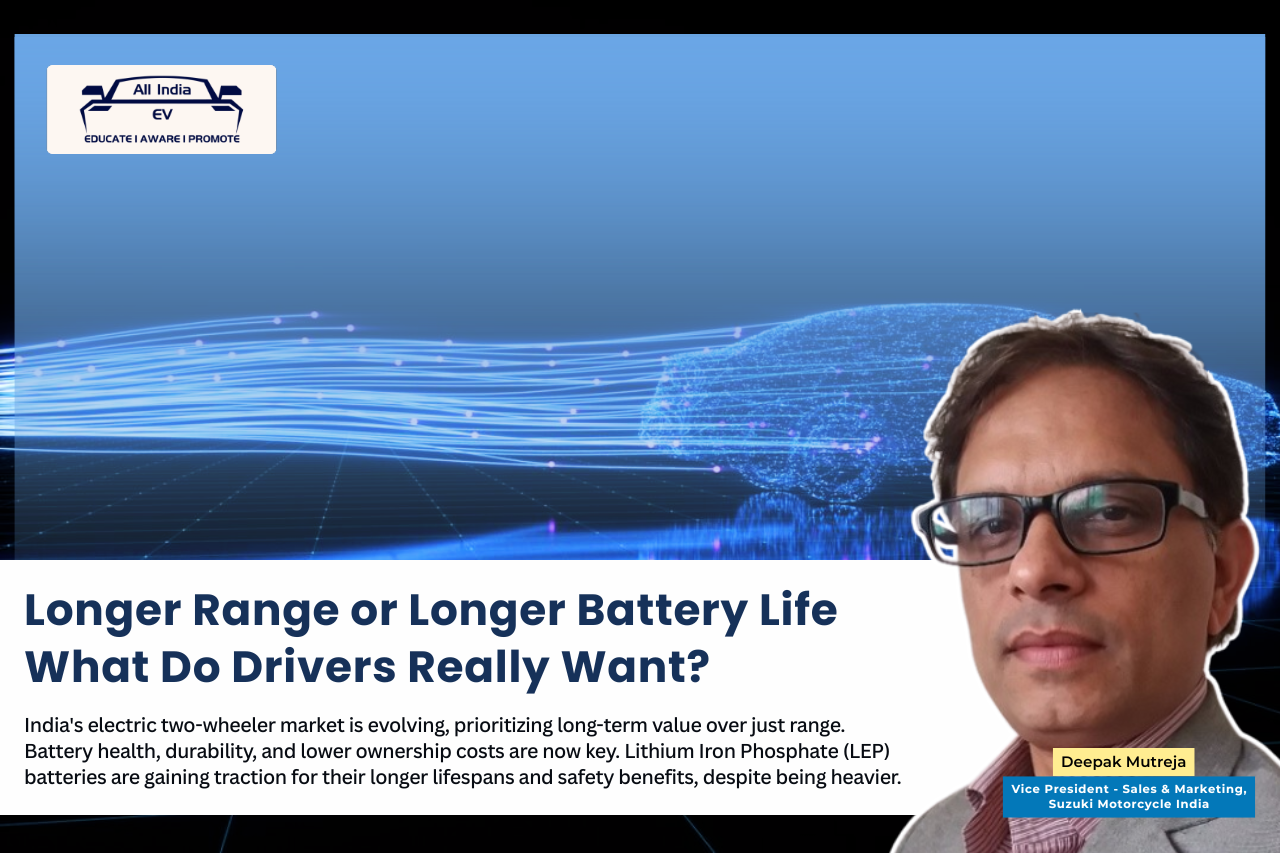
“India’s electric two-wheeler market is evolving, prioritizing long-term value over just range. Battery health, durability, and lower ownership costs are now key. Lithium Iron Phosphate (LFP) batteries are gaining traction for their longer lifespans and safety benefits, despite being heavier.”

Contents
  • Rethinking the ‘Range Race’
  • Reliability and longevity: Building trust that lasts
  • Battery life in real-world perspective
  • Looking beyond price tags: Total cost of ownership
  • The Road Ahead: A broader vision for sustainable mobility

The electric two-wheeler (EV 2W) market in India is rapidly expanding, fuelled by the growing demand for sustainable mobility solutions. While range is often discussed, electric mobility technology has evolved significantly. Advancements in battery chemistry, vehicle architecture, and energy management systems have redefined what makes an EV truly sustainable. Today, true sustainability is being defined by factors like long-lasting battery life, dependable performance, a refined rider experience, and a lower cost of ownership.


Rethinking the ‘Range Race’

As the electric mobility landscape matures, the focus is shifting beyond the “race for range” toward a more holistic approach to EV development, one that emphasizes long-term value and sustainability.

Hence, the true value of an EV lies in vital aspects like battery health, long-term performance, and vehicle durability. These factors are the real differentiators between an EV that’s appealing at first and one that remains dependable for years.

Reliability and longevity: Building trust that lasts

In any automotive segment, trust is a currency earned over time and reliability is central to building that trust. Whether from a legacy manufacturer or a startup, consumers expect their electric vehicles to be dependable and require minimal maintenance. Delivering on that expectation demands the use of robust components, rigorous validation processes, and smart engineering.Battery Management Systems (BMS), for example, play a key role in ensuring battery safety and performance by constantly monitoring voltage, current, and temperature to prevent damage from overcharging or deep discharges.

Just as important is the choice of battery chemistry. Lithium Iron Phosphate (LFP) batteries are being adopted for their advantages in thermal stability and longevity. Compared to Nickel Manganese Cobalt (NMC) batteries, LFP batteries typically offer a longer cycle life, 2–3 times the cycle life of NMC batteries. Their characteristic of being less prone to thermal runaway also reduce the risk of overheating or battery related issues. Though LFP batteries are heavier and less energy-dense than NMC, their long-life span makes them a compelling choice where consistent performance and durability are paramount.The industry must continue to prioritize building electric two-wheelers that deliver consistent performance over time, minimize maintenance needs, and offer consumers tangible value, not just at the point of purchase, but throughout the entire ownership experience.

Battery life in real-world perspective

To better understand battery degradation, consider a simple analogy: your mobile phone. When new, it might last nearly two days on a single charge. But after a few years of daily use and charging, its battery life often drops to just a day or even less. Eventually, you consider replacing the battery or even the device itself. EV batteries behave similarly. A brand-new EV that once offered 100 km of range may only provide a fraction of that after several years. When range drops significantly, battery replacement becomes a consideration, a cost that’s not insignificant.That’s where high-quality batteries with longer lifespans, such as LFP, make a critical difference. A longer-lasting battery means your vehicle maintains usable range for more years, reducing the frequency and cost of replacements while enhancing overall ownership satisfaction.

More EV News

How was 2023 for eOxigen Automotive?
Montra Electric’s Rhino, India’s 1st 55-ton GCW EV Truck, crosses 1.2 crores kilometres
FPGA-based EVCharger & Normal EVCharger
Market of On-Demand EV Charging Globally
How was 2023 for ChargeUp?

Looking beyond price tags: Total cost of ownership

Sustainability in EVs goes beyond the showroom price. Consumers are increasingly evaluating the Total Cost of Ownership (TCO), a more holistic view that includes not just the initial cost, but also ongoing expenses such as charging, routine servicing, and eventual battery replacement.Well-built, reliable vehicles with longer battery life spans ultimately offer better TCO, even if their upfront cost is slightly higher. Choosing sustainable battery technology like LFP over short-term specs like “maximum range” can lead to a more economical and rewarding ownership experience.

The Road Ahead: A broader vision for sustainable mobility

As an industry, our responsibility extends beyond simply selling electric vehicles. We must advocate for a future that champions longevity, trust, and consumer-first innovation. True sustainability is not about chasing numbers on a spec sheet. It’s about building products that deliver consistent performance over time, minimize resource consumption, and offer real-world value to the rider. Let’s move the conversation beyond just “kilometres” and instead steer the industry toward a destination where durability, reliability, and thoughtful engineering drive sustainable progress.

The article is authored by Deepak Mutreja (Vice President – Sales & Marketing, Suzuki Motorcycle India Pvt. Ltd.).

Join All India EV Community

Click here for more such EV Updates

Journey of Motorama EV Private Limited
Understanding Credit Risks in India’s Nascent EV Ecosystem
India’s Electric Motorcycle Gap, and Raptee.HV’s High-Voltage Answer
Vecmocon Chargers: The Unreplicable Standard in India’s EV Tech Evolution
Simple Energy Raises $10 Mn in Bridge Round to Expand Retail Presence

Sign Up For Daily Newsletter

Be keep up! Get the latest breaking news delivered straight to your inbox.
Loading
By signing up, you agree to our Terms of Use and acknowledge the data practices in our Privacy Policy. You may unsubscribe at any time.
Share This Article
Facebook Whatsapp Whatsapp LinkedIn Copy Link Print
Leave a Comment

Leave a Reply Cancel reply

Your email address will not be published. Required fields are marked *

Follow US
XFollow
InstagramFollow
YoutubeSubscribe
LinkedInFollow
What: India’s finance ministry has directed public sector banks, insurers, and financial institutions to reduce operational spending and accelerate adoption of electric vehicles across official fleets. The move is part of a wider austerity push linked to rising global economic uncertainty and fuel-related risks. The Number: The directive impacts major public institutions including State Bank of India, Bank of Baroda, and Life Insurance Corporation of India, covering millions of employees and thousands of operational vehicles nationwide. The Impact: The policy signals a new phase of institutional fleet electrification in India, where EV adoption is now being tied directly to fiscal discipline, fuel import management, and public-sector operational efficiency. The Core News India’s finance ministry has formally instructed state-run financial institutions to implement strict expenditure controls while simultaneously accelerating EV adoption for official transport operations. The directive from the Department of Financial Services asks organisations to replace petrol and diesel vehicles used at head offices and branch operations with electric vehicles “as far as possible.” The order comes amid growing concern over the economic impact of prolonged geopolitical instability in West Asia, which threatens to increase crude oil prices, widen India’s import bill, and pressure the rupee. Alongside the EV transition mandate, the government has also pushed virtual meetings, reduced foreign travel, and tighter administrative spending controls across public-sector institutions. For India’s EV ecosystem, the directive is strategically important because it expands demand visibility beyond state transport undertakings and government departments into the financial sector itself. PSU banks and insurers operate one of the country’s largest distributed office networks, including regional offices, branch fleets, field operations, and administrative mobility services. Even a phased transition could create a sizeable procurement pipeline for electric passenger vehicles, charging infrastructure providers, and fleet management companies. Breaking Down the Update • The Department of Financial Services issued the austerity and EV adoption directive to PSU banks, insurers, and financial institutions. • The government wants petrol and diesel vehicles used in official operations to be progressively replaced by EVs wherever operationally feasible. • The policy push follows Prime Minister Narendra Modi’s appeal for fuel conservation and controlled discretionary spending amid global energy uncertainty. • The directive also mandates greater use of video conferencing to reduce travel-related operational expenditure. • The move could indirectly support domestic EV OEMs, leasing firms, and charging infrastructure operators through institutional procurement demand. • The banking and insurance sector may emerge as a new enterprise fleet electrification category in India’s EV transition roadmap. How PSU banks EV adoption will help Indian EV Market The expansion of PSU banks EV adoption could create a strong institutional demand layer for India’s electric mobility sector. Public sector banks and insurers operate thousands of branch offices across urban, semi-urban, and rural India. Their transition to EV fleets can generate predictable procurement volumes for domestic automakers, especially in the electric sedan, compact SUV, and commercial mobility segments. Beyond vehicle sales, the policy may also accelerate deployment of workplace charging infrastructure at bank headquarters, zonal offices, and regional branches. This can support charger utilisation economics while helping normalise EV infrastructure in tier-2 and tier-3 cities. Another important impact is signalling. When large state-linked financial institutions adopt EVs as operational assets rather than pilot projects, it improves confidence across the broader enterprise mobility market. Private banks, NBFCs, and insurance firms could eventually follow similar fleet transition models to reduce long-term fuel and maintenance costs. PSU banks EV adoption also aligns with India’s larger energy security strategy. Lower petroleum consumption in institutional fleets directly supports efforts to reduce crude import dependence while stabilising operational expenditure during periods of volatile global oil prices. Conclusion & Next Steps The government’s push toward PSU banks EV adoption reflects a broader shift where EV deployment is increasingly being linked with macroeconomic resilience rather than only sustainability targets. Execution, however, will depend on procurement timelines, charging infrastructure readiness, and operational suitability across
India directs state-run banks, insurance firms to cut costs, shift to EVs
20 May 2026
Uttar Pradesh To Get 714 New EV Charging Stations Under Centre’s Rs 500 Crore Infrastructure Push
20 May 2026
China’s EV slowdown could trigger the industry’s biggest global reset
20 May 2026
All India EV: Edition 49
What all happened in April 2026?
Click Here
All India EV

Daily EV Industry updates for you…

Categories

  • EV News
  • EV Launch
  • Investments & Funding
  • Market Insights
  • Guest Articles
  • EV Engineering

Quick Links

  • Community
  • Content Services
  • Branding Services
  • My EV Charger
  • Substack

© Developed and Managed by “The Energy Log”

Welcome Back!

Sign in to your account

Username or Email Address
Password

Lost your password?

Not a member? Sign Up