

What: The Skilling-Credit Equation That Will Define India’s EV Decade highlights how India’s electric mobility transition is increasingly dependent on workforce capability, technical reskilling, and financing models linked to operational performance.
The Number: India’s EV ecosystem spans rapidly growing two-wheeler, three-wheeler, commercial fleet, charging infrastructure, and battery deployment segments, with workforce readiness emerging as a core execution bottleneck.
The Impact: The report positions workforce capability as a direct financial and operational variable for EV adoption, fleet uptime, lender confidence, and long-term asset performance in India’s EV market.

The Core News
The Skilling-Credit Equation That Will Define India’s EV Decade argues that India’s EV transition is moving beyond a pure infrastructure and subsidy conversation into a deeper operational challenge centered around workforce readiness. As EV penetration accelerates across commercial fleets, charging infrastructure, and battery ecosystems, the industry is encountering a growing mismatch between technology requirements and existing automotive skillsets.
Unlike internal combustion engine (ICE) ecosystems that rely heavily on mechanical repair capabilities, electric mobility systems demand expertise in battery diagnostics, embedded electronics, firmware management, telematics, and high-voltage safety systems. The article highlights that this transition is structural rather than incremental, making traditional automotive training frameworks partially obsolete for modern EV operations.
More EV News

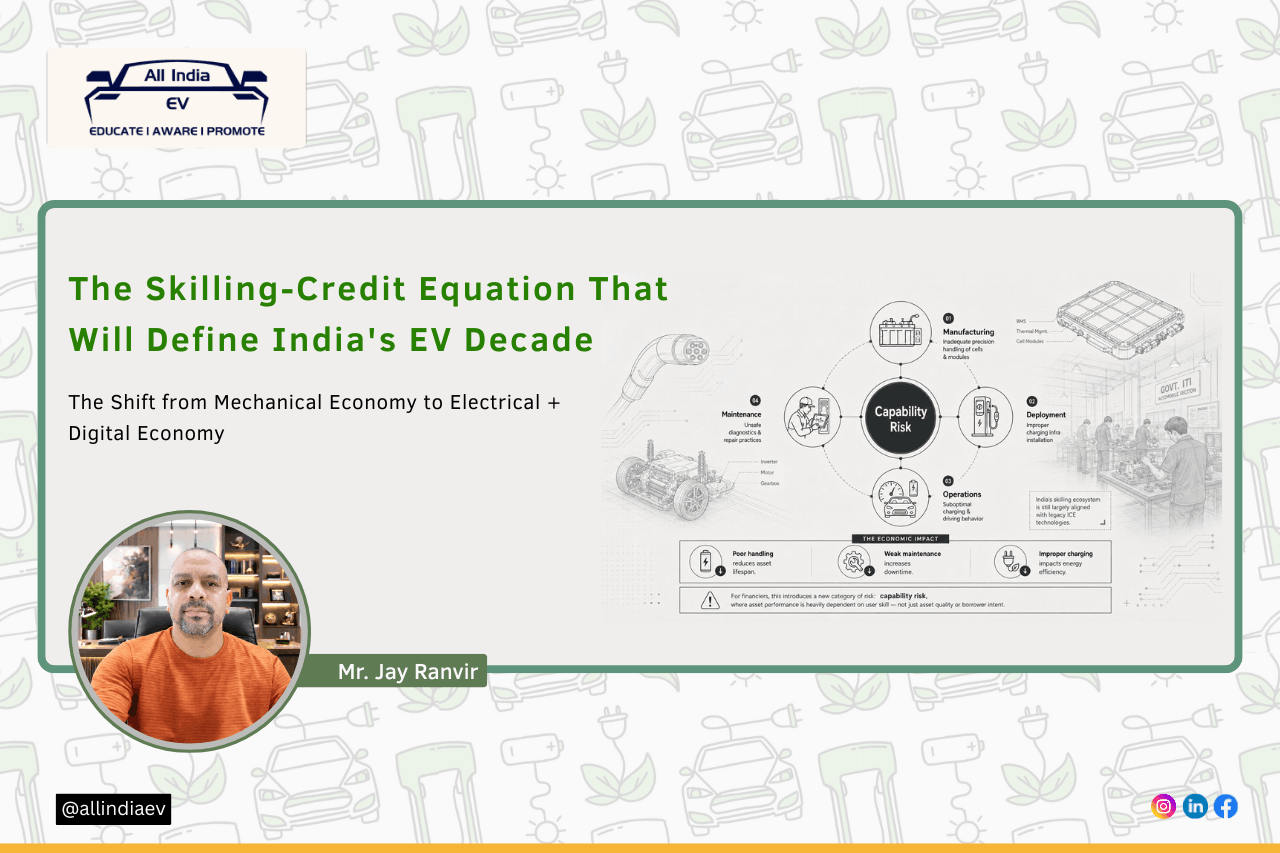
A major concern raised is the emergence of “capability risk” within EV financing. According to the analysis, vehicle uptime, battery health, energy efficiency, and operational cash flow are increasingly influenced by driver behaviour, maintenance quality, charging practices, and diagnostic capability. This creates a direct linkage between workforce quality and repayment behaviour, especially in high-utilisation commercial EV segments such as last-mile logistics and cargo mobility.
Breaking Down the Update
• The EV ecosystem is shifting from mechanical-centric systems to electrical and software-driven platforms
• Traditional ITI and automotive training systems remain largely aligned with ICE technologies
• Poor battery handling and weak charging practices can directly impact fleet economics and uptime
• Workforce capability is emerging as a financial risk parameter for lenders and insurers
• Commercial EV financing may increasingly integrate operator certification and skill validation
• Reskilling existing mechanics, electricians, and drivers is viewed as a faster pathway than building a new workforce from scratch
• Telematics and operational analytics could become part of future credit assessment frameworks
• Safety training is being positioned as both a compliance and financial safeguard mechanism
How The Skilling-Credit Equation That Will Define India’s EV Decade will help Indian EV Market
The Skilling-Credit Equation That Will Define India’s EV Decade brings attention to one of the least discussed but most critical barriers in India’s electric mobility transition: workforce capability. While policy incentives and charging infrastructure expansion continue to dominate public discussions, operational readiness at the technician, driver, and fleet-management level remains uneven across the country.
A structured focus on EV skilling can improve multiple layers of the ecosystem simultaneously. Better-trained technicians can reduce downtime and improve battery lifecycle performance. Skilled drivers can optimise energy consumption and reduce operating costs for fleet operators. Certified charging installers can improve charging reliability and reduce safety incidents.
From a financing perspective, workforce capability could become an important underwriting metric for commercial EV lending. Higher uptime and better asset utilisation improve cash flow predictability, which directly lowers repayment risk for lenders and NBFCs. This becomes particularly important in India’s fast-growing last-mile delivery and logistics sectors where profitability margins remain thin.
The article also reinforces the need for closer collaboration between OEMs, training institutions, financiers, and policymakers to create scalable EV certification frameworks across India.
Conclusion & Next Steps
The Skilling-Credit Equation That Will Define India’s EV Decade underlines that India’s EV market will not scale sustainably through vehicle deployment alone. Workforce capability, operational discipline, and financing innovation are becoming equally critical pillars of the transition. The next phase of India’s EV growth will likely depend on how effectively the industry integrates skilling, safety, and credit ecosystems into mainstream electric mobility deployment.
Read More: Catch up on All India EV’s related coverage on India’s evolving commercial EV subsidies and battery swapping policies at All India EV