
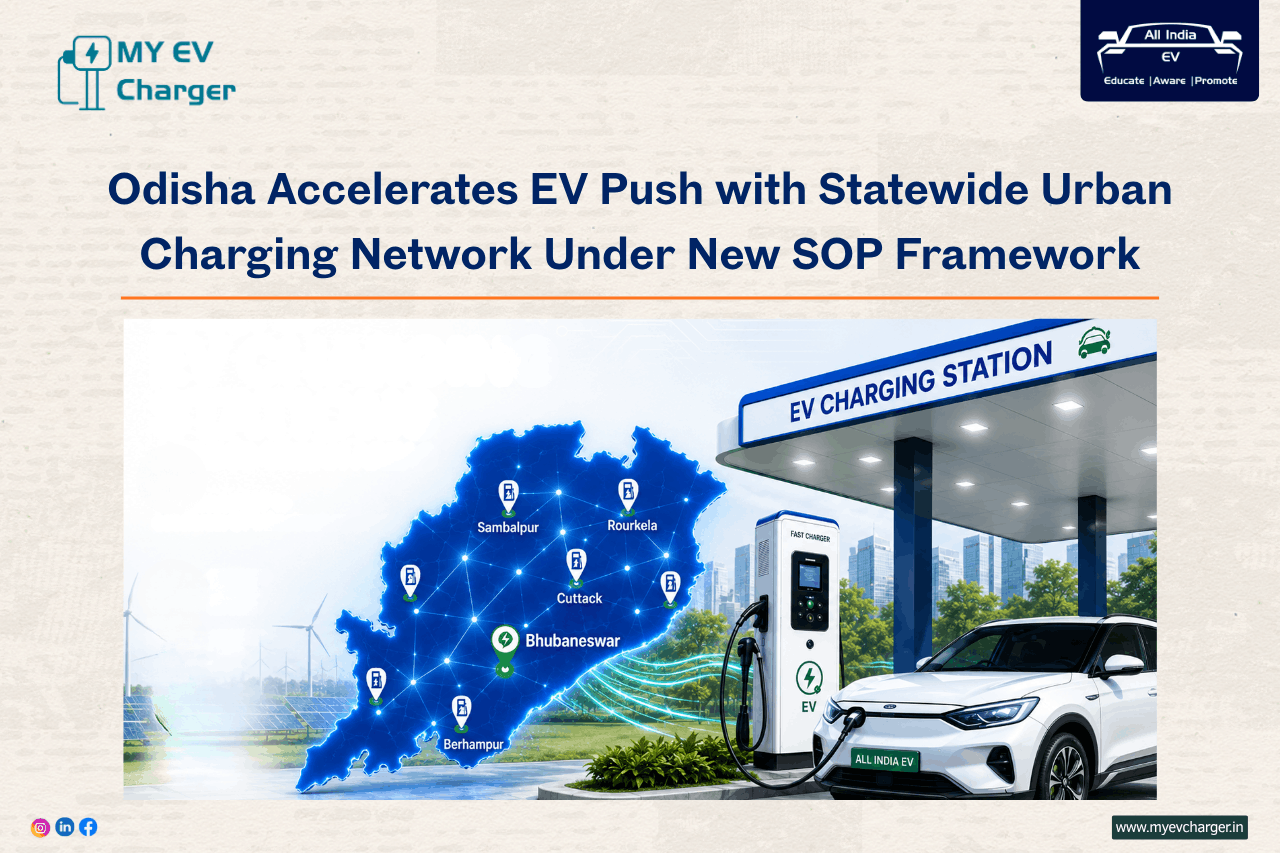

What: The Odisha government has issued a draft Standard Operating Procedure (SOP) to accelerate the deployment of public EV charging infrastructure across urban local bodies (ULBs). The framework outlines how cities will identify land, approve projects, and facilitate the development of charging stations.
The Number: 190 EV charging station locations have already been proposed across six key cities under the PM E-DRIVE initiative. At the same time, the new SOP aims to create a standardized rollout model across urban Odisha.
The Impact: The EV charging infrastructure in Odisha initiative could reduce one of the biggest barriers to EV adoption, charging accessibility, while creating a more predictable investment environment for charge point operators.

The Core News
The EV charging infrastructure push in Odisha has entered a new phase, with the Housing and Urban Development Department preparing a draft SOP for the deployment of charging stations across urban local bodies. The initiative is aligned with the Odisha EV Policy 2021 and subsequent state notifications aimed at increasing electric mobility adoption. Under the proposed framework, ULBs will identify suitable government-owned or controlled land for charging station deployment.
According to the draft guidelines, priority locations will include public parking areas, commercial hubs, government offices, markets, and major transit corridors. The objective is to ensure that charging infrastructure is available in locations with high vehicle movement and public accessibility. The SOP also seeks to create a uniform approval and implementation process for local authorities, reducing delays often associated with infrastructure deployment.
More EV News

The move comes as Odisha simultaneously expands its charging network through central government-supported programs. Earlier this year, the state proposed 190 charging station sites across Bhubaneswar, Cuttack, Puri, Angul, Balasore, and Kalinganagar under the PM E-DRIVE scheme. Together, the SOP and planned charging network indicate that Odisha is moving from policy planning toward execution-focused infrastructure development.
Breaking Down the Update
• Odisha has drafted a standardized SOP for urban EV charging deployment.
• Urban Local Bodies (ULBs) will identify government-controlled land for charging stations.
• Priority sites include parking hubs, commercial centers, markets, government offices, and transport corridors.
• The framework aligns with Odisha EV Policy 2021.
• The SOP aims to streamline approvals and infrastructure rollout.
• Odisha has already proposed 190 charging station locations under the PM E-DRIVE scheme.
• The initiative targets stronger charging accessibility in major urban centers.
How EV charging infrastructure in Odisha will help the Indian EV Market
The expansion of EV charging infrastructure in Odisha is significant not only for the state but also for India’s broader electric mobility ecosystem. One of the key challenges slowing EV adoption remains charging accessibility, particularly in tier-2 cities and emerging urban centers. By creating a structured SOP, Odisha is addressing a problem faced by many states the lack of standardization in charging station deployment.
The framework can help accelerate project approvals, improve land allocation efficiency, and create greater confidence among private charging operators. A predictable deployment model often attracts additional investment from infrastructure companies, utilities, and energy providers.
For EV users, wider charging availability reduces range anxiety and improves the practicality of electric two-wheelers, three-wheelers, passenger vehicles, and commercial fleets. The focus on public locations such as parking facilities, transit corridors, and commercial districts also improves charger utilization rates.
If implemented effectively, Odisha’s model could become a reference framework for other states seeking to expand charging infrastructure without creating complex approval processes. As India targets higher EV penetration levels, state-led charging infrastructure programs like this will play a critical role in supporting vehicle adoption and long-term market growth.
Conclusion & Next Steps
The EV charging infrastructure in Odisha initiative reflects a shift from policy commitments toward on-ground infrastructure execution. The next phase will depend on how quickly urban local bodies identify suitable sites, attract operators, and complete installations. If implementation remains on schedule, Odisha could emerge as one of the more active state-level examples of urban EV charging network expansion in India.
Read More: Catch up on All India EV’s related coverage on India’s evolving commercial EV subsidies and battery swapping policies at All India EV