
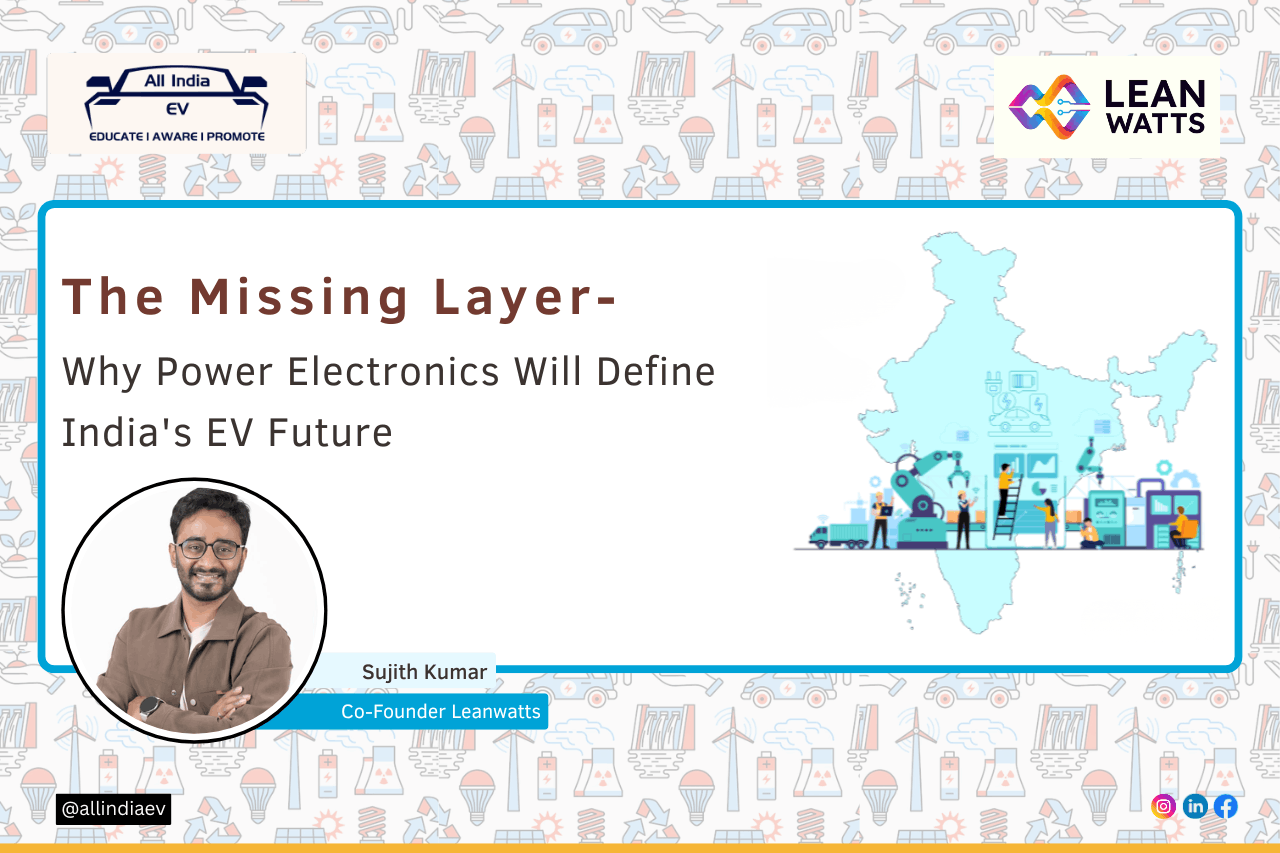

What: India’s EV sector is rapidly scaling vehicle assembly and battery localisation, but core power electronics systems remain heavily import-dependent and poorly standardised. In a discussion with Lean Watts Founder Sujith Kumar, All India EV examined how charger reliability, thermal management, and deep hardware engineering are becoming central to long-term EV scalability.
The Number: A significant portion of EV charger failures, battery degradation issues, and field reliability complaints can be traced back to power electronics and system integration layers.
The Impact: The conversation highlights how power electronics for EV market development could become one of the most critical factors shaping India’s next phase of electric mobility growth.

The Core News
India’s EV transition is often measured through battery capacity additions, charging station rollouts, and vehicle sales targets. But behind every functioning EV platform lies a less visible yet highly critical layer — power electronics. This includes systems that manage current flow, charging efficiency, thermal behaviour, voltage conversion, and vehicle reliability under real-world operating conditions. The discussion around power electronics for EV market growth is now moving closer to the centre of India’s EV manufacturing conversation.
According to Sujith Kumar, Founder of Lean Watts, the biggest challenge is not merely building EV hardware but designing systems that can survive India-specific operating conditions. High ambient temperatures, unstable grid quality, connector inconsistencies, and aggressive cost optimisation continue to pressure charger and onboard power systems. While several OEMs are localising assembly operations, deep design ownership in areas like onboard chargers and portable charging systems still remains limited.
The broader implication is significant for India’s EV ecosystem. Field failures in charging systems directly affect consumer confidence, battery health, and operating costs. Without stronger domestic engineering capabilities in power conversion and control systems, India risks remaining dependent on imported subsystems despite large-scale EV manufacturing ambitions. Companies focusing on vertically integrated design and field-tested reliability engineering could therefore become increasingly important as EV adoption expands across passenger and commercial segments.
More EV News

Breaking Down the Update
• Power electronics remains one of the least discussed yet most critical layers in EV engineering.
• Charger failures and battery degradation often originate from thermal, voltage, or conversion system inefficiencies.
• India-specific conditions such as heat, voltage instability, and infrastructure inconsistencies require localised hardware engineering.
• LeanWatts is focusing on onboard and portable EV chargers designed specifically for Indian operating environments.
• The sector still faces gaps in standardisation, deep hardware integration, and domestic IP ownership.
• Reliability-focused engineering may become a key differentiator as EV adoption scales nationwide.
How power electronics for EV market will help Indian EV Market
The development of robust power electronics for EV market expansion can directly improve reliability, charging efficiency, and long-term operational stability across India’s electric mobility ecosystem. Power electronics act as the intelligence layer inside EVs and charging infrastructure, controlling how energy is converted, distributed, and managed between batteries, motors, and chargers.
For India, this becomes especially important because EV systems must operate under difficult environmental and infrastructure conditions. High temperatures, grid fluctuations, inconsistent earthing, and heavy-duty daily usage create stress on charging systems and battery performance. Better locally engineered power electronics can reduce charger downtime, improve battery life cycles, and lower maintenance costs for fleet operators and consumers.
Domestic development in this segment also supports India’s localisation goals. Currently, several high-value electronic subsystems are still imported. Building indigenous capabilities in onboard chargers, DC-DC converters, thermal control systems, and charging management electronics can strengthen supply chain resilience while reducing dependency on overseas suppliers.
As India moves toward mass EV adoption, power electronics for EV market growth could become as strategically important as battery manufacturing itself. The companies investing in reliability engineering today may define the next generation of India’s EV infrastructure ecosystem.
Way Forward ..
India’s EV sector is entering a phase where reliability, engineering depth, and system durability may matter more than headline launch volumes. The conversation around power electronics for EV market growth is likely to intensify as charging infrastructure scales and fleet deployments increase. The next challenge for the industry will be moving beyond assembly-led localisation toward genuine design ownership and standardised hardware engineering.
Read More: Catch up on All India EV’s related coverage on India’s evolving commercial EV subsidies and battery swapping policies at All India EV