
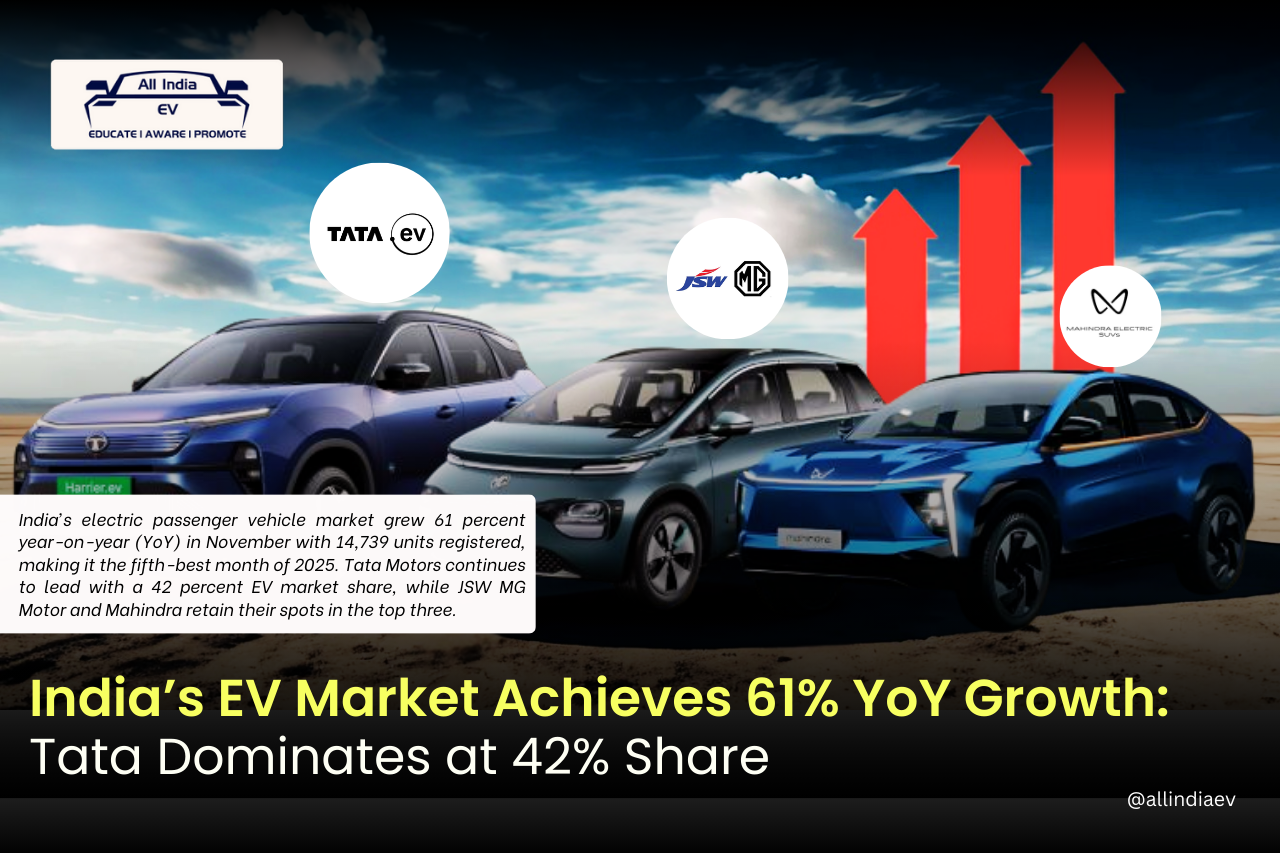

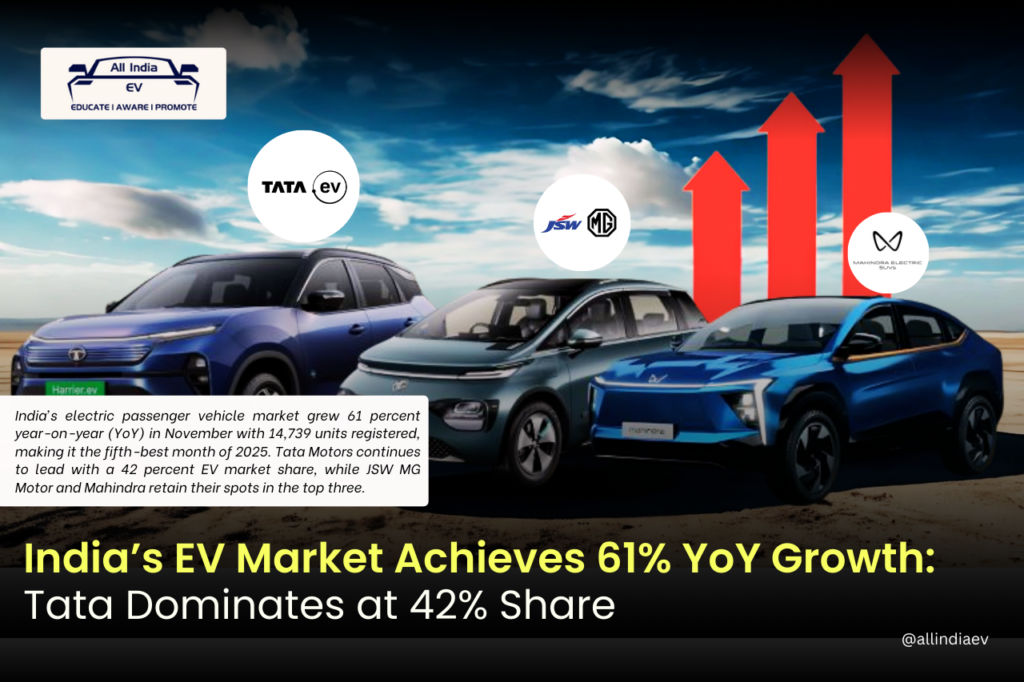
India’s electric passenger vehicle (e-PV) segment registered strong 61% year-on-year (YoY) growth in November 2025, with 14,739 units sold, marking the fifth-best month of the year. Tata Motors continued its commanding lead with a 42% market share, while JSW MG Motor and Mahindra maintained their positions among the top three EV manufacturers.
- 🚗 Mass-Market EV Makers: Tata Dominates, MG and Mahindra Battle for No. 2
- 🏎️ Luxury EV Makers: Segment Grows 66% YoY, BMW Leads but Faces New Competition
- 🌟 Vinfast Emerges as the Biggest Surprise — Outsells BMW
- ⚡ Tesla Completes Third Month in India with Steady Momentum
- 📈 EV Market Outlook: Strong Momentum Heading Into 2026
The month also saw impressive progress from new entrants. Vinfast climbed rapidly to seventh place, and Tesla completed its third month of retail operations, signaling strengthening competition in the EV landscape. Despite an industry-wide cooling after October’s festive peak, EV sales remained resilient, highlighting steady consolidation in the segment.
Electric Car & SUV Retail Sales – November 2025
| Rank | EV OEM | Oct ’25 | Nov ’25 | MoM % Change | Nov ’24 | YoY % Change |
| 1 | Tata Motors | 7,118 | 6,121 | -14% | 4,447 | 38% |
| 2 | JSW MG Motor | 4,497 | 3,676 | -18% | 3,347 | 10% |
| 3 | Mahindra & Mahindra | 3,867 | 2,940 | -24% | 583 | 404% |
| 4 | Kia | 655 | 463 | -29% | 74 | 526% |
| 5 | BYD | 560 | 418 | -25% | 367 | 14% |
| 6 | Hyundai | 437 | 372 | -15% | 21 | 1671% |
| 7 | Vinfast | 131 | 288 | 120% | New | – |
| 8 | BMW | 303 | 267 | -12% | 107 | 150% |
| 9 | Mercedes-Benz | 90 | 69 | -23% | 107 | -36% |
| 10 | Tesla | 40 | 48 | 20% | New | – |
| 11 | Citroen | 52 | 30 | -42% | 82 | -63% |
| 12 | Volvo | 20 | 28 | 40% | 32 | -13% |
| 13 | Porsche | 13 | 4 | -69% | 1 | 300% |
| 14 | Rolls-Royce | 0 | 1 | — | 1 | 0% |
| 15 | Audi | 1 | 0 | -100% | 3 | -100% |
| 16 | JLR | 0 | 0 | — | 0 | — |
| Total | — | 17,772 | 14,739 | -17% | 9,172 | 61% |
🚗 Mass-Market EV Makers: Tata Dominates, MG and Mahindra Battle for No. 2
Tata Motors once again led the mass-market EV space with 42% share, driven by sustained demand for the Punch EV and Nexon EV. The Tiago EV also contributed steady volumes, cementing Tata’s position as the country’s undisputed EV leader.
MG Motor India retained second place with a 25% market share, led primarily by the Windsor EV. November was MG’s second-lowest sales month of 2025 (after February’s 3,489 units), but the brand crossed a major milestone by surpassing 1 lakh cumulative EV sales. MG’s electric roadster, the Cyberster, continues to attract strong demand, with a waiting period of up to five months and 350+ units delivered through its premium Select outlets.
Mahindra continued its strong run with sustained traction for the BE 6 and XEV 9e. The automaker also expanded its lineup with the launch of the XEV 9S, its first three-row mass-market electric SUV. Mahindra sold 2,940 electric SUVs in November, securing a 20% e-PV share.
Kia India saw the biggest climb among mainstream brands, jumping from eighth place in November 2024 to No. 4 this year. With 463 units sold, Kia captured a 3% EV share, driven by the popularity of the Carens Clavis EV MPV.
BYD India slipped to fifth place despite earlier gains. The company plans to increase prices of the Sealion 7 from January 2026, while allowing buyers to lock in current prices until December 31.
More EV News

Hyundai Motor India posted an extraordinary 1,671% YoY rise with 372 EVs sold in November. The Creta Electric remains the main growth engine, though sales have stabilized after its initial launch surge.
Citroen continued to struggle, selling just 30 units, a 63% decline compared to last year. The eC3 remains its sole electric offering.
Overall, the mass-market EV category continues expanding on the back of strong consumer interest, better availability, and improving charging infrastructure, especially across Tier-1 and Tier-2 cities.
🏎️ Luxury EV Makers: Segment Grows 66% YoY, BMW Leads but Faces New Competition
India’s luxury EV segment, though small, continued to rise steadily. Luxury carmakers sold 417 EVs in November — a 66% YoY jump — capturing 3% of overall e-PV sales.
BMW India maintained its lead with 267 units, representing 64% of the premium EV segment. However, BMW slipped to eighth place overall, overtaken by Vinfast’s accelerating performance. In the first 11 months of 2025, BMW sold 2,837 EVs.
Mercedes-Benz secured second place in luxury EVs with 69 units, accounting for 17% share, though this was a 36% decline compared to November 2024. Between January and November, Mercedes delivered 1,087 EVs, marking 28% YoY growth.
Volvo followed with 28 EVs, down 13% YoY, while Porsche sold 4 units, up from a single unit last year but down from its October 2025 performance.
The luxury segment overall has already exceeded full-year 2024 volumes, indicating a steady shift toward premium electrification.
🌟 Vinfast Emerges as the Biggest Surprise — Outsells BMW
Vietnam’s Vinfast recorded one of its strongest months in India, rising to No. 7 overall, ahead of several mainstream manufacturers. The company delivered 288 units of its VF6 and VF7 electric SUVs — an impressive 113% month-over-month jump from October’s 135 units.
In a significant milestone, Vinfast outsold luxury leader BMW in November.
The company also confirmed that its Limo Green 7-seater MPV will launch in February 2026. Vinfast currently operates 24 retail outlets and plans to add 11 more by the end of the year.
⚡ Tesla Completes Third Month in India with Steady Momentum
Tesla India delivered 48 units of the Model Y in November, placing it third among luxury EV makers. Over the last three months, Tesla has sold 157 Model Y units in Mumbai, Delhi, Pune, and Gurugram.
📈 EV Market Outlook: Strong Momentum Heading Into 2026
Cumulative electric passenger vehicle sales for January–November 2025 reached 160,628 units, already surpassing full-year 2024 sales (99,694 units).
With market momentum accelerating — and with the anticipated launch of the Maruti e-Vitara — the Indian EV segment is expected to close 2025 with record retail sales of 175,000 to 180,000 units.
Even as some automakers faced month-on-month dips, the overall trajectory remains unmistakably positive. Expanding model choices, new-brand entry, strengthening infrastructure, and rising customer acceptance are collectively pushing India’s EV market into a new phase of rapid, competitive growth.
Author’s Comment:
India’s electric passenger vehicle market continues to show remarkable resilience, even as seasonal slowdowns affect monthly numbers. The strong YoY surge, coupled with rising competition from newcomers like Vinfast and Tesla, signals a market that is rapidly expanding and maturing.
With mainstream and luxury EV adoption both gaining momentum, and several major launches lined up for early 2026, India’s EV landscape is entering a pivotal phase where scale, affordability, and innovation will define the next wave of growth.