

Unlocking sub-15-minute en-route charging to enable intercity EV buses with diesel-like uptime.
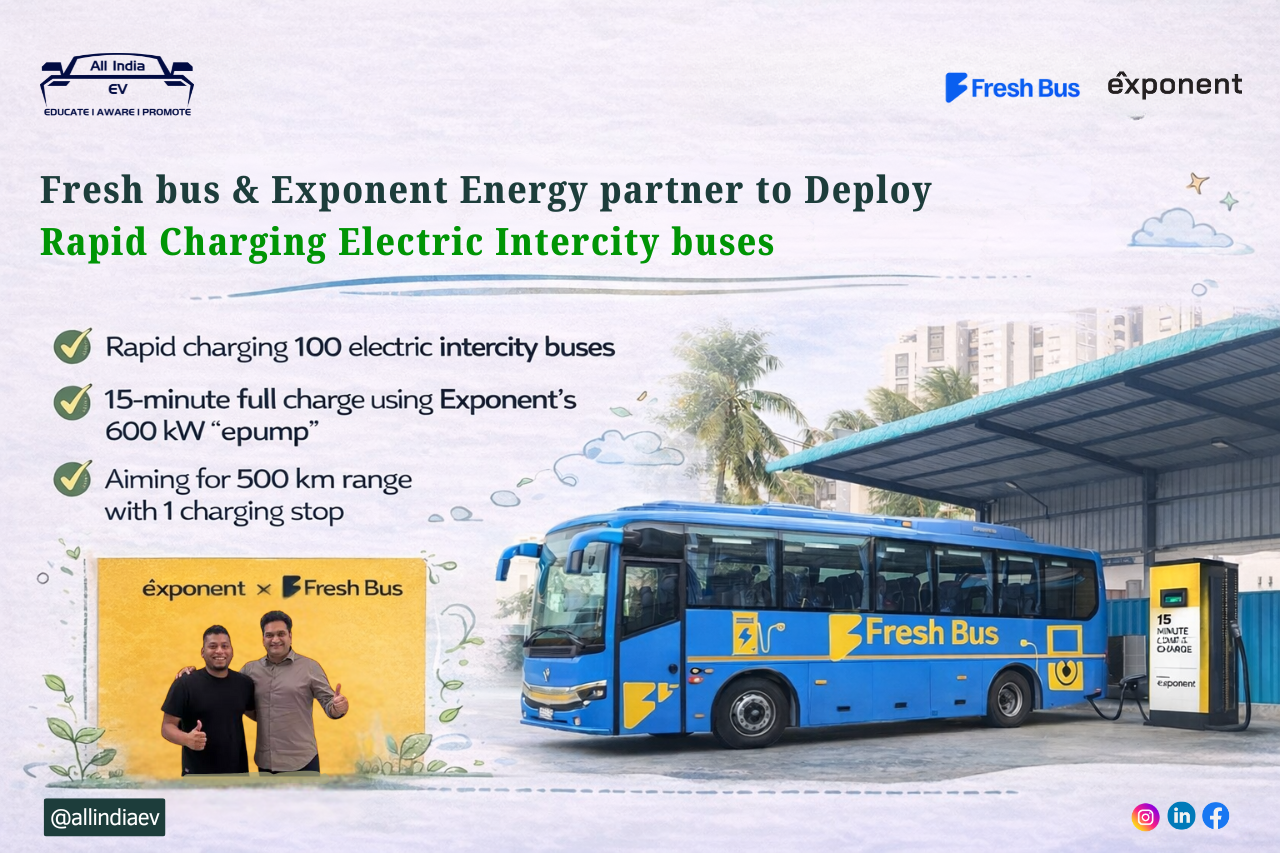
An MoU inked between Fresh Bus and Exponent Energy signals a technical pivot in India’s electric intercity mobility narrative from battery-heavy buses to rapid-charge-enabled operations that mimic diesel refueling cadence. Coming at a time when range anxiety and infrastructure gaps still shape fleet economics, this deal tries to reframe charging strategy as a competitive asset. Yet questions on commercial scale economics, real estate, grid impact, and unit cost remain open.
Deal Facts
- Fresh Bus, an India-based electric intercity bus operator, has signed a Memorandum of Understanding (MoU) with Bengaluru-based Exponent Energy focused on rapid-charging electric buses.
- Scope: Deployment of up to 250 electric buses with en-route rapid charging and associated infrastructure.
- Charging platform: Exponent Energy’s rapid-charging technology and up to 1.5 MW charging capacity.
- Geography (Phase 1): Targeted on the Hyderabad–Bengaluru corridor, with plans to expand to other intercity corridors.
- Charging speed claim: ~15-minute quick charges spaced about every ~300 km to enable long-hauls (~1,000 km+).
- Operational paradigm: Rapid charging en-route as alternative to oversized onboard battery packs.
- Strategic ambition (Fresh Bus): Long-term goal of operating 10,000 electric buses and capturing roughly 10 % of India’s intercity bus market.
- Financials: Investment figures are not disclosed; cost exposure and capex allocation between partners is unspecified a key factor for fleet economics.
- Ownership structure: Not disclosed; the MoU does not disclose equity or JV stakes, implying early stage pre-commercial alignment.
What Each Partner Brings
Fresh Bus
- Existing intercity electric bus operator with live routes and fleet deployment experience; commercial understanding of passenger demand and route economics.
- Strategic intent to scale rapidly and integrate charging strategy tightly with route operations.
Exponent Energy
- Rapid charging technology stack including high-power (up to 1.5 MW) charge points, battery packs, and connectors engineered in India.
- Technical chassis and hardware expertise to deploy fast charging at scale across fleets.
The Operating Model
This partnership advances a charging-centric operating model for intercity electrification. Rather than burdening buses with large, heavy batteries sized for full route range, the model leans on rapid, high-power charging stations situated en-route (endpoints and intermediate points). In essence, buses could resemble diesel operations periodic quick stops every few hundred kilometres for a ~15-minute charge, smoothing vehicle utilization and potentially reducing battery cost and weight.
In practical terms, the deal suggests coordination between fleet scheduling, charging station siting, and grid provisioning. Fresh Bus would have to integrate charging windows into timetables, while Exponent must deliver reliable, high-uptime hardware in highway settings often with variable grid quality and land acquisition constraints. The charging assets must also be interoperable and supported by operations tech (booking/timing/energy management) to avoid bus idle time and queueing delays.
Integration & Execution Risks
- Grid and power quality constraints: Rolling out 1.5 MW chargers across highways requires grid upgrades not trivial in many Indian corridors.
- Real estate and siting: Securing land for charging stations at strategic highway intervals is complex and often cost-heavy.
- Unspecified investment and commercial terms: Without disclosed economics, fleet ROI assumptions and capex recovery models are unclear.
- Charging reliability: High-power charging at scale can stress equipment and local grids, risking downtime that cascades through route schedules.
- Regulatory and permits: Highway charging networks face multiple permits at state and local levels; misalignment could delay rollouts.
Who Wins / Who Gets Squeezed
Winners
More EV News
- Electric bus operators who can leverage rapid charges to improve asset utilization and reduce battery costs vs. big packs.
- Charging technology suppliers with proven high-power solutions, positioning India as a potential export hub for rapid EV charging hardware.
Squeezed
- Conventional battery OEMs focused on large energy packs without rapid charge tech may lose share in long-haul segments.
- Diesel incumbents may face accelerated displacement if electric long-haul becomes operationally competitive.
Next 90 Days: What to Track
- [OEM] Confirmation of bus OEMs supplying the 250-unit order and their battery/vehicle specs.
- [CPO] Site acquisition and commissioning of the first high-power charging stations on Hyderabad–Bengaluru.
- [Supplier] Finalization of Exponent Energy’s technology certs and grid readiness assessments.
- [Fleet] First pilot runs, utilisation rates, and actual turnaround charging times vs. claims.
- [Investor] Funding commitments or capex support announcements for deployment and scaling phases.
- [Policy] State/regional electricity tariff or highway charging incentive clarity to support high-power EV charging.
Questions That Get People Talking
- How will rapid charging impact long-distance EV bus scheduling compared with overnight depot charging?
- What are real unit economics (₹/km) when substituting a big battery pack for frequent high-power charges?
- Can a rapid charging network across multiple states be standardized without central policy alignment?