


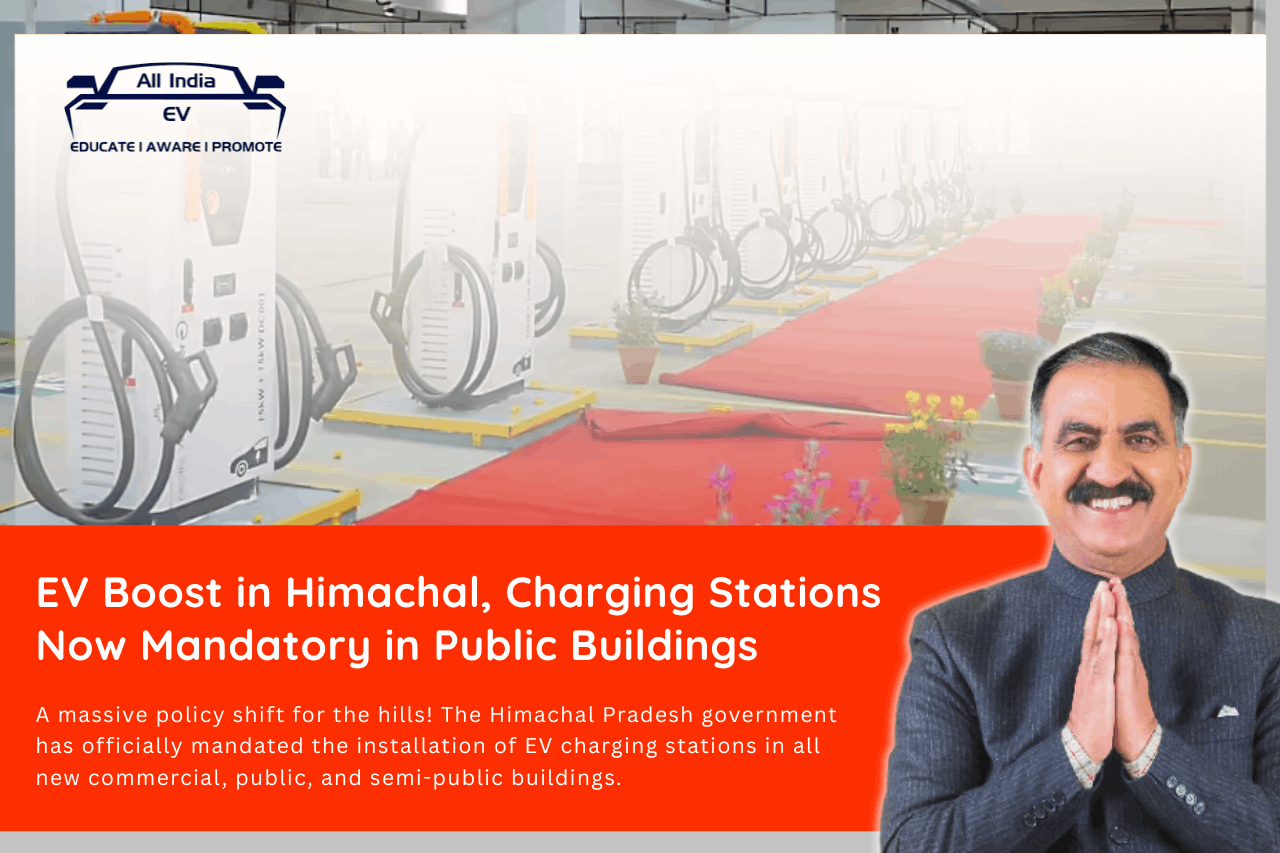
The HP govt mandates installation of EV charging stations in commercial, public buildings, a move aimed at strengthening electric mobility infrastructure across the state. The decision has been introduced through the Himachal Pradesh Town and Country Planning (17th Amendment) Rules, 2026, making EV charging infrastructure compulsory in commercial, public, semi-public buildings and new real estate projects.
According to state officials, the new rule requires developers and building planners to integrate EV charging facilities at the design and approval stage itself. The policy aligns with the state government’s long-term objective of promoting cleaner transportation and building sustainable urban infrastructure that supports electric mobility adoption.
The mandate applies to a wide range of infrastructure categories, including commercial complexes, public institutions, semi-public buildings, and newly planned real estate developments. By embedding charging infrastructure within urban planning regulations, the state aims to ensure that EV charging access grows alongside vehicle adoption.
Himachal Pradesh has been gradually expanding its EV ecosystem in recent years through various policy initiatives. The state’s EV policy targets increased adoption of battery electric vehicles and emphasizes the development of charging infrastructure as a key pillar for accelerating the transition to electric mobility.
In addition to policy measures, the state government has also been identifying locations and projects to support charging infrastructure deployment. Officials have previously identified multiple locations for EV charging stations and are continuing to develop supporting infrastructure to encourage EV adoption across cities and transport corridors.
By making EV charging stations a mandatory component of urban development, the Himachal Pradesh government is taking a regulatory approach to ensure that charging infrastructure expands systematically across the state.
More EV News
How This Will Help the Indian EV Market
The Himachal Pradesh government’s decision to mandate EV charging stations in commercial and public buildings reflects a broader structural shift in India’s EV ecosystem—from vehicle adoption to infrastructure planning.
One of the biggest barriers to EV adoption globally is charging accessibility, especially in urban environments where many vehicle owners do not have private parking or home charging facilities. By integrating EV chargers into commercial buildings, shopping complexes, offices, and public institutions, the state is effectively building distributed charging infrastructure across urban areas.
This model also reduces the pressure on standalone public charging stations because EV drivers can access charging at locations where vehicles are already parked for long durations—such as offices, hotels, malls, and government buildings. Such locations are ideal for AC slow and semi-fast chargers, which are cost-effective and easier to deploy.
From an ecosystem perspective, regulatory mandates like this also create a predictable demand for EV charging hardware, software platforms, and service providers. Charger manufacturers, charge point operators (CPOs), and energy service companies can expand their business models knowing that new real estate developments must include charging infrastructure.
If similar policies are adopted across other Indian states, EV charging could gradually become a standard component of urban infrastructure, much like parking spaces, elevators, or fire safety systems. This would significantly accelerate India’s transition toward electric mobility while supporting the long-term growth of the EV ecosystem.