
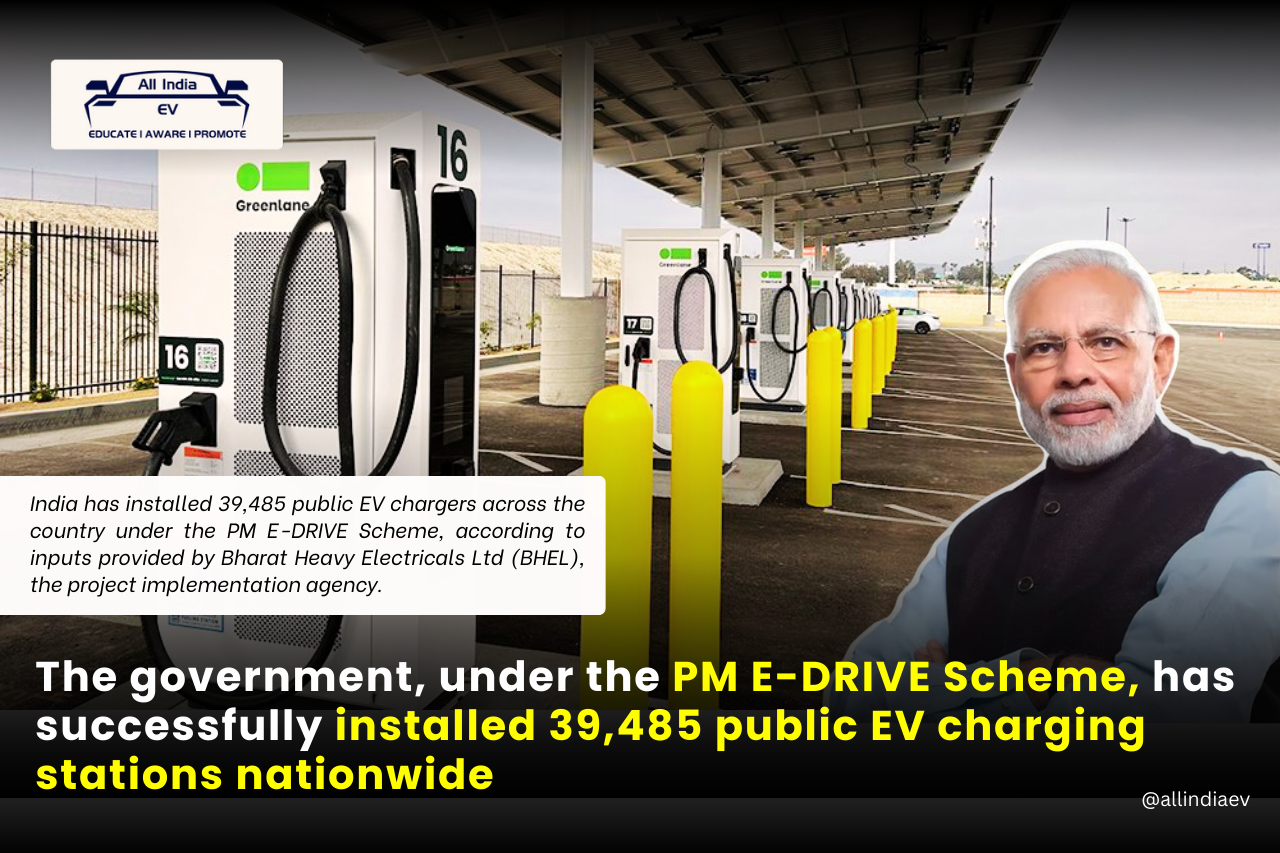

In a major boost to India’s fast-growing electric mobility ecosystem, the country has now installed 39,485 public EV charging stations under the PM E-DRIVE Scheme, according to data shared by Bharat Heavy Electricals Ltd (BHEL), the scheme’s implementation agency. Of these, a remarkable 8,414 are fast chargers, significantly expanding rapid-charging access for electric cars and addressing one of the biggest barriers to EV adoption — range anxiety.
To streamline nationwide EV infrastructure deployment, the Ministry of Power had earlier introduced the 2024 Guidelines for EV Charging Infrastructure, covering standards, safety norms, interoperability protocols and specifications for both charging and battery-swapping stations. Importantly, setting up charging stations continues to remain an unlicensed activity, allowing private players, startups and energy companies to participate freely. Additionally, the PM E-DRIVE Scheme has dedicated ₹2,000 crore exclusively for expanding public charging networks nationwide.
The Ministry of Heavy Industries (MHI) highlighted parallel efforts to strengthen EV manufacturing and mobility. Under PM E-DRIVE’s ambitious electric bus procurement programme, 10,900 e-buses have been allocated to five major Indian cities in Phase I, for which bids were opened on 14 November 2025. A further 2,900 e-buses have been sanctioned under Phase II, reinforcing the government’s focus on clean urban transportation.
India currently has no fixed national targets for EV adoption, but multiple major schemes are driving industry growth:
- PLI Auto & Auto Component Scheme (₹25,938 crore): Boosts domestic manufacturing of advanced automotive technologies, including EVs.
- PLI for Advanced Chemistry Cell (ACC) Batteries (₹18,100 crore): Aims to create a robust 50 GWh battery-manufacturing ecosystem.
- PM E-DRIVE Scheme (₹10,900 crore): Supports e-2Ws, e-3Ws, e-trucks, e-buses, e-ambulances, and public charging infrastructure.
- PM e-Bus Sewa – PSM Scheme (₹3,435 crore): Targets deployment of over 38,000 e-buses with payment security assistance.
- SPMEPCI Scheme: Requires a minimum investment of ₹4,150 crore with localisation milestones of 25% (Year 3) and 50% (Year 5) to boost electric passenger car manufacturing.
Minister of State for Heavy Industries Bhupathiraju Srinivasa Varma, in a written reply to the Rajya Sabha, emphasised that this multi-scheme approach is designed to accelerate EV adoption, strengthen domestic manufacturing, and build one of the world’s most reliable nationwide charging networks.
Author’s Comment:
Crossing 39,485 public EV chargers under PM E-DRIVE marks a defining moment for India’s electric mobility transformation. With fast chargers rising rapidly and multiple flagship schemes converging—from PLI to PM e-Bus Sewa—the government is clearly building a dense, future-ready EV ecosystem.
The challenge now is seamless execution and sustained momentum to ensure this expanding infrastructure truly empowers citizens, accelerates adoption, and positions India among the world’s leading EV-ready nations.