

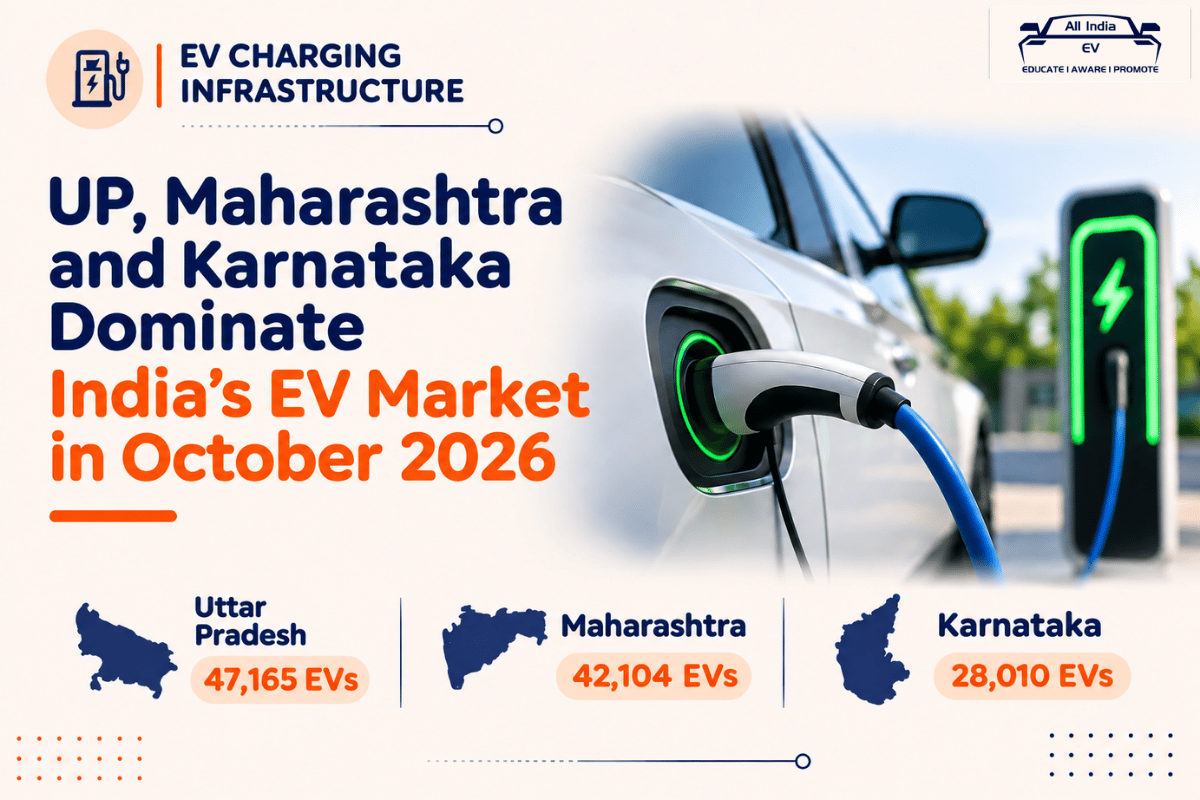
India’s electric vehicle (EV) market continued its growth trajectory in October 2026, with Uttar Pradesh, Maharashtra and Karnataka emerging as the country’s leading states in EV registrations. According to the latest monthly report by JMK Research, these three states maintained strong positions as electric mobility adoption expanded across different regions.
Uttar Pradesh retained the top position, registering 47,165 electric vehicles in October and accounting for 13.31% of total national EV registrations. Maharashtra secured second place with 42,104 registrations, representing an 11.88% market share. Karnataka followed in third position with 28,010 registrations and a 7.90% share.
The rankings highlight the growing importance of state-level EV adoption, supported by government initiatives, expanding charging infrastructure, manufacturing capabilities and increasing consumer demand.
India’s EV Registrations Increase 51% Year-on-Year
India recorded a total of 3,54,378 EV registrations in October 2026, compared with 3,33,670 units in September. This represented a 6.21% month-on-month increase. On a year-on-year basis, registrations grew by 51.43% compared with 2,34,019 electric vehicles registered in October 2025.
Despite the increase in registrations, EV penetration declined to 11.15%, suggesting that overall vehicle sales grew at a faster pace than electric vehicle sales during the month.
The top 10 states accounted for approximately 72% of India’s total EV registrations, demonstrating that electric mobility adoption remains concentrated in a limited number of major markets.
Southern and Northern States Show Different EV Adoption Trends
Karnataka continued to lead southern India’s EV market, benefiting from its established electric mobility ecosystem, early EV policy initiatives, manufacturing base and technology-driven startup environment. Demand from Bengaluru has also played an important role in supporting the state’s electric vehicle growth.
Southern states collectively contributed 29% of India’s EV registrations in October, compared with 25% from northern states. The southern market was primarily driven by private vehicle ownership, particularly electric two-wheelers.
In contrast, northern states recorded stronger demand for electric three-wheelers, which are widely used for commercial transportation and last-mile connectivity.
Tamil Nadu ranked fourth nationally with 24,259 registrations, followed by Rajasthan with 22,991 and Madhya Pradesh with 21,138. Odisha recorded 18,611 registrations, while Bihar registered 17,857 units. Telangana and Gujarat completed the top 10 with 16,355 and 15,743 registrations, respectively.
Other notable markets included West Bengal, Delhi, Andhra Pradesh, Kerala and Assam.
Electric Two-Wheelers Continue to Dominate the Market
Electric two-wheelers remained the largest contributor to India’s EV market in October, accounting for 63.20% of total registrations. Passenger electric three-wheelers followed with a 21.10% share, while electric cars contributed 10.39%.
High-speed electric two-wheeler registrations increased by 8% month-on-month to 2,23,964 units, compared with 2,07,314 units in September. Registrations also recorded 48% annual growth.
In the electric two-wheeler segment, TVS Motor led with a 26.99% market share, followed by Bajaj Auto at 21.92%, Ather Energy at 14.21% and Hero MotoCorp at 13.36%. Established manufacturers accounted for nearly 62% of sales among the nine largest companies.
Electric Three-Wheelers and Passenger EVs Record Growth
Electric three-wheeler registrations reached 88,569 units in October, representing 3% monthly growth and 25% annual growth. Passenger electric three-wheelers accounted for 74,789 units, while cargo electric three-wheelers contributed 13,780 units.
Bajaj Auto led the passenger electric three-wheeler category with a 19.87% market share, followed by Mahindra Last Mile Mobility at 18.93%.
The electric passenger car segment also delivered strong annual growth. Registrations increased 87% year-on-year to 36,823 units in October. Tata Motors maintained its leadership with a 39.64% market share, followed by Mahindra & Mahindra at 23.08% and MG Motor at 16.04%.
Electric bus registrations increased 133% year-on-year to 768 units, with JBM Auto and Olectra Greentech registering 202 buses each. Meanwhile, electric truck registrations recorded 156% annual growth, reaching 4,162 units.
Growing Regional Demand Supports India’s EV Transition
The October registration data highlights the increasing contribution of regional markets to India’s electric mobility transition. Uttar Pradesh continues to benefit from strong three-wheeler demand, while Maharashtra maintains its position among the country’s largest EV markets. Karnataka’s established technology and manufacturing ecosystem further strengthens its electric mobility landscape.
With electric two-wheelers and three-wheelers accounting for the majority of registrations, these segments are expected to remain important drivers of India’s EV adoption.
The growing participation of established automobile manufacturers, improvements in financing availability and continued infrastructure development will also play an important role in expanding the market.
As more states strengthen their EV policies and supporting ecosystems, India’s electric mobility sector is positioned for further growth across private transportation, commercial mobility and public transport.