

Preparatory Consultations Begin with Ministry, Experts & Think Tanks for India’s EV Strategy and Policy Planning
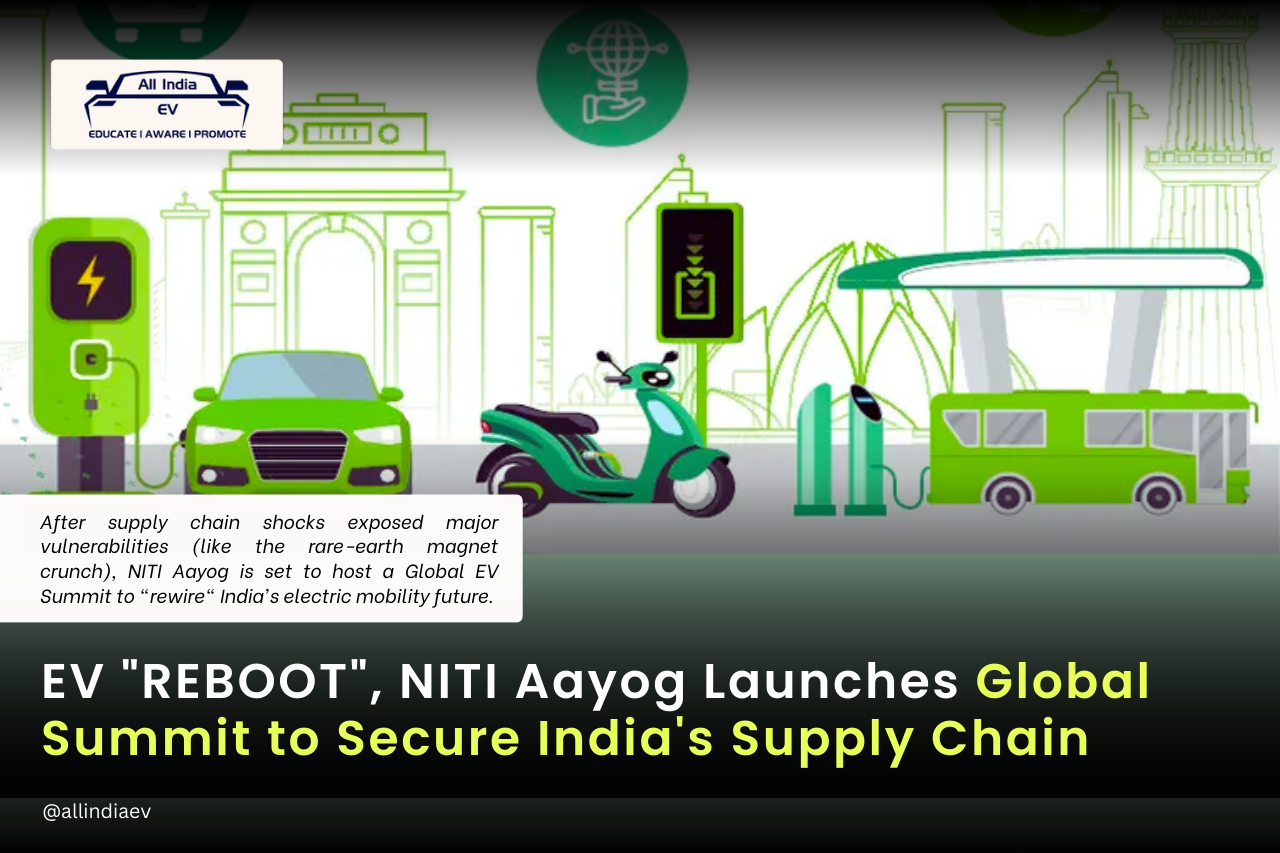
India is taking a significant leap in its electric mobility ambitions, announcing plans to host a Global EV Summit as the country recalibrates its electric vehicle (EV) strategy in response to recent challenges in supply chains and adoption. The summit, organized by the government think tank NITI Aayog, is expected to bring together top global EV companies, industry experts, and senior government officials.
The initiative comes amid supply chain shocks, particularly the global shortage of rare-earth magnets, and a slow response from major international EV manufacturers to earlier Indian policies aimed at attracting investment. The government’s renewed strategy underscores its commitment to accelerating EV adoption and strengthening domestic manufacturing capabilities.
Global EV Summit: A Sequel to MOVE 2018
According to sources familiar with the plans and a concept note reviewed by industry observers, NITI Aayog aims to host the summit in March-April, positioning it as a follow-up to the 2018 MOVE Summit inaugurated by Prime Minister Narendra Modi. Preparatory consultations are already underway with the Ministry of Heavy Industries and domestic as well as international experts and think tanks.
The summit will focus on creating domestic policy mandates to drive EV adoption across all segments, with particular emphasis on electric trucks and buses. It will also address supply chain challenges, including rare-earth magnet shortages, and showcase emerging technologies in EVs and charging infrastructure.
Policy and Incentives: Driving Domestic EV Adoption
Electric trucks and buses are key segments in the government’s EV roadmap, incentivized under the PM E-Drive Scheme, which is set to continue till FY28. Two- and three-wheelers, which have already received incentives, are slated to phase out under the same scheme by March 2026.
More EV News

The upcoming summit aims to attract investments from domestic and global institutions, fostering large-scale manufacturing within India. Another critical objective is to enhance Indian businesses’ participation in global EV value chains, allowing the country to secure a stronger position in the rapidly growing international EV market.
Earlier in March 2024, India launched the Scheme to Promote Manufacturing of Electric Passenger Cars in India (SPMEPCI), commonly called the ‘Tesla scheme’. The initiative offered import duty reductions for fully built-up electric vehicles, provided that manufacturers establish a local production plant with a minimum $500 million investment and incorporate significant local content. However, the scheme failed to attract major EV players to set up manufacturing units in India.
When approached for comments, NITI Aayog and the Ministry of Heavy Industries did not respond, and US-based Tesla also remained silent.
VinFast Sees India as a Key Market
Vietnamese automaker VinFast has emerged as a notable player in India. CEO Pham Sanh Chau told industry media, “India is one of VinFast’s key strategic markets, and we expect it to make an important contribution to our global business results.” Within just two months of entering the market, VinFast has become one of the top-selling EV brands in India.
The company plans to expand its network to 35 dealerships across 27 cities by 2025, and later to 100 dealerships in 60 cities. VinFast also intends to launch three new EV models in 2026, including the 7-seat Limo Green, and is considering electric buses and two-wheelers for the Indian market.
Supply Chain Pressures Reshape Policy
The summit and policy recalibration come in response to supply chain pressures, particularly the global rare-earth magnet shortage triggered by China’s export control order in April 2024. With China controlling approximately 90% of the world’s rare-earth processing capacity, global EV manufacturers faced severe disruptions. These magnets are essential for electric motors in EVs, as well as for sectors such as defense, electronics, and renewable energy.
To address these shortages, India amended local manufacturing incentive rules under the ₹10,900-crore PM E-Drive scheme, allowing e-truck and e-bus manufacturers to import motors containing rare-earth magnets while still availing government incentives. This move reflects the sector’s ongoing dependence on Chinese imports.
On 26 November, the Union Cabinet approved a ₹7,280-crore package to set up five rare-earth magnet manufacturing units in India. The scheme has a two-year gestation period, with incentives distributed over five years after the plants become operational.
Market Outlook: EV Adoption Still Modest
India’s EV adoption has been modest compared to global leaders. According to a NITI Aayog report in August 2025, while over half of all three-wheelers are electric, other segments such as two-wheelers, four-wheelers, buses, and trucks continue to lag. Global EV penetration reached 16.48% in 2024, whereas India’s penetration stands at just 7.66%.
To accelerate adoption, India has implemented incentives for all EV segments, including e-tractors in certain states. Major schemes such as PLI-Auto (₹25,938 crore) and PLI-ACC (₹18,100 crore) send a strong signal about India’s intent to localize EV and battery manufacturing.
Complementary initiatives like FAME (Faster Adoption and Manufacturing of Electric and Hybrid Vehicles) and the PM E-Drive scheme provide consumers with purchase discounts, further promoting the EV ecosystem.
EV Sector Growth and Future Potential
India’s EV sector was valued at $54 billion in 2025 and is projected to double to $110 billion by 2029, according to Mordor Intelligence. Over 2 million EVs have been registered in India this year, accounting for 7.92% of all new vehicle registrations.
Industry experts describe the sector as showing “promising growth with multiple segments gaining traction”. Ashim Sharma, senior partner and business unit head at Nomura Research Institute Solutions and Consulting, noted that charging infrastructure expansion and resilient supply chains for rare earths and batteries are major challenges that must be addressed to sustain growth.
Key Takeaways
The upcoming Global EV Summit is more than a conference—it is a strategic move to reshape India’s EV landscape. Key objectives include:
- Boosting domestic EV adoption through policy mandates.
- Securing global and domestic investments to scale manufacturing.
- Strengthening supply chains amid global rare-earth shortages.
- Enhancing India’s participation in global EV value chains.
- Fostering innovation in EV technologies and charging infrastructure.
With initiatives like the Tesla-inspired SPMEPCI scheme, PM E-Drive incentives, and PLI-linked battery and EV manufacturing programs, India is signaling its intent to become a global EV hub.
While challenges remain, including limited charging infrastructure, dependence on imported materials, and uneven adoption across vehicle segments, India’s strategic pivot, highlighted by the upcoming Global EV Summit, may well accelerate the country’s journey toward sustainable mobility and global EV competitiveness.
Author’s Comment:
India’s plan to host the Global EV Summit marks a strategic push to strengthen domestic EV adoption, attract investments, and secure resilient supply chains amid global challenges.
While ambitious policies like PM E-Drive and SPMEPCI signal India’s intent to become a global EV hub, success will depend on scaling infrastructure, enhancing manufacturing capabilities, and ensuring equitable adoption across all vehicle segments.
The summit could prove pivotal in shaping India’s path toward sustainable and competitive electric mobility.