
All India EVAll India EVAll India EV
Notification
Font ResizerAa
  • Home
  • EV News
  • EV Launch
  • Market Insights
  • Investments & Funding
  • Guest Articles
  • EV Engineering
  • Contact
Reading: Federal Judge Rules Trump Administration Unlawfully Suspended EV Charger Infrastructure Program
Share
All India EVAll India EV
Font ResizerAa
  • Home
  • EV News
  • EV Launch
  • Market Insights
  • Guest Articles
  • EV Engineering
  • Contact
Search
  • Home
    • Home 1
    • Home 2
    • Home 3
    • Home 4
    • Home 5
  • Home
  • Categories
    • Electric
  • Categories
  • Shows
    • Rap
  • More Foxiz
    • Blog Index
    • Contact
  • Bookmarks
    • Customize Interests
    • My Bookmarks
  • More Foxiz
    • Blog Index
    • Sitemap
Have an existing account? Sign In
Follow US
Home » Blog » Federal Judge Rules Trump Administration Unlawfully Suspended EV Charger Infrastructure Program
EV Global

Federal Judge Rules Trump Administration Unlawfully Suspended EV Charger Infrastructure Program

Sunita
By
Sunita
Last updated: 27 January 2026
Share
6 Min Read
SHARE

The Trump administration pushed policies favoring gas-powered vehicle sales while scaling back EV incentives for automakers and consumers, reshaping the U.S. auto market.

Contents
  • Judge’s Ruling: Unlawful Suspension
  • What This Means for EV Infrastructure
  • Administration’s Actions and Response
  • Political and Legislative Context
  • Conclusion: A Crucial Victory for EV Growth

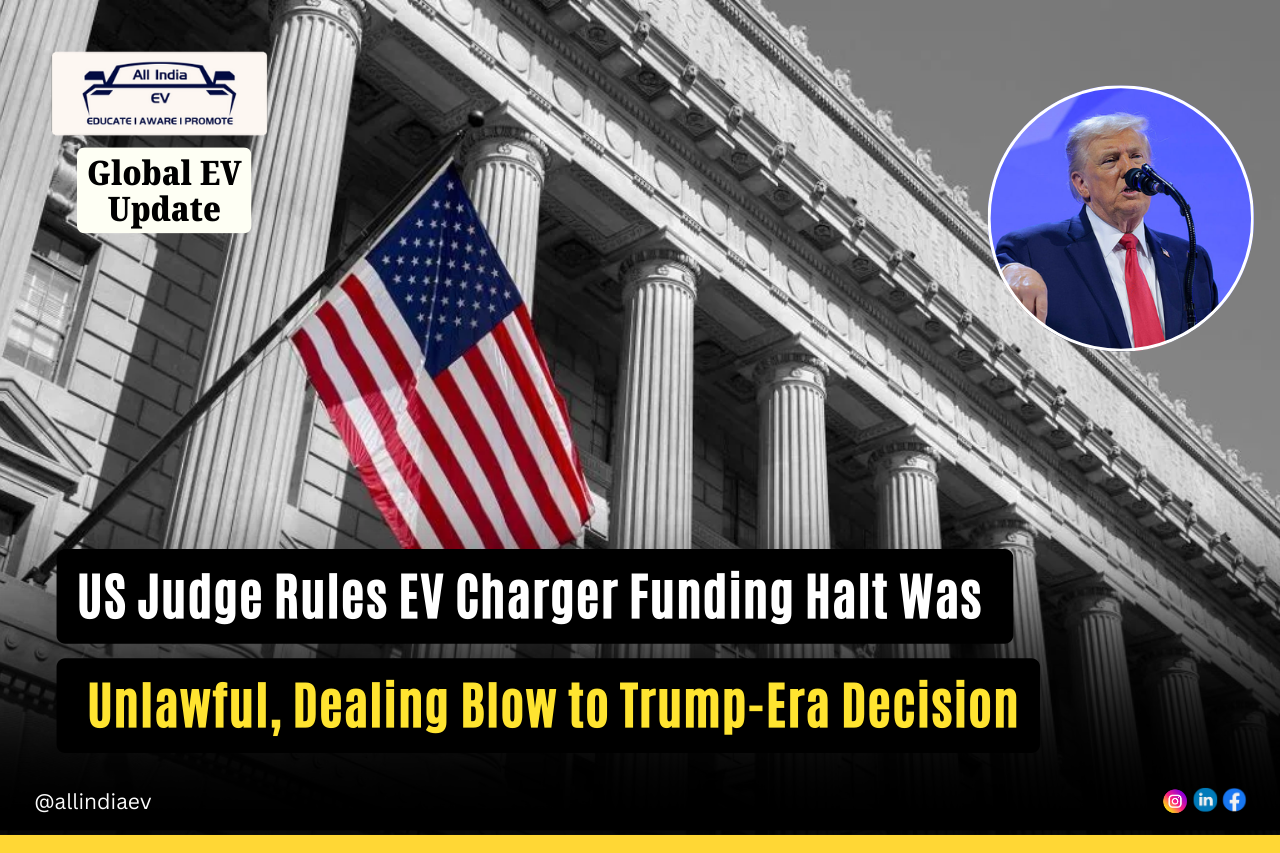
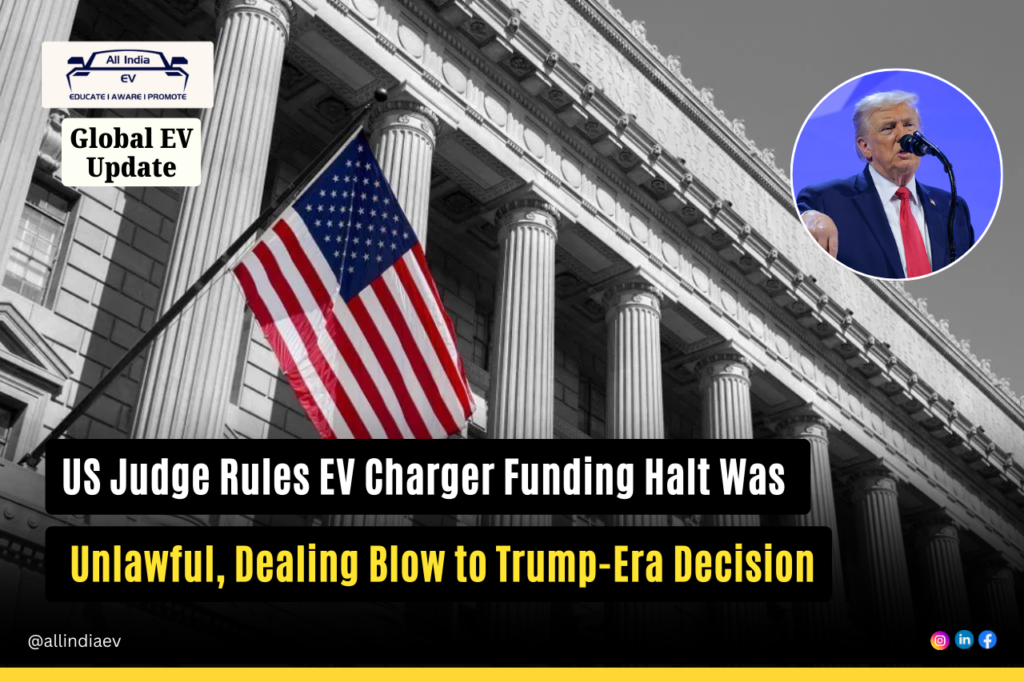
In a landmark decision with major implications for the future of electric vehicle (EV) infrastructure in the United States, a federal judge has ruled that the Trump administration acted unlawfully when it suspended a key federal program designed to expand EV charging stations across the country.

The case centers on the National Electric Vehicle Infrastructure (NEVI) Formula Program, a $5 billion initiative created under the Infrastructure Investment and Jobs Act (IIJA) of 2021 to support the nationwide buildout of EV charging stations. This program was intended to accelerate EV adoption by ensuring reliable charging networks along highways and in urban and rural areas alike.


Judge’s Ruling: Unlawful Suspension

On January 23, 2026, U.S. District Judge Tana Lin in Seattle ruled that the Trump administration’s decision to halt funding for the NEVI program was contrary to federal law. The ruling came as a result of a lawsuit brought by 20 Democratic-led states and the District of Columbia, who argued that the U.S. Department of Transportation (DOT) illegally withheld funds that Congress had authorized for EV infrastructure.

Judge Lin found that the Transportation Department and its agencies had “pulled the NEVI Program’s plug from the socket” without following required administrative procedures. She held that the IIJA did not authorize any pause, even temporary, in the release of funds for the program, meaning the suspension violated federal administrative law.

Her order permanently prohibits the DOT and the Federal Highway Administration from withholding NEVI funds or cancelling states’ approved implementation plans — ensuring that states can continue building out charging networks under the original federal funding.


What This Means for EV Infrastructure

The ruling is being hailed by environmental advocates and state officials as a major win for clean energy and the rule of law. By blocking the administration from cutting off or rescinding previously approved funds, the decision protects billions in federal support for EV charging projects.

More EV News
EVs slash millions of barrels of global fuel consumption in 2025
Ferrari opens Cell Lab as Electric Supercar Competition Heats Up
India Plans Global EV Summit as It Revamps Electric Mobility Strategy
BYD Powered China’s EV Boom, Now Faces Slowing Sales and Pressure
Energy Giants Ink Landmark Deal for 5 GWh of Battery Storage Solutions

State attorneys general leading the lawsuit emphasized that EV charging infrastructure is essential for achieving broader clean-energy goals and supporting the transition away from fossil fuels. Washington State Attorney General Nick Brown said widespread charging networks are critical to helping residents embrace electric vehicles.

Proponents argue that a strong public charging network will help reduce range anxiety, encourage EV adoption, and support economic growth in sectors tied to the clean-energy transition.


Administration’s Actions and Response

Shortly after President Trump’s inauguration, Transportation Secretary Sean Duffy directed the DOT to suspend the NEVI Formula Program. This suspension stopped the release of funds to states that had developed plans to build EV chargers under the program. Critics noted that this move was part of a broader shift by the administration to favor policies supporting gas-powered vehicles and reduce EV incentives for automakers and consumers.

The Trump administration had characterized the pause as temporary and argued that it was reviewing EV initiatives as part of broader transportation priorities. However, the court concluded that such a pause was not contemplated by the IIJA and therefore not legally permissible.

At the time of the ruling, the Department of Transportation had not immediately responded with a public comment.


Political and Legislative Context

The decision comes amid ongoing political debate in Washington over the future of federal support for EV infrastructure. The U.S. Senate was scheduled to consider legislation that would redeploy nearly $879 million earmarked for the EV charging network toward other infrastructure priorities — a sign that funding decisions remain contested in Congress.

Supporters of the NEVI program argue that redirecting EV infrastructure funds undermines both economic and environmental goals. Opponents maintain that federal funds should be flexible to address a broader range of infrastructure needs.


Conclusion: A Crucial Victory for EV Growth

The federal judge’s ruling marks a significant legal and policy victory in the fight to expand EV charging infrastructure in the U.S. By upholding congressional intent and protecting billions in funding, the decision reinforces the role of federal law in shaping the country’s transition to cleaner transportation. It also sends a clear message about the limits of executive power in altering program implementation without proper statutory authority.

Whether the Trump administration will appeal the decision, or how Congress will adjust its infrastructure priorities, remain key questions as the U.S. continues to grapple with climate, energy, and transportation policy in the years ahead. 
All India EV Community

Click here for more such EV Updates

Loading
Chinese EV Makers Gain $2000 Cost Edge, Target 35% Global Share by 2030
Solid-state EV batteries are coming sooner than expected
Renault’s Ampere and Basquevolt Forge Battery Breakthrough for Next-Gen EVs
MHP and AWS Launch New Global Standard for EV Battery Digital Twins
Historic Shift in Europe: Electric Cars Outsell Petrol Vehicles for the First Time

Sign Up For Daily Newsletter

Be keep up! Get the latest breaking news delivered straight to your inbox.
Loading
By signing up, you agree to our Terms of Use and acknowledge the data practices in our Privacy Policy. You may unsubscribe at any time.
Share This Article
Facebook Whatsapp Whatsapp LinkedIn Copy Link Print
Leave a Comment

Leave a Reply Cancel reply

Your email address will not be published. Required fields are marked *

Follow US
XFollow
InstagramFollow
YoutubeSubscribe
LinkedInFollow
EV push could raise import bill faster than it cuts crude oil dependence initially
15 May 2026
Musashi India signs LOI with Kinetic Green for 2W EV powertrain supply
15 May 2026
What: Eicher has completed a Kashmir-to-Kanyakumari (K2K) endurance run using its fully loaded Eicher Pro X EV commercial truck, positioning the campaign as a real-world validation of electric logistics capability in India. The company claims the vehicle became the first and fastest electric commercial vehicle to complete the route under loaded operating conditions. The Number: The Eicher Pro X EV covered over 4,000 km in six days across diverse terrain and temperature conditions ranging from approximately -2°C to 40°C, while setting four India Book of Records milestones during the journey. The Impact: The Eicher Pro X EV Kashmir Kanyakumari run directly addresses one of the biggest concerns in India’s electric commercial vehicle segment — operational reliability over long distances. The campaign also highlights the growing viability of public charging infrastructure for commercial EV deployment. The Core News VE Commercial Vehicles, through its Eicher Trucks and Buses division, has launched a proof-focused electric mobility campaign centred around the Eicher Pro X EV’s successful Kashmir-to-Kanyakumari expedition. The campaign, branded around the “#XpertHaiTohPossibleHai” initiative, is aimed at demonstrating practical commercial EV readiness instead of relying solely on specification-based marketing claims. The vehicle reportedly completed the Srinagar-to-Kanyakumari route while operating under fully loaded conditions, travelling through highways, plains, ghats, urban corridors, and varying climate zones. Eicher stated that the vehicle depended on public charging infrastructure accessed through the MyEicher App ecosystem during the expedition. The company used third-party validation through the India Book of Records to independently verify route compliance, charging stops, distance covered, and operational conditions. The campaign reflects a broader shift underway in India’s commercial EV industry, where manufacturers are increasingly focusing on operational economics, fleet confidence, uptime assurance, and infrastructure reliability rather than only announcing vehicle launches. Long-haul and mid-mile logistics remain one of the most difficult electrification segments due to concerns around charging availability, payload impact, range predictability, and route downtime. Eicher’s demonstration appears strategically designed to reduce these concerns for fleet operators evaluating electric truck adoption. Breaking Down the Update • The Eicher Pro X EV completed a Kashmir-to-Kanyakumari expedition under loaded commercial operating conditions • The journey covered more than 4,000 km in six days across multiple terrain conditions • Eicher claims the run established four India Book of Records milestones • Public charging infrastructure was used throughout the route via the MyEicher App ecosystem • The campaign focused on proving operational reliability instead of conventional promotional messaging • The route included highways, mountainous regions, urban corridors, and coastal stretches • The initiative targets commercial fleet operators evaluating electric logistics deployment • The campaign aligns with India’s broader decarbonisation and green logistics objectives How Eicher Pro X EV Kashmir Kanyakumari run will help Indian EV Market The Eicher Pro X EV Kashmir Kanyakumari run could become an important reference point for India’s electric commercial vehicle sector because it focuses on real operational validation instead of controlled test conditions. One of the largest barriers to electric truck adoption in India has been fleet operator hesitation around range reliability, charging access, payload capability, and uptime consistency during long-distance movement. By completing a loaded multi-state logistics route using public charging infrastructure, Eicher is attempting to demonstrate that electric commercial vehicles can gradually move beyond short urban delivery applications into more demanding logistics operations. This is particularly important for India’s mid-mile and intra-city freight segments, where electrification potential remains significant but operational confidence is still developing. The campaign also indirectly highlights improvements in India’s charging infrastructure ecosystem. Commercial EV adoption depends heavily on charger availability, route planning tools, energy management systems, and service support networks. Demonstration runs like this help validate ecosystem readiness for fleet operators who typically evaluate vehicles based on total operational efficiency rather than environmental positioning alone. If more OEMs begin showcasing real-world logistics deployment data instead of laboratory claims, the Indian commercial EV sector could move faster toward practical fleet electrification and wider private-sector adoption. Conclusion & Next Steps The Eicher Pro X EV Kashmir Kanyakumari run reflects a growing maturity in India’s electric commercial vehicle market, where operational proof is becoming more valuable than launch announcements alone. The next challenge will involve scaling charging reliability, lowering fleet transition costs, and ensuring consistent uptime performance under commercial deployment conditions. As electric logistics adoption expands, real-world validation exercises like this are likely to become increasingly important for fleet decision-making across India’s freight sector
Eicher sets new EV benchmark with K2K campaign
15 May 2026
All India EV: Edition 49
What all happened in April 2026?
Click Here
All India EV

Daily EV Industry updates for you…

Categories

  • EV News
  • EV Launch
  • Investments & Funding
  • Market Insights
  • Guest Articles
  • EV Engineering

Quick Links

  • Community
  • Content Services
  • Branding Services
  • My EV Charger
  • Substack

© Developed and Managed by “The Energy Log”

Welcome Back!

Sign in to your account

Username or Email Address
Password

Lost your password?

Not a member? Sign Up