
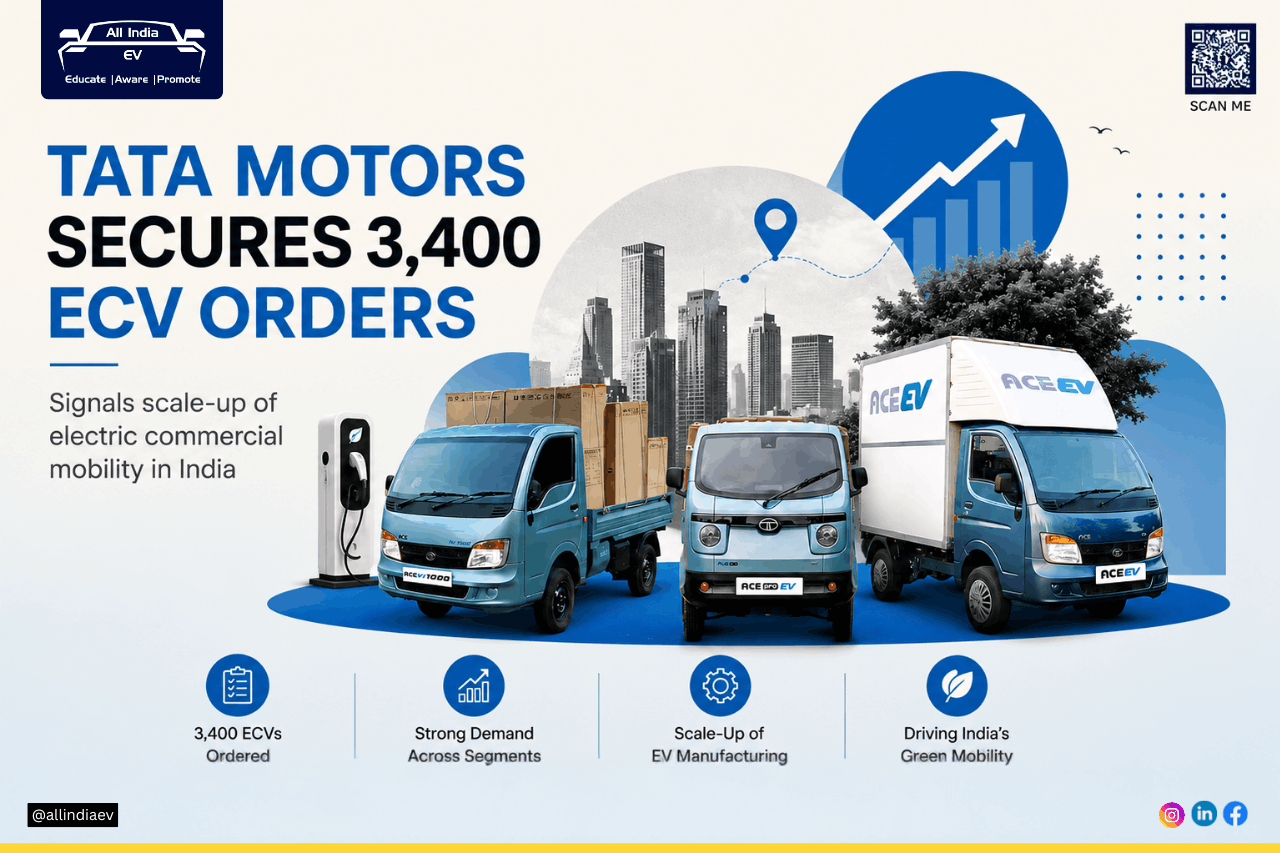

What Happened: Tata Motors has reportedly secured 3,400 orders for electric commercial vehicles, underscoring rising fleet interest in electric freight and cargo mobility. The order wins points to stronger demand visibility for the company’s ECV portfolio in India.
The Key Number: 3,400 orders.
Why It Matters: This is a meaningful scale signal for India’s electric commercial vehicle market, where fleet economics matter more than marketing. Large orders can improve factory planning, fleet confidence, and the pace of EV adoption in logistics and intra-city cargo use.

The Core News
Tata Motors secures 3,400 ECV orders in a development that highlights growing commercial acceptance of electric trucks and cargo vehicles in India. The order book strengthens the company’s position in a segment that is still early-stage but increasingly relevant for fleet operators looking to control fuel and maintenance costs.
The timing is important because electric commercial mobility is moving from pilot projects to more structured fleet procurement. Businesses are now paying closer attention to total cost of ownership, route predictability, and charging access, all of which can favour electric platforms in specific operating cycles.
More EV News

For the wider EV ecosystem, this is a practical signal that demand is broadening beyond passenger EVs. If Tata Motors can convert these orders into timely deployment and service support, it could help establish a stronger template for electric fleet adoption across Indian logistics, delivery, and urban transport operations.
🔹 Breaking Down the Update
- Order size: 3,400 electric commercial vehicle orders.
- Market segment: Electric commercial mobility, not passenger EVs.
- Industry signal: Fleet buyers are showing a stronger willingness to commit to EVs.
- Business impact: Larger order books improve production planning and execution visibility.
- Ecosystem effect: Supports the transition of logistics and cargo operations toward electrification.
🔹 How Tata Motors secures 3,400 ECV orders will help the Indian EV market
Tata Motors secures 3,400 ECV orders at a time when India’s EV conversion is expanding from private car buyers to commercial fleet operators. That matters because commercial vehicles usually travel more predictable routes, making them better candidates for electrification when charging and service support are available. As a result, this kind of demand can accelerate adoption in urban freight, last-mile delivery, and intra-city cargo movement.
For Indian OEMs, the biggest benefit is validation. Large ECV orders indicate that buyers are no longer treating electric commercial vehicles as experiments; they are beginning to assess them as operational assets. For policymakers, it reinforces the case for charging infrastructure, depot planning, and fleet-focused incentives that can support cleaner transport at scale.
In the near term, the key effect will be confidence. In the longer term, repeat fleet orders could help reduce unit costs, improve utilisation, and build a more stable commercial EV market in India. That would make electrification less dependent on consumer sentiment and more tied to business economics.
🔹Way Forwad ….
The next thing to watch is how Tata Motors executes these 3,400 ECV orders and whether the demand converts into sustained fleet expansion. Tata Motors’ securing 3,400 ECV orders is a strong indicator that commercial EV adoption in India is moving into a more scalable phase, but delivery timelines, service readiness, and charging support will decide how durable that momentum becomes. If execution holds, this could become a useful benchmark for the next wave of electric freight growth in the country.
Read More: Catch up on All India EV’s related coverage on India’s evolving commercial EV subsidies and battery swapping policies at All India EV