
All India EVAll India EVAll India EV
Notification
Font ResizerAa
  • Home
  • EV News
  • EV Launch
  • Market Insights
  • Investments & Funding
  • Guest Articles
  • EV Engineering
  • Contact
Reading: IIT Indore Revolutionizes EV Batteries with Advanced Composite
Share
All India EVAll India EV
Font ResizerAa
  • Home
  • EV News
  • EV Launch
  • Market Insights
  • Guest Articles
  • EV Engineering
  • Contact
Search
  • Home
    • Home 1
    • Home 2
    • Home 3
    • Home 4
    • Home 5
  • Home
  • Categories
    • Electric
  • Categories
  • Shows
    • Rap
  • More Foxiz
    • Blog Index
    • Contact
  • Bookmarks
    • Customize Interests
    • My Bookmarks
  • More Foxiz
    • Blog Index
    • Sitemap
Have an existing account? Sign In
Follow US
IIT Indore Revolutionizes EV Batteries with Advanced Composite
Home » Blog » IIT Indore Revolutionizes EV Batteries with Advanced Composite
EV News

IIT Indore Revolutionizes EV Batteries with Advanced Composite

Ankit Sharma
By
Ankit Sharma
ByAnkit Sharma
Follow:
Last updated: 7 November 2024
Share
7 Min Read
SHARE
IIT Indore Revolutionizes EV Batteries with Advanced Composite

IIT Indore Revolutionizes EV Batteries with Advanced Composite

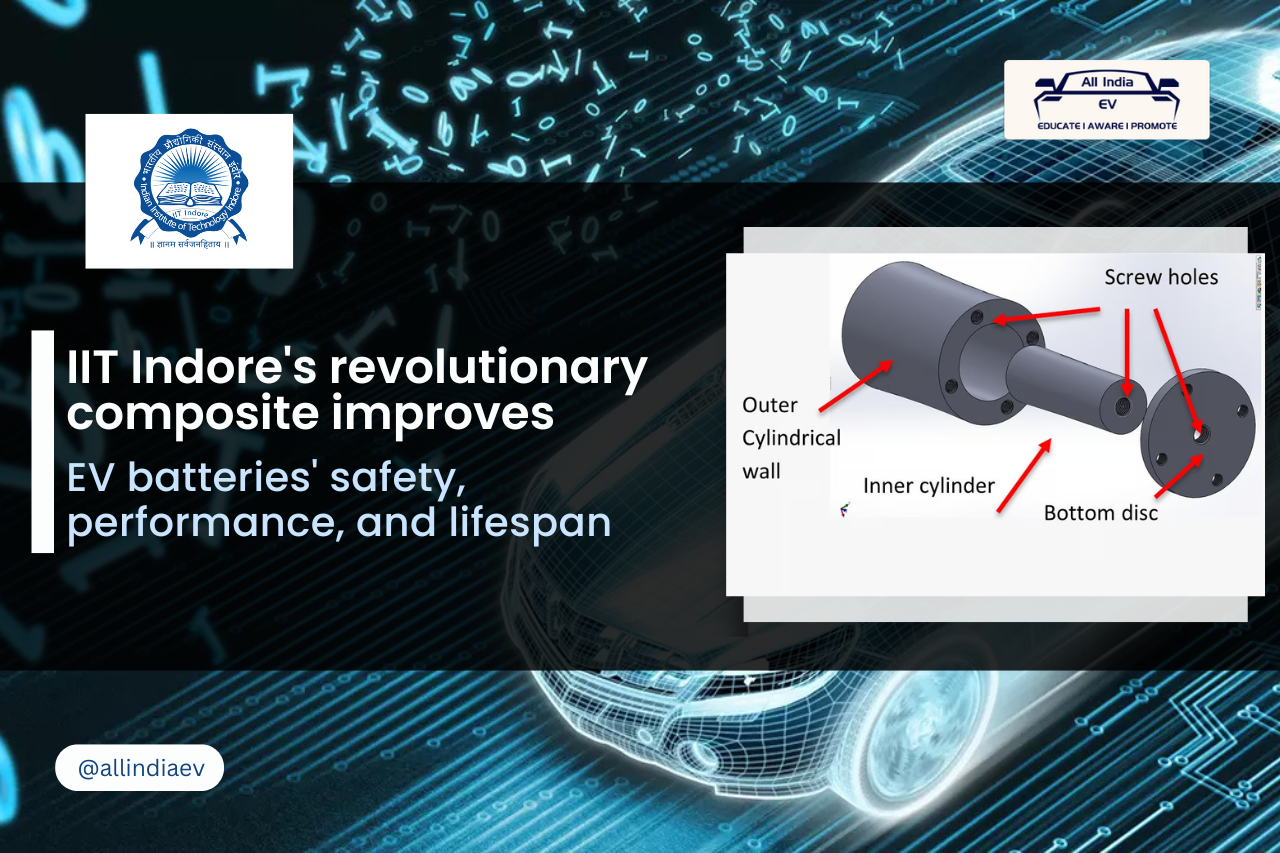
In a major breakthrough for the electric vehicle (EV) industry, researchers at IIT Indore have developed a revolutionary Novel Phase-Change Composite (NPCC) that promises to significantly improve the thermal management of lithium-ion batteries used in electric vehicles. Spearheaded by Prof. Santosh Kumar Sahu from the Mechanical Engineering department, this cutting-edge composite offers enhanced battery safety, performance, and lifespan, addressing some of the most pressing challenges in EV technology today. As battery efficiency, safety, and durability are key concerns for the EV market, the NPCC has the potential to drive a new wave of innovation in the sector.

Contents
  • IIT Indore Revolutionizes EV Batteries with Advanced Composite
  • The Role of Thermal Management in EV Battery Safety
  • Key Advantages of NPCC in EV Battery Applications
  • Impact of NPCC on EV Manufacturers and Consumers
  • Commercialization and Broader Applications of NPCC Technology

The material is lightweight, cost-effective, and easy to manufacture, making it a promising alternative to traditional cooling systems that are often bulky and maintenance-heavy. This breakthrough technology not only holds the potential to advance EV battery systems but also finds applications in renewable energy storage and other sectors requiring superior thermal management solutions. The NPCC is already moving towards commercialization, with Simple Energy Private Limited in Bangalore set to integrate it into their electric two-wheelers.

The Role of Thermal Management in EV Battery Safety

Effective thermal management is a critical aspect of electric vehicle (EV) design, as it directly impacts the performance and safety of the battery system. In lithium-ion batteries, excessive heat can cause irreversible damage, leading to thermal runaway, a process that can result in fires, explosions, or battery failures. The Novel Phase-Change Composite (NPCC) developed by IIT Indore addresses this issue by ensuring that battery temperatures remain stable and within optimal ranges during both charging and discharging cycles.

This stability prevents the battery from overheating, reducing the risk of catastrophic failures. The NPCC acts as a heat sink, absorbing excess heat and maintaining a uniform temperature across the battery module, thereby ensuring safer and more reliable operation. Unlike traditional liquid-cooled systems that often require pumps, pipes, and constant maintenance, the NPCC offers a passive solution that is both efficient and easy to manage.

Key Advantages of NPCC in EV Battery Applications

The NPCC introduces several critical advantages over traditional battery cooling methods. Some of its key benefits include:

  • Improved Thermal Conductivity: The NPCC ensures that heat is efficiently distributed across the battery, preventing hotspots that could damage individual cells or cause performance degradation.
  • Shape Stability: The composite maintains its structure under varying conditions, ensuring consistent thermal management over time without deformation.
  • Flame Resistance: An important safety feature, the NPCC offers flame-retardant properties that protect the battery from fire hazards in case of extreme heat buildup.
  • Electrical Insulation: The material is designed to insulate against electrical currents, minimizing the risk of short circuits and enhancing the overall safety of the battery system.
  • Lightweight and Cost-Effective: Unlike traditional liquid cooling systems, the NPCC is lightweight, reducing the overall weight of the EV, while also being more cost-effective and easy to manufacture.

By addressing both performance and safety concerns, the NPCC presents a significant leap forward in battery technology, offering a more reliable, durable, and safer alternative to current thermal management solutions.

Impact of NPCC on EV Manufacturers and Consumers

The introduction of NPCC technology is set to bring about profound changes for both electric vehicle manufacturers and consumers. For manufacturers, the new composite offers several operational advantages, such as reducing the complexity and cost associated with traditional cooling systems. Since the NPCC eliminates the need for heavy pumps, pipes, and other cooling components, manufacturers can save on material and maintenance costs, leading to overall cost savings and higher efficiency in production. Additionally, NPCC’s efficiency in regulating temperature enhances the battery’s performance and longevity, leading to fewer battery replacements and lower maintenance costs for consumers.

More EV News

Servotech Power Systems and Electra EV partner for innovative EV Charging Technologies
Arenq and DE Power collaborate to provide EV charging stations and chargers in India
Subsidies for Electric 2 & 3 Wheeler Charging Stations
The Future of Batteries: MIT’s Game-Changing Discovery
Tesla is preparing to launch six-seater Model Y variant in India

For consumers, this innovation promises longer-lasting batteries, resulting in a reduction in the frequency of battery replacements, a key concern in the EV industry. The longer lifespan of the battery will also make EVs more cost-effective in the long term, reducing the total cost of ownership. As the NPCC ensures greater battery safety, it will provide consumers with added peace of mind, particularly with regard to the risks associated with overheating and thermal runaway. The technology’s contribution to environmental sustainability by reducing waste and the need for raw materials further strengthens its value proposition, making EVs more attractive as a sustainable and reliable transportation option.

Commercialization and Broader Applications of NPCC Technology

The commercialization of the NPCC technology has already begun, with Simple Energy Private Limited in Bangalore securing the rights to integrate it into their electric two-wheelers. This collaboration marks the first step in bringing the technology to market, and it is expected to extend to other EV manufacturers in the future. As the demand for electric vehicles continues to grow globally, the NPCC’s ability to enhance battery efficiency and lifespan makes it an attractive solution for companies looking to improve their EV offerings.

Beyond the EV sector, the NPCC also has wider applications in industries where thermal management is crucial. For example, it could play a significant role in renewable energy storage systems, where it would be used to maintain the stability and safety of energy storage devices. In addition, industries such as consumer electronics, telecommunications, and industrial applications that rely on batteries and require efficient thermal management could benefit from the use of NPCC. By enabling safer, longer-lasting, and more efficient battery systems, the NPCC could contribute to the development of sustainable technologies across various sectors, reducing dependence on fossil fuels and helping to combat climate change.

Join All India EV Community

Click here for more such EV Updates

A Month of Milestones: Key Developments in the Global Automotive Industry by BYD
BYD India Aims for 90% EV Market Share
Tamil Nadu Announces ₹20,000 E-Scooter Subsidy for Gig Workers
SUN Mobility Unveils India’s First Modular Battery-Swapping Technology for Heavy EVs
ABB Launches ‘Battery Energy Storage Systems-as-a-Service’ to Accelerate Clean Energy Transition
TAGGED:EVEV IndiaIITIIT Indore

Sign Up For Daily Newsletter

Be keep up! Get the latest breaking news delivered straight to your inbox.
Loading
By signing up, you agree to our Terms of Use and acknowledge the data practices in our Privacy Policy. You may unsubscribe at any time.
Share This Article
Facebook Whatsapp Whatsapp LinkedIn Copy Link Print
Leave a Comment

Leave a Reply Cancel reply

Your email address will not be published. Required fields are marked *

Follow US
XFollow
InstagramFollow
YoutubeSubscribe
LinkedInFollow
Haryana cabinet approves new rules: No petrol, diesel vehicles for cab aggregators in NCR
21 May 2026
Ultraviolette and Bolt.Earth Expand Type-6 DC Fast Charging Infrastructure Across India
Ultraviolet and Bolt. Earth Expand Type-6 DC Fast Charging Infrastructure Across India
21 May 2026
What: India’s finance ministry has directed public sector banks, insurers, and financial institutions to reduce operational spending and accelerate adoption of electric vehicles across official fleets. The move is part of a wider austerity push linked to rising global economic uncertainty and fuel-related risks. The Number: The directive impacts major public institutions including State Bank of India, Bank of Baroda, and Life Insurance Corporation of India, covering millions of employees and thousands of operational vehicles nationwide. The Impact: The policy signals a new phase of institutional fleet electrification in India, where EV adoption is now being tied directly to fiscal discipline, fuel import management, and public-sector operational efficiency. The Core News India’s finance ministry has formally instructed state-run financial institutions to implement strict expenditure controls while simultaneously accelerating EV adoption for official transport operations. The directive from the Department of Financial Services asks organisations to replace petrol and diesel vehicles used at head offices and branch operations with electric vehicles “as far as possible.” The order comes amid growing concern over the economic impact of prolonged geopolitical instability in West Asia, which threatens to increase crude oil prices, widen India’s import bill, and pressure the rupee. Alongside the EV transition mandate, the government has also pushed virtual meetings, reduced foreign travel, and tighter administrative spending controls across public-sector institutions. For India’s EV ecosystem, the directive is strategically important because it expands demand visibility beyond state transport undertakings and government departments into the financial sector itself. PSU banks and insurers operate one of the country’s largest distributed office networks, including regional offices, branch fleets, field operations, and administrative mobility services. Even a phased transition could create a sizeable procurement pipeline for electric passenger vehicles, charging infrastructure providers, and fleet management companies. Breaking Down the Update • The Department of Financial Services issued the austerity and EV adoption directive to PSU banks, insurers, and financial institutions. • The government wants petrol and diesel vehicles used in official operations to be progressively replaced by EVs wherever operationally feasible. • The policy push follows Prime Minister Narendra Modi’s appeal for fuel conservation and controlled discretionary spending amid global energy uncertainty. • The directive also mandates greater use of video conferencing to reduce travel-related operational expenditure. • The move could indirectly support domestic EV OEMs, leasing firms, and charging infrastructure operators through institutional procurement demand. • The banking and insurance sector may emerge as a new enterprise fleet electrification category in India’s EV transition roadmap. How PSU banks EV adoption will help Indian EV Market The expansion of PSU banks EV adoption could create a strong institutional demand layer for India’s electric mobility sector. Public sector banks and insurers operate thousands of branch offices across urban, semi-urban, and rural India. Their transition to EV fleets can generate predictable procurement volumes for domestic automakers, especially in the electric sedan, compact SUV, and commercial mobility segments. Beyond vehicle sales, the policy may also accelerate deployment of workplace charging infrastructure at bank headquarters, zonal offices, and regional branches. This can support charger utilisation economics while helping normalise EV infrastructure in tier-2 and tier-3 cities. Another important impact is signalling. When large state-linked financial institutions adopt EVs as operational assets rather than pilot projects, it improves confidence across the broader enterprise mobility market. Private banks, NBFCs, and insurance firms could eventually follow similar fleet transition models to reduce long-term fuel and maintenance costs. PSU banks EV adoption also aligns with India’s larger energy security strategy. Lower petroleum consumption in institutional fleets directly supports efforts to reduce crude import dependence while stabilising operational expenditure during periods of volatile global oil prices. Conclusion & Next Steps The government’s push toward PSU banks EV adoption reflects a broader shift where EV deployment is increasingly being linked with macroeconomic resilience rather than only sustainability targets. Execution, however, will depend on procurement timelines, charging infrastructure readiness, and operational suitability across
India directs state-run banks, insurance firms to cut costs, shift to EVs
21 May 2026
All India EV: Edition 49
What all happened in April 2026?
Click Here
All India EV

Daily EV Industry updates for you…

Categories

  • EV News
  • EV Launch
  • Investments & Funding
  • Market Insights
  • Guest Articles
  • EV Engineering

Quick Links

  • Community
  • Content Services
  • Branding Services
  • My EV Charger
  • Substack

© Developed and Managed by “The Energy Log”

Welcome Back!

Sign in to your account

Username or Email Address
Password

Lost your password?

Not a member? Sign Up