


Government Cracks Down on Battery Waste Pollution
The Indian government has imposed stern orders of environmental compensation upon offenders in case they violate the Battery Waste Management (BWM) Rules, 2022, designed to curb the increasing menace of battery waste pollution.
According to guidelines issued by the Central Pollution Control Board (CPCB) on 10 September, heavy penalties are proposed against an individual or a firm if found violating the provisions.
Under the new guidelines, violators could face a few lakhs to even crores of rupees, depending on the severity of the offense. Penalties are designed to be a deterrent and obtain compliance with the BWM Rules, whereby their aim is proper collection, storage, transportation, treatment, and disposal of waste batteries.
Stricter Penalties for Battery Waste Rule Violators
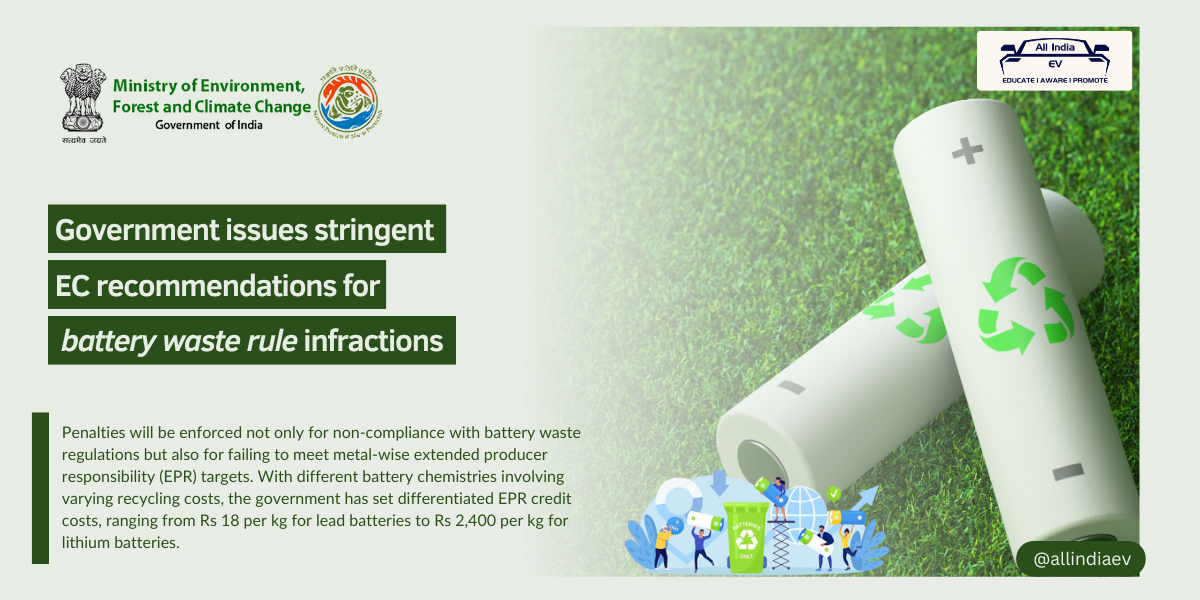
The Indian government has further tightened its grip on battery waste management by introducing penalties not only for non-compliance with regulations but also for failing to meet metal-wise extended producer responsibility (EPR) targets.
Recognizing the varying recycling costs associated with different battery chemistries, the government has implemented a differentiated EPR credit cost system. This system assigns different costs based on the type of battery, with lead batteries having the lowest cost at Rs 18 per kg and lithium batteries facing the highest cost at Rs 2,400 per kg.
This structured approach ensures that producers are held accountable for managing battery waste in proportion to the environmental impact and recycling complexity of their products. It incentivizes responsible waste management practices and discourages the use of batteries with higher environmental footprints.
More EV News

EPR targets are environmental regulations that mandate producers to take responsibility for the entire lifecycle of their products, including their disposal and recycling. By imposing penalties for non-compliance with these targets, the government aims to promote a circular economy and reduce the burden on the environment.
Battery Manufacturers Face Stricter Penalties for Waste Non-Compliance
As a measure of increasing environmental responsibility, it has incurred severe penalties for Indian battery manufacturers who are unable to meet the EPR targets.
To back up this new law, manufacturers are required to collect or recycle a part of their lead or lithium batteries after use. In this case, the degree targets differ according to the type of material. In any failure case, they are required to pay an EC, or financial penalty, meant for promoting sound waste management and eco-friendly design.
The task of the Central Pollution Control Board would be to formulate directions for the imposition and collection of EC from those who fail to comply with the order. It would ensure that the environmental impacts of battery products are borne by the manufacturing industries themselves.
To promote compliance, the government has introduced graduated levels of penalties for defaults other than for deficiencies in EPR. A first default attracts an EC of Rs 20,000—equivalent to the application fee payable for registration under the Battery Waste Management Rules. Subsequent defaults are to be doubled; on the second default, an amount equivalent to Rs 40,000 is envisaged and an amount of Rs 80,000 on the third.
Strict Penalties for Battery Waste Rule Violators
The BWM Rules have stipulated that the entities that are contravened to the said Rules should make payment of environmental compensation (EC) and fine in a stipulated time frame. Payments delayed for more than three months will attract interest payable, with a minimum annual rate of 12 percent when such payments are made within one month from the date of due payment. Other government measures could include closing the unit, seizing trade documents, or filing a case under the EPA.
The government has also made provision for a system of progressively graded punishments for late payments. This is a very strong disincentive to ensure that everybody is on time in their compliance with the BWM Rules.
The MoEFCC has the records that indicate that the current registration under the CPCB is for 252 recyclers. These are the recyclers who currently have to take care of the battery wastes of India in a proper and efficient way.