
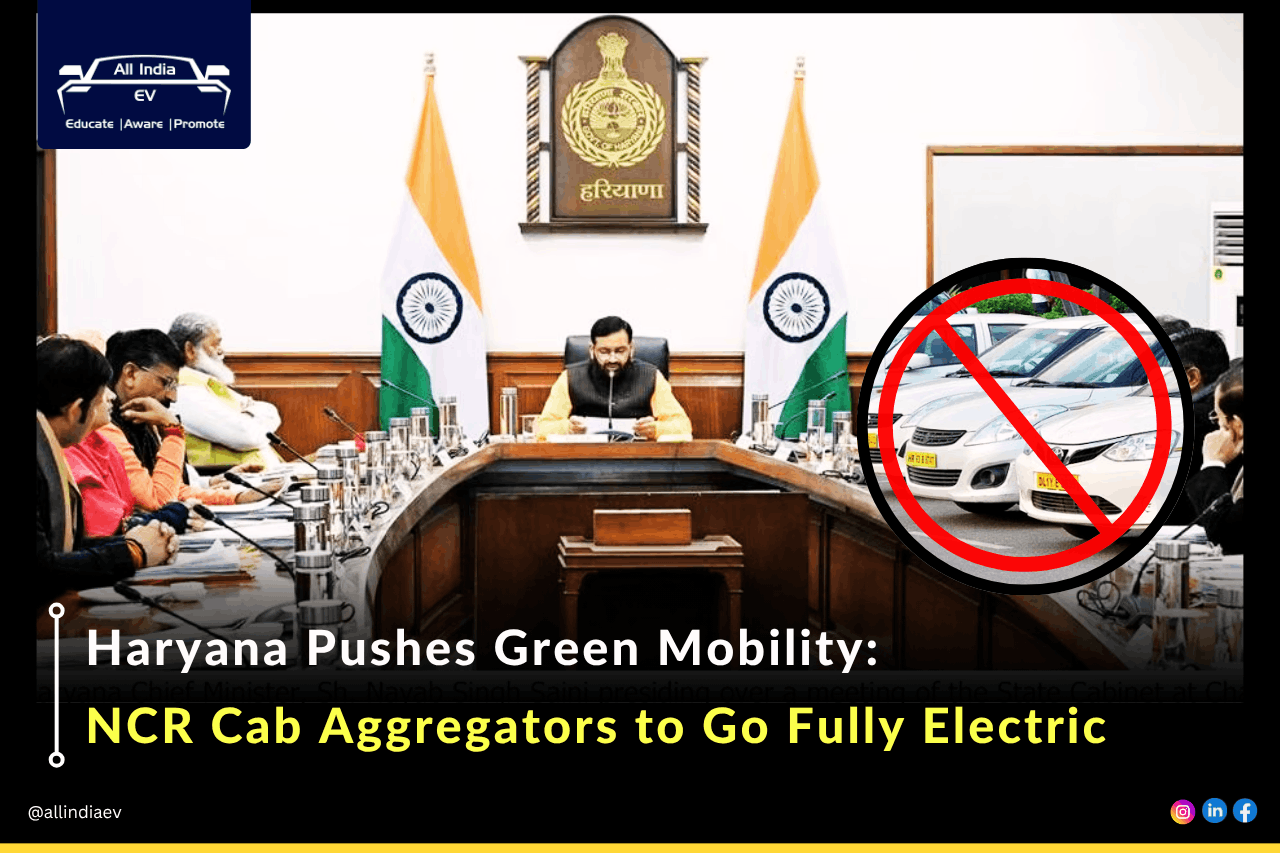

What: The Haryana government has approved new aggregator licensing rules that ban the addition of new petrol and diesel vehicles into cab, delivery, and e-commerce fleets operating in NCR districts from January 1, 2026. The policy directly pushes cleaner mobility adoption through mandatory CNG and electric vehicle integration.
The Number: All new fleet vehicles inducted after January 1, 2026 must run on CNG, EV, battery-operated systems, or other cleaner fuels. The rules also mandate ₹5 lakh passenger insurance, ₹5 lakh driver health insurance, and ₹10 lakh term insurance for onboarded drivers.
The Impact: The Haryana EV fleet policy signals a major transition for Delhi-NCR mobility operators, especially ride-hailing and last-mile delivery companies. The move could accelerate commercial EV demand while tightening compliance and operating standards across app-based mobility platforms.

The Core News
The Haryana Cabinet, chaired by Chief Minister Nayab Singh Saini, has approved revised aggregator licensing rules under the Haryana Motor Vehicles Rules, 1993. The framework aligns with directives issued by the Ministry of Road Transport and Highways and the Commission for Air Quality Management (CAQM), which had already instructed NCR states to stop adding new petrol and diesel fleet vehicles from 2026 onward.
Under the updated rules, all new vehicles added by cab aggregators, delivery operators, and e-commerce logistics companies in Haryana’s NCR districts must use cleaner fuels such as CNG or electric powertrains. Existing fleets are not immediately banned, but all future induction into aggregator fleets will gradually shift toward low-emission mobility. Three-wheeler auto-rickshaws entering these fleets will also be restricted to CNG or electric models only.
Beyond fuel transition mandates, the Haryana EV fleet policy also introduces a broader compliance architecture for app-based transport operators. The framework includes mandatory licensing, digital vehicle verification through VAHAN and SARATHI portals, cybersecurity requirements for apps, fare regulation oversight, passenger safety mechanisms, and mandatory 24×7 grievance systems. Vehicle tracking devices, panic buttons, fire extinguishers, and first-aid kits will now become compulsory in applicable fleet vehicles.
More EV News

Breaking Down the Update
• Haryana will prohibit new petrol and diesel vehicles in aggregator fleets from January 1, 2026
• The rule applies to cab aggregators, delivery companies, and e-commerce operators in NCR districts
• Only CNG or electric auto-rickshaws can now join existing fleet networks
• Aggregators must provide ₹5 lakh passenger insurance and ₹10 lakh driver term insurance
• Mandatory safety systems include GPS tracking, panic buttons, and fire extinguishers
• Driver and vehicle verification will happen digitally through VAHAN and SARATHI portals
• Haryana is also considering 100% EV tax exemption to accelerate adoption
• The state has separately announced plans to procure 500 electric buses
How Haryana EV fleet policy will help Indian EV Market
The Haryana EV fleet policy could become one of the most influential regional commercial mobility transitions in North India. Since Haryana covers key NCR urban clusters like Gurugram and Faridabad, the regulation directly impacts large-scale ride-hailing and delivery operations run by companies such as Uber, Ola, and multiple logistics operators.
Commercial fleet electrification typically creates faster EV adoption cycles compared to private ownership because fleet vehicles operate at higher daily utilization rates. This increases the economic viability of EVs through lower running costs and better total cost of ownership calculations. As operators replace aging petrol and diesel fleets, demand for electric sedans, electric three-wheelers, and electric two-wheelers is expected to rise significantly.
The Haryana EV fleet policy could also improve charging infrastructure investments in NCR corridors. Fleet-focused charging ecosystems often become anchor demand generators for public fast-charging deployment. In parallel, stricter compliance norms around insurance, safety systems, and digital monitoring could push fleet formalization across India’s app-based mobility sector.
If Haryana also approves the proposed 100% EV tax exemption, the combined policy structure may create a stronger commercial EV adoption model that other NCR-linked states could replicate over the next few years.
Way Forward ..
The Haryana EV fleet policy marks a decisive shift toward regulated clean mobility in NCR-linked transport operations. While the transition timeline primarily affects new vehicle induction rather than existing fleets, the policy will pressure aggregators and logistics operators to accelerate EV procurement and charging partnerships. The next phase to watch will be implementation efficiency, charging infrastructure readiness, and whether Haryana proceeds with full EV tax exemptions to strengthen commercial EV economics.
Read More: Catch up on All India EV’s related coverage on India’s evolving commercial EV subsidies and battery swapping policies at All India EV