


Despite Fierce Rivalry Among EV Leaders, India’s Electric Two-Wheeler Sales Plateau at 1.3 Lakh Units Year-on-Year, Shows Vahan Data
- Rare Earth Magnet Shortage Impacts Production
- TVS Motor Slips to Second Place
- How Bajaj Regained the Lead
- Ather Energy’s Record Month and Expanding Market Footprint
- Hero MotoCorp Gains Ground with VIDA’s Rising Popularity
- Ola Electric’s Decline Continues
- Ola’s Troubles: From Product Glitches to Registration Hiccups
- Aggarwal’s New Move: Democratizing Spare Parts Access
- Industry Snapshot: Shifting Market Dynamics
- Conclusion: A Market in Transition
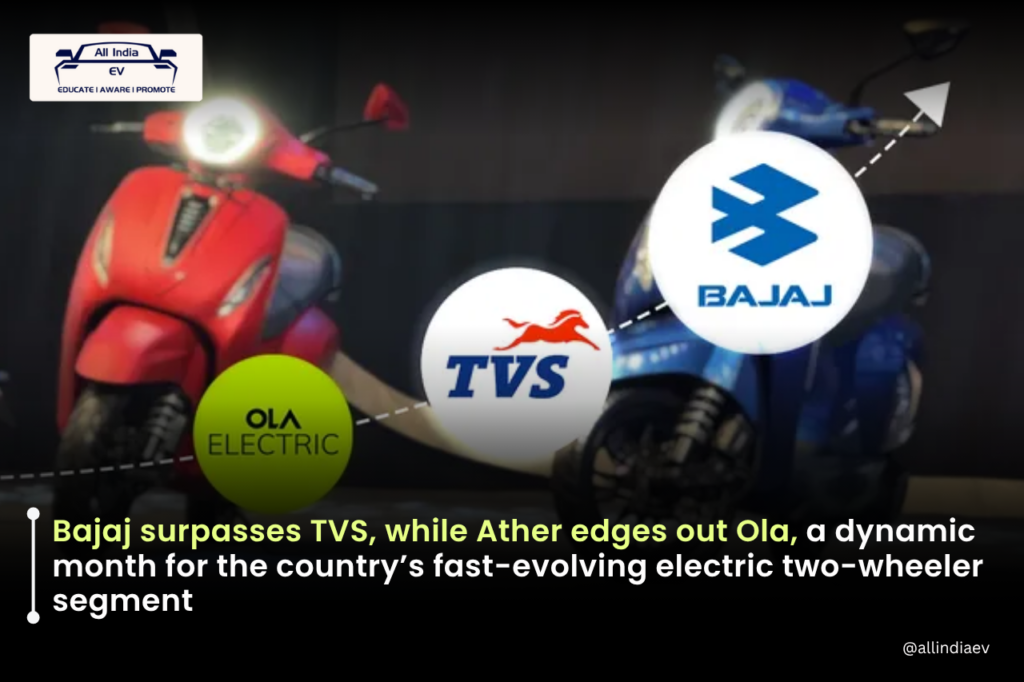
India’s fast-evolving electric two-wheeler (e2w) market continues to witness intense competition as legacy automaker Bajaj Auto edged past TVS Motor Company to claim the top spot in October 2025, marking a remarkable comeback in the country’s highly competitive EV segment.
Meanwhile, Ather Energy registered its best-ever monthly performance, securing the third position and leaving Ola Electric far behind at fifth place. Hero MotoCorp, too, surprised the industry with record sales for its VIDA brand, nearing the 15,000-unit mark for the month.
However, beneath this fierce battle for the top ranks lies a concerning reality — India’s overall e2w sales have plateaued year-on-year, with October 2025 sales crossing just 1.3 lakh units, compared to 1.35 lakh units during the same month last year, according to Vahan data.
Rare Earth Magnet Shortage Impacts Production
Industry experts attribute this slowdown primarily to the shortage of rare earth magnets, a critical component in electric motor production. The shortage has hit TVS volumes the hardest, but almost every OEM has felt the impact to some degree.
October’s sales were also influenced by seasonal and market factors. The Shraddh fortnight, considered inauspicious for vehicle purchases, and the GST 2.0 rate cuts that made internal combustion engine (ICE) vehicles cheaper, led to temporary buyer hesitation in the EV segment.
Analysts now wonder whether recent ICE vehicle price cuts will dampen electric two-wheeler demand further. Despite short-term challenges, most manufacturers believe the Total Cost of Ownership (TCO) still favors EV adoption in the long run.
More EV News

Encouragingly, the Ministry of External Affairs confirmed that China has partially lifted export curbs on rare earth magnets, which may ease the component shortage and boost production in the coming months.
TVS Motor Slips to Second Place
TVS Motor Company, which has consistently been a top performer in the e2w space, acknowledged during its Q2 FY26 earnings call that rare earth magnet shortages constrained production.
“For our EV products, the demand is very high. We are increasing capacity and will be able to deliver more. However, there has been a shortage of magnets affecting supplies,” said a TVS executive during the call.
According to Vahan data, TVS sold over 27,600 units in October, showing month-on-month growth but still trailing behind Bajaj Auto, which clocked over 28,000 units.
How Bajaj Regained the Lead
After facing production constraints in August and September, Bajaj Auto managed to bounce back strongly in October.
A market analyst explained that Bajaj had strategically built up inventory in previous months when production was slowed due to supply issues. The company also fulfilled a backlog of bookings, which reflected in the latest figures.
This strategy helped Bajaj regain its crown as India’s top e2w manufacturer, albeit by a narrow margin. Queries sent to Bajaj Auto regarding their October strategy remained unanswered at press time.
Ather Energy’s Record Month and Expanding Market Footprint
Ather Energy has emerged as one of India’s most consistent and fast-growing EV brands. The company recorded its best-ever monthly sales, exceeding 25,000 units in October, consolidating its position at number three and maintaining its lead over Ola Electric for a second consecutive month.
CEO Tarun Mehta, speaking at Ather’s Annual General Meeting, highlighted the company’s regional dominance, particularly in southern India.
“In all southern markets combined, Ather has already reached the number one position in market share,” Mehta said.
He added that Ather’s next growth phase is focused on expanding in non-South Indian markets, including Gujarat, Maharashtra, Madhya Pradesh, Chhattisgarh, and Odisha, where premium scooter demand is rising steadily.
“Our distribution footprint in central India has expanded considerably. In Gujarat, Ather has consistently been No. 1 for several months,” Mehta noted.
To strengthen its national presence, Ather plans to add 80–90 new experience centers every quarter, targeting 700 stores nationwide by next year.
Hero MotoCorp Gains Ground with VIDA’s Rising Popularity
Hero MotoCorp, a late entrant in the EV race, is now gaining traction through its VIDA electric scooter line. The brand’s October sales neared 15,000 units, its best performance yet, signaling strong consumer acceptance.
Market observers attribute this surge to Hero’s new VIDA variant featuring a Battery-as-a-Service (BaaS) option — a model that allows customers to rent batteries instead of buying them outright, reducing upfront costs.
Additionally, Hero’s high-profile marketing campaign, featuring Bollywood celebrities, has significantly boosted brand recall and trust among potential buyers.
While Hero has not commented publicly on its October performance, insiders suggest that the company’s aggressive promotional strategy and dealer network strength are paying off.
Ola Electric’s Decline Continues
Ola Electric, once the undisputed leader in India’s e2w segment, continues to struggle with sliding sales and market share erosion.
Although Ola retained its cumulative third place for the January–October 2025 period, with 1.74 lakh units registered, its monthly sales momentum has weakened sharply. By comparison, Ather has sold nearly 1.55 lakh units so far and is poised to overtake Ola if the current trend continues.
In FY25’s June quarter, almost every second e-scooter sold in India was an Ola. Fast-forward to FY26, and Ola’s share has dropped below 20%, as rivals Bajaj, TVS, Ather, and Hero capture a larger slice of the market.
Ola’s Troubles: From Product Glitches to Registration Hiccups
The company’s recent struggles can be traced to a series of product quality issues and registration process delays.
Earlier this year, thousands of consumer complaints regarding faulty vehicles led to an investigation by the Central Consumer Protection Authority (CCPA). Ola had to allocate significant financial resources to address warranty claims.
In early 2025, vehicle registration glitches emerged after Ola ended its contract with an external registration agency and attempted to bring the process in-house. This transition period slowed down deliveries and negatively impacted monthly sales.
Ola’s ‘Mahurat Mahotsav’ discount campaign in September — which claimed “all products sold out in 15 minutes” — drew criticism. Industry insiders revealed that only limited stock was available, making the campaign more symbolic than substantial.
Despite these setbacks, Ola remains confident. In a recent letter to shareholders, Chairman and MD Bhavish Aggarwal acknowledged that the entire EV sector is entering a consolidation phase, with the company adapting its strategy for long-term stability rather than rapid growth.
Aggarwal’s New Move: Democratizing Spare Parts Access
In an effort to rebuild customer trust, Aggarwal announced a new initiative to make Ola spare parts accessible online.
“Every Ola customer can now buy genuine parts directly through our app or website, and any mechanic can self-train to service Ola vehicles,” Aggarwal said on X (formerly Twitter).
He added that wider access to parts will boost aftermarket transparency and improve vehicle serviceability, reinforcing Ola’s direct-to-consumer sales model that bypasses traditional dealerships.
Industry Snapshot: Shifting Market Dynamics
The October 2025 leaderboard showcases the fluid nature of India’s electric two-wheeler sector, where market positions can change monthly based on component availability, pricing strategies, and consumer sentiment.
| Rank | Company | Units Sold (October 2025, till date) |
| 1 | Bajaj Auto | ~28,000 units |
| 2 | TVS Motor Company | ~27,600 units |
| 3 | Ather Energy | ~25,000+ units |
| 4 | Hero MotoCorp (VIDA) | ~15,000 units |
| 5 | Ola Electric | ~12,000–13,000 units (estimated) |
While Ather and Hero are rapidly expanding, traditional giants Bajaj and TVS continue to benefit from deep dealer networks and strong brand trust. Ola’s direct-to-customer model, once seen as an advantage, now faces execution and service challenges.
Conclusion: A Market in Transition
October’s numbers highlight how India’s e2w market has entered a new phase — one defined by fierce competition, innovation, and strategic realignments.
As supply chain challenges ease and component imports normalize, the industry is expected to resume its growth trajectory.
Yet, for now, the real story is Bajaj’s comeback, TVS’s resilience, Ather’s rapid ascent, Hero’s late surge — and Ola’s continuing fall from grace.
Comment by Author
India’s electric two-wheeler market is clearly in a transition phase, where legacy automakers are reclaiming leadership and new-age EV startups are reshaping competition.
The October sales show how Bajaj, TVS, and Ather are driving momentum even amid supply challenges, while Ola’s decline highlights the need for stronger consistency and customer trust.
As supply chains stabilize and consumer awareness deepens, India’s e2w segment is poised for renewed growth and a more balanced, mature market ahead.