
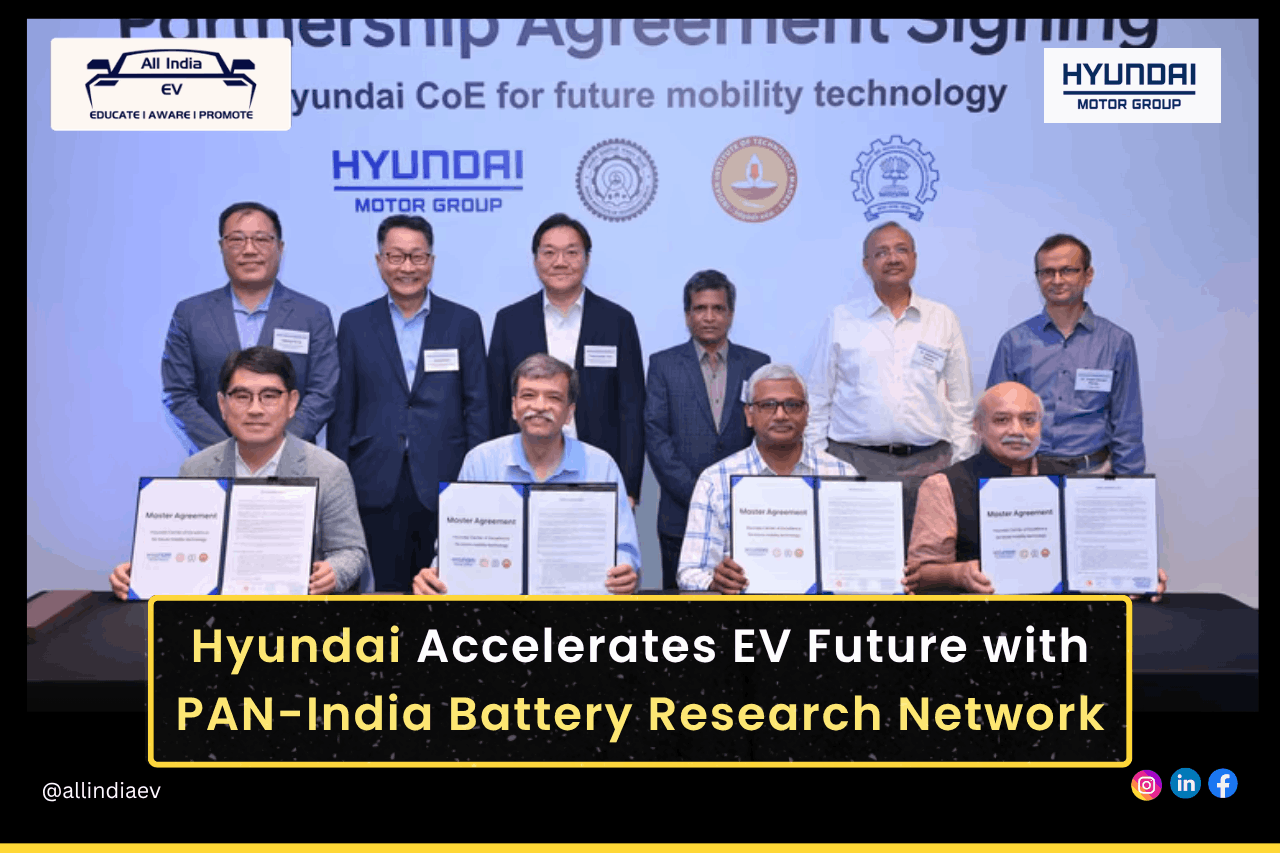

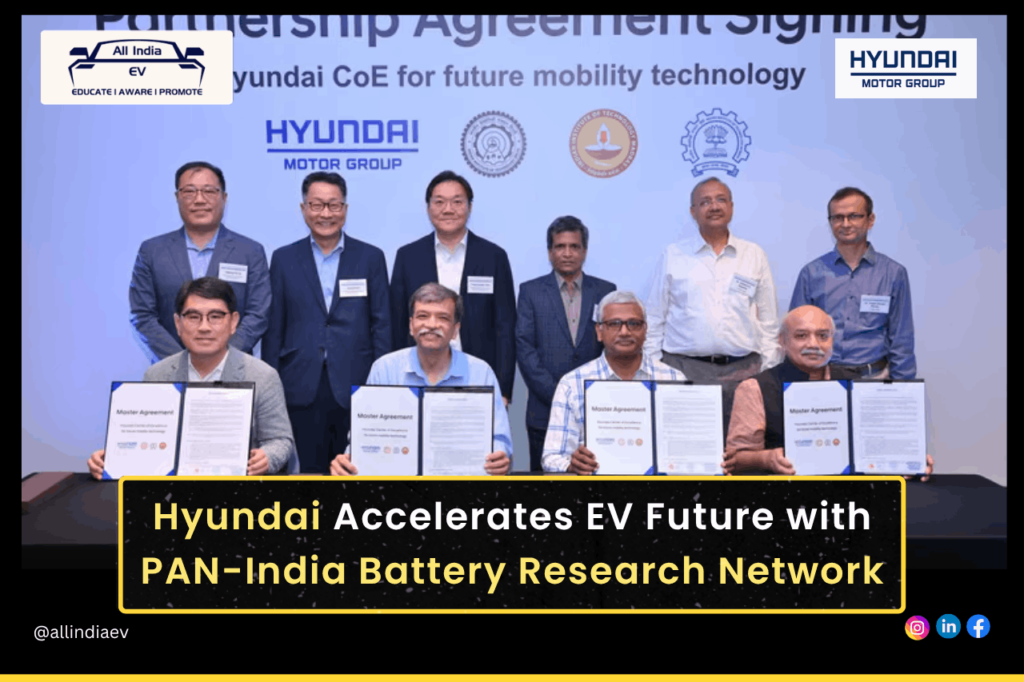
What: Hyundai Motor Group has expanded its India-focused EV research ecosystem by adding four new academic institutions to its Hyundai Center of Excellence (Hyundai CoE) network. The move is aimed at accelerating battery and electrification technologies tailored for Indian operating conditions.
The Number: The research platform is now working across 7 universities with 39 active joint projects focused on battery systems, BMS, safety, energy density, diagnostics, and Vehicle-to-Grid (V2G) technologies.
The Impact: The expanded Hyundai EV research network signals a deeper localisation push from global OEMs in India’s EV ecosystem. Instead of depending entirely on imported R&D capabilities, Hyundai is building India-specific battery engineering capacity through academia-industry collaboration.

The Core News
The expanded Hyundai EV research network marks a strategic shift in how global automakers are approaching India’s electrification market. Hyundai Motor Group has onboarded IIT Kanpur, IIT Hyderabad, VNIT Nagpur, and Tezpur University into its Hyundai Center of Excellence ecosystem, taking the total academic network to seven institutions. The initiative builds on partnerships already established with IIT Delhi, IIT Bombay, and IIT Madras.
Unlike conventional academic partnerships that remain limited to pilot studies, Hyundai’s India program is being positioned as a long-term technology pipeline focused on commercial EV readiness. The research scope includes battery cells, thermal safety, battery management systems, durability optimisation, diagnostic tools, and energy-density enhancement. Hyundai has also confirmed work on AI-enabled Vehicle-to-Grid (V2G) systems, an area becoming increasingly important as India scales renewable energy integration alongside EV adoption.
The development also reflects a broader industry trend where OEMs are moving beyond vehicle launches and investing directly into localised EV engineering ecosystems. India’s climatic conditions, charging behaviour, grid instability, and cost sensitivity require battery systems specifically engineered for domestic use cases. Hyundai’s research expansion indicates that future product competitiveness may increasingly depend on India-specific battery intelligence rather than only vehicle design or pricing strategy.
More EV News
Breaking Down the Update
• Hyundai expanded its Hyundai CoE network from 3 to 7 academic institutions
• 39 active research projects are currently underway across the platform
• Key focus areas include battery cells, BMS, diagnostics, safety, and durability
• AI-powered Vehicle-to-Grid (V2G) research is part of the program
• Hyundai aims to strengthen India-specific EV technology development
• The initiative supports long-term localisation of battery engineering capabilities
• Technology exchange programs between Indian and Korean researchers are also planned
How Hyundai EV research network will help Indian EV Market
The Hyundai EV research network could play a significant role in strengthening India’s domestic EV technology ecosystem over the next few years. One of the biggest challenges in India’s EV sector remains the dependence on imported battery technologies that are not always optimised for Indian climate, road, and charging conditions. Through direct collaboration with Indian academic institutions, Hyundai is creating a localized R&D pipeline that focuses on solving those specific operational challenges.
Battery thermal management, degradation under extreme temperatures, fast-charging optimisation, and low-cost battery diagnostics are all critical areas for India’s EV growth. Research in these domains can help improve battery life, safety standards, and charging efficiency for future electric vehicles sold in the country.
The network can also help build a stronger EV talent ecosystem. By involving professors, researchers, and engineering students in live industrial projects, Hyundai is effectively creating future-ready battery engineering talent within India. This becomes strategically important as India attempts to reduce dependence on imported EV technologies and scale domestic manufacturing under its localisation and clean mobility goals.
If executed effectively, the Hyundai EV research network could help accelerate India’s transition from being mainly an EV consumption market to becoming a meaningful EV technology development hub.
Conclusion & Next Steps
The expansion of the Hyundai EV research network shows that global automakers are now investing deeper into India’s core EV technology ecosystem rather than focusing only on product launches. The next phase to watch will be how quickly these research collaborations translate into commercially deployable battery technologies, localized EV architectures, and scalable charging intelligence. Execution speed, industry integration, and technology commercialization will determine the long-term impact of this initiative on India’s EV competitiveness.
Read More: Catch up on All India EV’s related coverage on India’s evolving commercial EV subsidies and battery swapping policies at All India EV