
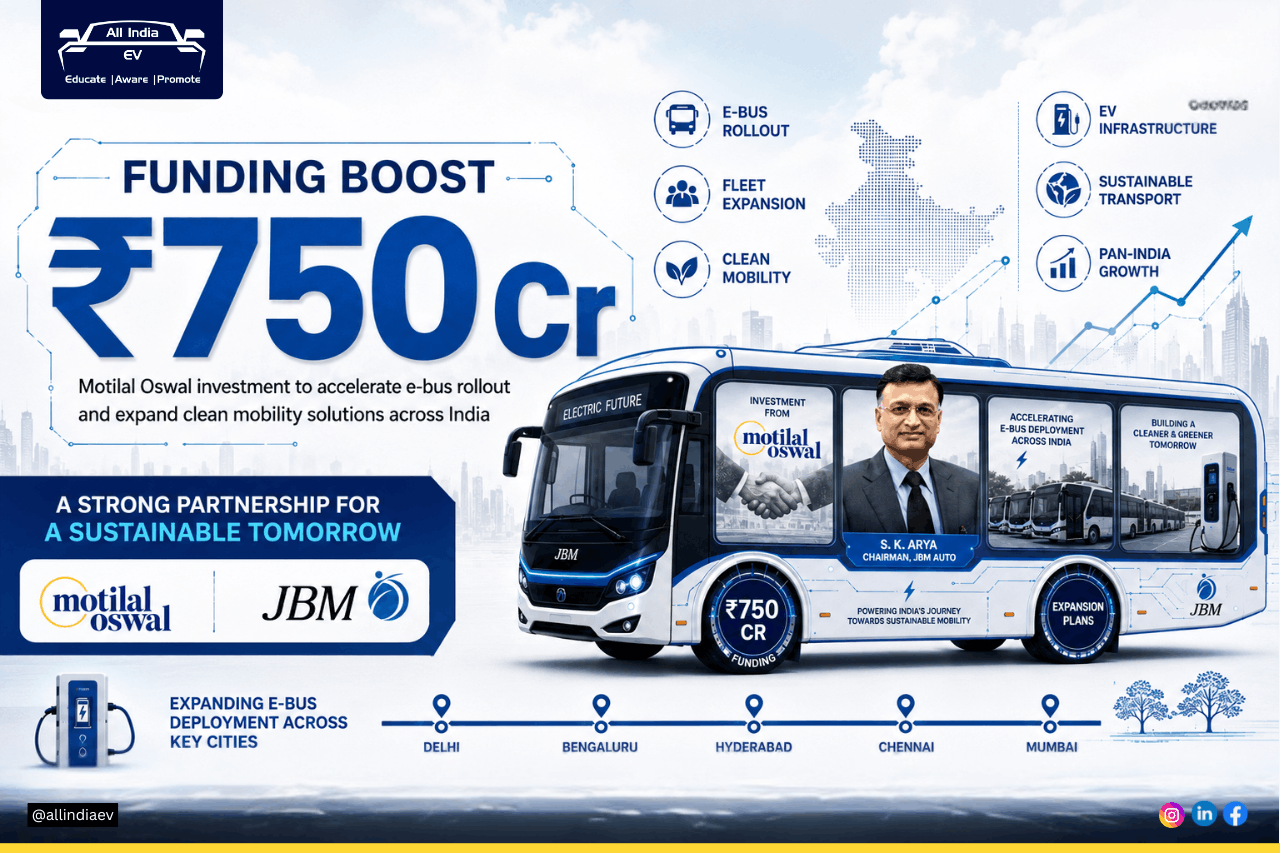

JBM Auto’s arm has secured ₹750 crore in funding from Motilal Oswal to support the expansion of its electric bus rollout. The capital is expected to strengthen fleet deployment and execution capacity as India’s e-bus market scales up.
The Key Number:
₹750 crore.
Why It Matters:
This is a strong financing signal for India’s electric bus ecosystem, where large upfront costs often slow deployment. Fresh funding can accelerate production, procurement, and route expansion for clean public transport

🔹 The Core News
JBM Auto arm gets ₹750 crore funding from Motilal Oswal to expand e-bus rollout, marking another meaningful capital infusion into India’s electric bus segment. The funding should help the company widen deployment, support operations, and improve the pace at which e-buses reach city fleets and transport contracts.
The timing matters because electric buses require substantial upfront investment, lengthy planning cycles, and reliable financing structures. That makes debt or structured capital especially important for scaling beyond pilot projects and into repeatable fleet expansion.
More EV News

For the broader EV ecosystem, this is a positive sign for the electrification of public transport. It suggests lenders and investors are increasingly willing to back e-bus platforms, which could improve confidence across OEMs, operators, and municipal buyers.
🔹 Breaking Down the Update
- Funding amount: ₹750 crore.
- Purpose: Expansion of e-bus rollout.
- Company impact: Improves execution capacity and fleet deployment.
- Market signal: Stronger investor confidence in electric buses.
- Sector relevance: Supports public transport electrification in India.
🔹 How JBM Auto arm gets ₹750 crore funding from Motilal Oswal to expand e-bus rollout, Will Help the Indian EV Market
JBM Auto arm gets ₹750 crore funding from Motilal Oswal to expand e-bus rollout at a time when India needs more capital to move electric buses from order books to operating fleets. E-buses are among the most capital-intensive EVs in the market, so financing is often as important as the product itself. When a company secures structured funding of this scale, it becomes easier to expand manufacturing, deliver buses on time, and support deployment across multiple cities.
For Indian policymakers and public transport agencies, this kind of funding is useful because it reduces one of the biggest barriers to electrifying bus networks: upfront cost. It also supports a cleaner urban mobility transition without waiting for every deployment to be fully grant-led. In the near term, it can help JBM scale more confidently; in the longer term, it may encourage more financial institutions to treat electric buses as a bankable infrastructure asset rather than an experimental vehicle category.
The larger market effect is simple: better financing can speed up adoption. That matters because buses carry far more passengers per vehicle than private EVs, so every successful deployment has a larger emissions and efficiency payoff.
Way Forward …
The next thing to watch is how quickly JBM converts this capital into bus deliveries, route deployments, and contract wins. JBM Auto arm gets ₹750 crore funding from Motilal Oswal to expand e-bus rollout is a clear signal that electric bus financing in India is becoming more mature, but execution will decide how much of that promise becomes actual fleet growth. If the rollout scales smoothly, it could set a useful benchmark for future e-bus funding deals in the country.
Read More: Catch up on All India EV’s related coverage on India’s evolving commercial EV subsidies and battery swapping policies at All India EV