

After near-total electrification, Indian Railways plans to phase out remaining diesel engines, starting with yard operations, shunting, and last-mile freight services.
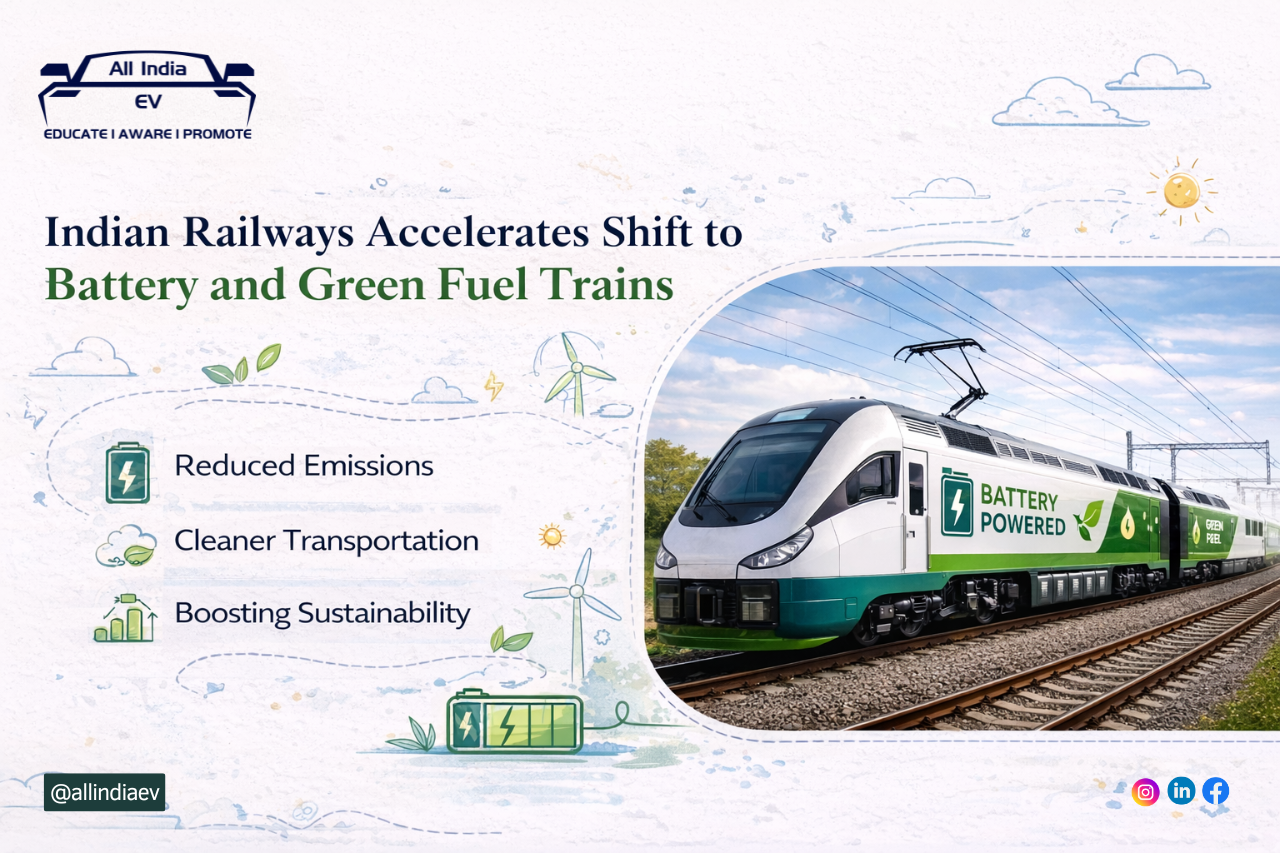
With India’s rail network nearing complete electrification, Indian Railways is accelerating its transition away from diesel-powered locomotives by deploying engines that run on batteries and alternative green fuels such as hydrogen.
Officials said the move follows near-total electrification of the national transporter’s 70,117 route-kilometre (rkm) network, with just 405 rkm left to be electrified. Attention has now shifted to reducing dependence on the remaining around 2,500 diesel locomotives, either by retrofitting them with clean propulsion systems or replacing them altogether.
“The first step will be replacing diesel locomotives used in yard operations, shunting services and last-mile freight connectivity,” a senior official said. These services still rely heavily on diesel traction due to non-electrified or intermittently electrified sections.
Battery traction as a parallel solution
While overhead electric traction will continue to dominate mainline operations, officials said battery-powered locomotives are being positioned as a parallel solution for specific operational needs, particularly in yards, terminals and short-haul routes.
In September last year, Concord Control Systems announced it had successfully retrofitted a 700-horsepower diesel locomotive to run on a lithium ferro phosphate (LFP) battery. On Friday, the company said it is also developing what it claims will be the world’s largest 3,100 HP hydrogen-fuelled locomotive propulsion system.
The hydrogen-powered locomotive is being developed for NTPC, primarily to haul coal for its thermal power plants.
More EV News
Hydrogen train trials underway
Railways minister Ashwini Vaishnaw recently said India is testing the world’s longest hydrogen train set, comprising 10 coaches and delivering 2,400 kW of power, on a broad-gauge platform. Officials described the trials as a key milestone in India’s push towards cleaner rail mobility.
Pilot projects exploring lithium-ion and other onboard battery technologies began nearly six years ago. Chittaranjan Locomotive Works was tasked with building 10 battery-powered locomotives, while Eastern Railway’s Kanchrapara workshop converted a motor coach into a battery-cum-25 kV shunting engine, capable of hauling freight and passenger trains at low speeds in battery mode.
Electric freight push gathers pace
Indian Railways continues to rely largely on diesel for long-haul freight, even as passenger services have mostly shifted to electric traction. In a major step, Siemens was awarded a ₹26,000-crore contract in December 2022 to supply and maintain 1,200 electric freight locomotives. The first batch was delivered in May 2025.
Officials said the combined push for electrification, battery traction and hydrogen fuel marks a decisive shift towards low-emission rail transport, reinforcing Indian Railways’ role in the country’s broader clean energy transition.
Comment by Author:
With electrification nearly complete, Indian Railways’ accelerated shift to battery- and hydrogen-powered locomotives marks a pragmatic next step in cutting diesel dependence. By targeting yards, shunting, and last-mile freight first, the strategy balances operational realities with climate goals. If pilot projects scale successfully, this transition could significantly lower emissions while positioning India as a global leader in clean rail propulsion.