
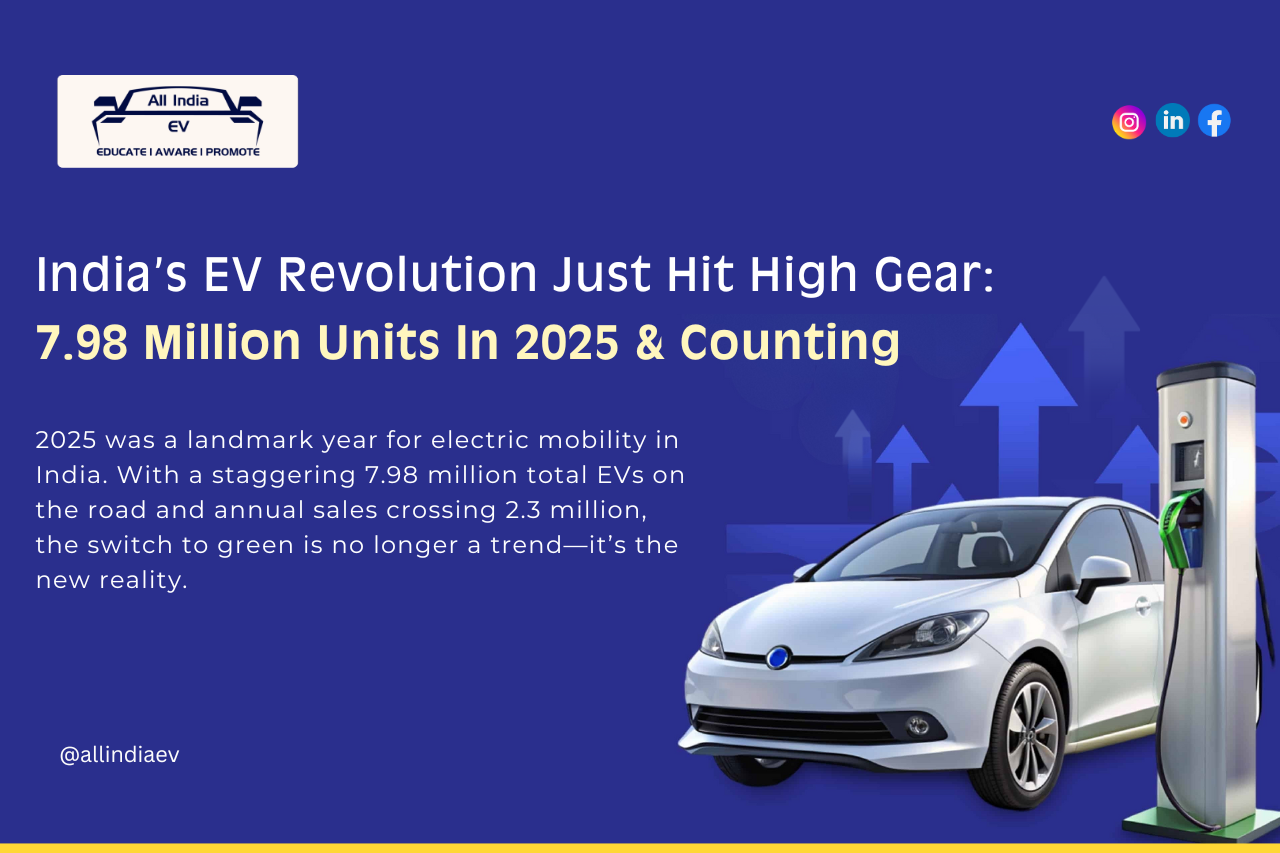

EV sales in India reach 7.98 million in 2025, reflecting strong policy support, rising consumer adoption, and rapid expansion of charging infrastructure.
India’s transition toward sustainable mobility reached a historic landmark in 2025, with the country’s cumulative electric vehicle (EV) sales soaring to 7.98 million units. A comprehensive industry report by JMK Research & Analytics reveals a year of explosive growth, driven by a robust charging network, aggressive manufacturer competition, and favorable state policies.
In 2025 alone, annual sales surpassed 2.3 million vehicles, signaling that the Indian consumer’s shift from internal combustion engines to electric powertrains is no longer a niche trend but a mainstream reality.
Highlights of the 2025 EV Market Report:
- Total Cumulative Sales: 7.98 million units reached by year-end.
- Dominant Segment: Electric Two-Wheelers (E2Ws) lead with 57% market share.
- Fastest Growing: Electric Cars witnessed a staggering 82% year-on-year growth.
- Infrastructure Boom: Over 29,000 public charging stations now operational nationwide.
- Top State: Uttar Pradesh continues to lead in total sales volume.
Two-Wheelers and Three-Wheelers Lead the Charge
The backbone of India’s EV revolution remains the two-wheeler segment. Accounting for over half of all EV sales, Electric Two-Wheelers (E2Ws) saw an 11% increase in 2025. The market is currently a three-horse race, with TVS Motors, Bajaj Auto, and Ather collectively commanding more than 60% of the market. Among these, TVS Motor stood out with the highest segment penetration at 5.26%.
The Electric Three-Wheeler (E3W) category, vital for last-mile connectivity and logistics, grew by 15%. In the passenger L5 category, the trio of Mahindra Last Mile Mobility, Bajaj Auto, and TVS dominated with a massive 84% market share. Mahindra also emerged as a titan in the cargo E3W space, maintaining a penetration rate of 63.66%.
More EV News

Exponential Growth in Electric Cars
Perhaps the most striking data point from the 2025 report is the 82% surge in Electric Car (E-car) sales. As urban infrastructure improves, Indian families are increasingly opting for battery-operated vehicles.
Tata Motors remains the market leader in this segment with a 39% share, though MG Motor is closing the gap rapidly. Interestingly, MG Motor recorded the highest EV penetration in the car segment at a remarkable 74.34%, suggesting that a vast majority of their total sales are now electric.
Public Transport and Infrastructure
The electrification of public transport is also gaining momentum. Electric buses (E-buses) grew by 18% in 2025. This sector is currently led by Olectra Greentech, PMI Electro, and Switch Mobility, who together account for 68% of all e-bus deliveries.
Supporting this vehicle surge is a rapidly expanding charging grid. India now boasts more than 29,000 public charging stations. This infrastructure is concentrated in five key regions—Karnataka, Maharashtra, Uttar Pradesh, Delhi, and Tamil Nadu—which host over 55% of the country’s total charging points.
Regional Leaders in Adoption
While Uttar Pradesh and Maharashtra lead in absolute numbers, smaller states are showing the highest “EV penetration” (the ratio of EVs to total vehicle sales). Tripura topped the charts with an 18.38% penetration rate, followed closely by Assam at 14.30%, highlighting the successful adoption of electric rickshaws in the North-East.
The Road Ahead: 2026 and Beyond
Industry analysts suggest that the momentum built in 2025 has set a permanent foundation for the future. With 7.98 million units already on the road, the focus for 2026 is expected to shift toward battery swapping technology and ultra-fast charging to further reduce range anxiety.
The report concludes that the synergy between proactive state governments, a maturing supply chain, and increased consumer trust has placed India on the global map as a premier hub for electric mobility. As manufacturing scales up, the dream of a green, emission-free transport sector is moving closer to the finish line.